

9 min read
4.2
· 13,599 Amazon ratingsShare This Review
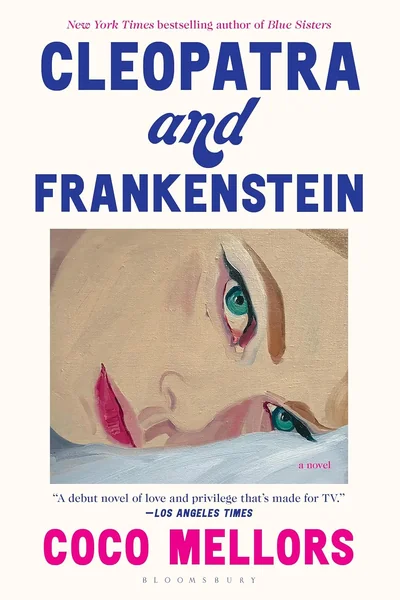
Cleopatra and Frankenstein by Coco Mellors Review: A Glittering, Uneven Debut Novel
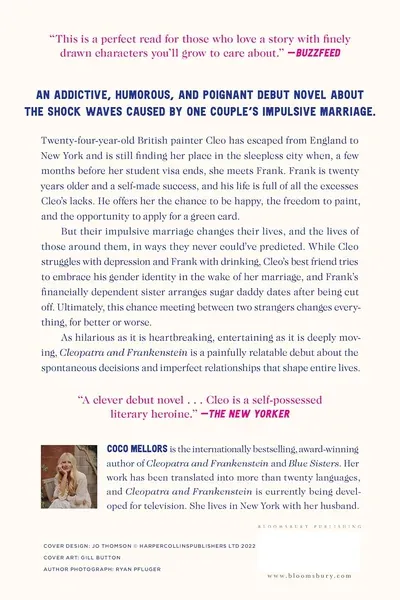
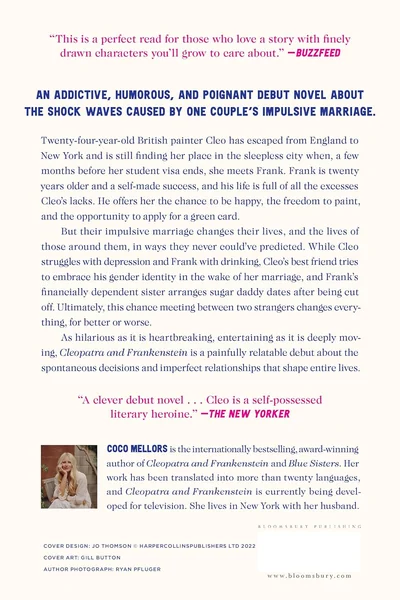
Coco Mellors' debut novel follows Frank, a successful Manhattan ad executive with a worsening drinking problem, and Cleo, an aspiring British painter twenty years his junior, who meet on New Year's Eve and are married six months later — a whirlwind union that slowly unravels under the weight of infidelity, addiction, and unresolved childhood wounds. Published by Bloomsbury, the novel is both an intimate portrait of a damaged marriage and a satirical panorama of downtown New York's creative class. Publishers Weekly called it "involving if strained," while the Evening Standard described being "intensely consumed" by its world — a tension that captures the book's essential duality: genuinely magnetic at its core, inconsistent at its edges.
 Tap to enlarge
LuvemBooks Verdict
Best for
Readers drawn to emotionally charged relationship fiction set against a vividly rendered urban backdrop — especially those who loved Sally Rooney's Conversations with Friends and want a novel that treats addiction, grief, and marital unravelling with candor rather than sentimentality.
Worth it if
The central relationship's sustained chemistry and the novel's unflinching handling of addiction and mental illness are enough to carry you through its structural unevenness.
Skip if
Readers who need a tightly controlled ensemble cast and consistent satirical tone may find the scattered threads and caricature-leaning supporting characters a genuine distraction.
What readers & critics say
Kirkus Reviews awarded the novel a starred review, calling it "a canny and engrossing rewiring of the big-city romance," while Publishers Weekly found it "involving if strained," noting that an "enticing aura glows at this work's heart" even as the satirical portrait of New York life too often reads like caricature. The LA Times praised the novel's socioeconomic texture and deliberate narrative structure but flagged that many supporting characters carry "origin stories and ethnicities that do too much of the work of explaining who they are."
“A canny and engrossing rewiring of the big-city romance.”
— Kirkus Reviews“Mellors dissects the tumultuous relationship between two magnetic and damaged people … an enticing aura glows at this work's heart.”
— Publishers WeeklyAge & Reading Level
Recommended age
Adult
Reading level
Adult
4 content notes · who it suits
Content to know about
Best for: Adults — explicit portrayal of alcoholism, addiction, infidelity, and parental suicide by suicide as formative backstory.
Skip if you want tightly controlled ensemble fiction with consistent satirical tone and fully realized supporting characters.
In This Review
- What Works & What Doesn't
- What the Novel Is and What It Does
- Significance and Place in Contemporary Fiction
- Strengths: Chemistry, Pathos, and the Eleanor Exception
- Limitations: Caricature and Scattered Tone
- Who This Novel Is For
What Works & What Doesn't
What Works
- The central relationship between Cleo and Frank is rendered with immediate, sustained chemistry that gives the novel's emotional arc genuine weight.
- Mellors handles addiction, grief, and mental illness with directness and candor, producing what Waterstones described as 'a shattering depiction of how addiction and mental illness warp our lives.'
- The character of Eleanor — a screenwriter drawn into Frank's orbit — stands out as a fully realized success, achieving, in Publishers Weekly's assessment, 'the mix of wit, pathos, and romance the rest strives to attain.'
- The novel builds a richly textured portrait of a specific stratum of downtown Manhattan life, with its socioeconomic contradictions made part of the story's substance.
- A national bestseller and Goodreads Choice Award finalist, the novel found a wide and enthusiastic readership from its debut.
What Doesn't
- The satirical treatment of supporting characters too often tips into caricature, with several figures defined more by social type than by genuine interiority, as Publishers Weekly noted.
- The tone across the novel's many threads — marital drama, addiction, ensemble satire, romance — can feel scattered, with not every storyline receiving equal depth or development.
What the Novel Is and What It Does
Significance and Place in Contemporary Fiction
Strengths: Chemistry, Pathos, and the Eleanor Exception
Limitations: Caricature and Scattered Tone
Who This Novel Is For
Frequently Asked Questions
Sources & Further Reading
The key facts and claims in this review are grounded in the retrieved, verified sources listed below.
- Cited in this review
- 1
publishersweekly.com
- 2
- 3
waterstones.com
- Further reading
- 4
Coco Mellors, Wikipedia
- 5
cleavermagazine.com
- 6
- 7
readingwritingandme.com
- 8
- 9
nbmagazine.co.uk
- 10
- 11
barnesandnoble.com
Related Reviews
Reviews of books we picked for readers who enjoyed Cleopatra and Frankenstein.
Reader Comments
No comments yet
Be the first to share your thoughts!