BOOKS
Published

Read Time

5 min read

Curated & edited by

LuvemBooks Editorial

How we create our reviews →
Share This Review

The Complete Book of Home Organization by Toni Hammersley Review: A Sweeping, Detail-Driven Decluttering Guide

Toni Hammersley's The Complete Book of Home Organization, published by Weldon Owen, is a wide-ranging home organization guide that moves room by room and challenge by challenge — from small apartment constraints to sprawling household disorder — with strategies covering storage solutions, cleaning routines, space-saving methods, and paper clutter management. Rooted in Hammersley's experience as the creator of the organizing blog A Bowl Full of Lemons, the book has earned a strong reader rating of 4.22 across more than 1,600 ratings and reviews.

LuvemBooks Verdict

Best for

Homeowners or renters who want a single, comprehensive reference to tackle organization across every room and life situation — from cramped apartments to cluttered family homes — and prefer granular, step-by-step guidance over minimalist philosophy.

Worth it if

You want a deeply practical, room-by-room reference that breaks everyday organizational challenges — paper clutter, storage, space-saving — into named categories and concrete actions, and you value a guide that is both functional and design-conscious.

Skip if

You're looking for a short motivational read or a single decluttering philosophy, or your household is fully digitized and you have no need for the mid-2010s-era tactical examples the book occasionally relies on.

What readers & critics say

According to Shortform, the book holds a 4.22 average rating across more than 1,644 ratings and reviews — a strong showing for a non-fiction reference title. A reviewer at To the Motherhood describes the book as covering everything from solutions for tiny apartments to tackling a big, messy home.

Sources: Shortform, To the Motherhood
4.6from 2,234 Amazon ratings— reader ratings, not a LuvemBooks score

Look inside the book

Preview the actual pages, via Google Books
In This Review
  • What Works & What Doesn't
  • What the Book Actually Is
  • Scope and Ambition
  • Strengths: Granularity and Practicality
  • Reader Reception
  • Considerations for Prospective Readers

What Works & What Doesn't

What Works
  • Encyclopedic in scope, addressing organization challenges across living situations from small apartments to large family homes
  • Highly granular and specific — breaks down everyday tasks like paper clutter management into named categories and concrete actions
  • Rooted in Hammersley's established expertise as creator of the widely-read organizing blog A Bowl Full of Lemons
  • Strong reader reception, holding a 4.22 average rating across more than 1,600 ratings and reviews
  • Designed to be both functional and design-conscious, appealing to readers who want an organized and visually appealing home
What Doesn't
  • The encyclopedic format means readers with specific or limited organizational needs may find large portions of the book less immediately applicable to their situation
  • Some tactical examples (such as cataloging physical DVD collections) are rooted in the mid-2010s context and may feel dated for fully digitized households
A practical, encyclopedic home organization reference grounded in real-world detail, this guide earns its reputation as a go-to resource for readers ready to bring lasting order to their living spaces.

What the Book Actually Is

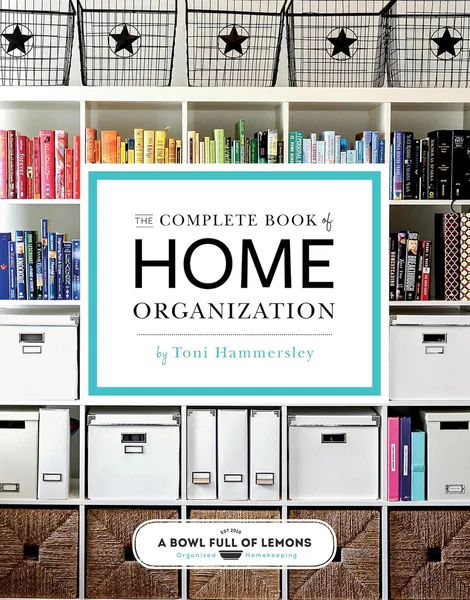
The Complete Book of Home Organization by Toni Hammersley front cover
The Complete Book of Home Organization is a comprehensive non-fiction guide authored by Toni Hammersley, published by Weldon Owen in an illustrated edition. Hammersley is the creator of A Bowl Full of Lemons, an organizing website that, per her publisher's description, inspires thousands of readers to bring structure to their everyday lives. The book is designed to address home organization across a wide spectrum of living situations — from solutions tailored to tiny apartments to strategies for tackling large, cluttered homes — with the stated goal of helping readers achieve and maintain balance in their spaces.
The book's approach is instructional and systematic. Its scope spans storage solutions, cleaning tips, space-saving methods, and expert strategies, with coverage of highly specific organizational tasks: cataloging DVDs, managing paper clutter by category (junk mail, bills, keepsakes, school papers), and even separating Tupperware lids from bases to maximize storage efficiency. This granular, room-by-room attention to detail is central to the book's design identity.

Scope and Ambition

The title's promise — "complete" — is not an idle one. The book is structured to address the full breadth of a household's organizational challenges rather than focusing on a single room or philosophy. Whether a reader is contending with a cramped urban apartment or a multi-room family home overwhelmed by years of accumulation, the guide is designed to meet them where they are. The publisher frames the book as being "packed with the tips and shortcuts you need to effectively organize your home," positioning it as a one-stop reference rather than a thematic manifesto.
This breadth distinguishes it from narrower decluttering titles that focus primarily on mindset or minimalist ideology. Hammersley's background as an organizing blogger — writing directly for an audience seeking practical, implementable advice — shapes the book's tone and structure, keeping it grounded in actionable guidance rather than abstract principles.

Strengths: Granularity and Practicality

Where the book draws particular notice is in its willingness to go deep on specifics. As noted in coverage tied to Simon & Schuster's promotional materials, Hammersley "dives into minutiae," offering guidance on tasks that broader organization books often skip over. The paper clutter management framework, for instance, breaks down an everyday household problem into a systematic daily process with distinct categories and prescribed actions for each. This level of detail is the book's clearest strength — it translates the often-abstract idea of "getting organized" into step-by-step, named tasks.
The book also aims to serve readers who want a home that is "clutter-free, design-conscious, and Pinterest-worthy," signaling that aesthetic presentation is part of the organizational vision, not an afterthought. The illustrated edition format supports this intent.

Reader Reception

Among readers who have rated and reviewed the book on platforms tracked by Shortform, The Complete Book of Home Organization holds a 4.22 average rating across more than 1,600 ratings and reviews — a notably strong showing for a non-fiction reference title. That depth of engagement suggests the book has found a loyal and sizeable audience well beyond its initial publication.
Hammersley's platform pre-dated the book, meaning many readers arrived already familiar with her voice and methodology from A Bowl Full of Lemons. That established community likely contributed to the book's reception, but the sustained rating across a large base of reviewers indicates the content itself holds up for readers across a range of household situations.

Considerations for Prospective Readers

The book's encyclopedic scope is also the source of its most honest limitation: readers seeking a single organizing philosophy or a short, motivational read will find the format dense. A guide that covers everything from DVD cataloging to Tupperware lid separation necessarily accumulates a great deal of material, and some readers may find certain sections more relevant to their specific situations than others. Those in particular living circumstances — a family home with children and paper accumulation, for instance — will find targeted chapters directly applicable, while others may need to navigate past sections less relevant to their space.
Additionally, some specific examples embedded in the book — such as cataloging physical DVD collections — reflect the organizational challenges of the mid-2010s era in which it was written. Readers in fully digitized households may find certain tactical recommendations less applicable, though the underlying organizational frameworks tend to be transferable.

Sources & Further Reading

The key facts and claims in this review are grounded in the retrieved, verified sources listed below.

  1. Cited in this review
  2. 1
  3. 2
  4. Further reading
  5. 3
  6. 4
  7. 5