Share This Review

Styled: Secrets for Arranging Rooms, from Tabletops to Bookshelves by Emily Henderson & Angelin Borsics Review: A Practical Stylist's Guide Worth Owning

Published by Potter Style in October 2015, Styled: Secrets for Arranging Rooms, from Tabletops to Bookshelves is a New York Times bestseller co-authored by Emily Henderson and Angelin Borsics that positions itself as the definitive guide to thinking like a professional stylist — offering 1,000 design ideas for creating beautiful, personal, and livable rooms, from large-scale furniture arrangements down to bookshelf vignettes and tabletop compositions.

LuvemBooks Verdict

Best for

Readers who have a clear sense of their own aesthetic taste but consistently struggle to translate it into a cohesive, finished-looking room — whether they're decorating a first apartment or finally tackling a stubborn bookshelf arrangement.

Worth it if

The ten-step, method-first framework appeals and the goal is a repeatable, practitioner-grounded system for styling real spaces — not a visual inspiration book or a guide to sourcing and renovation.

Skip if

Skip it if the primary need is help with sourcing, budgeting, or structural renovation, or if the room in question is architecturally complex enough that a universal framework will need more adaptation than the book explicitly guides through — and bear in mind that trend-specific examples reflect 2015.

What readers & critics say

Barnes & Noble and multiple retail cataloguing sources confirm its New York Times bestseller status and describe it as "the ultimate guide to thinking like a stylist, with 1,000 design ideas." Reviewer julieannrachelle.com calls it "the perfect resource for anyone looking to learn the basics of home styling and decorating," singling out Henderson's treatment of the "pulled-together" look as a particular strength.

Sources: Barnes & Noble, julieannrachelle.com
4.6from 1,364 Amazon ratings— reader ratings, not a LuvemBooks score
In This Review
  • What Works & What Doesn't
  • What the Book Actually Is and What It Sets Out to Do
  • The Central Argument: Styling as a Learnable Skill
  • Scope and Significance in the Genre
  • Genuine Strengths the Record Supports
  • Limitations and Readers Who May Want More
  • Who This Book Is genuinely For

What Works & What Doesn't

What Works
  • Structured around a concrete ten-step framework that applies to spaces of any scale, from full rooms to tabletops
  • Dense idea library of 1,000 design ideas across 304 indexed pages, designed for ongoing reference rather than a single read
  • Co-authored by a working professional stylist, grounding the instruction in practitioner-level authority
  • New York Times bestseller status reflects a broad and documented readership validating its appeal
  • Targets the specific, common gap between having aesthetic taste and knowing how to execute it in a real room
What Doesn't
  • Scope is limited to arranging and styling existing elements — not a guide to sourcing, budgeting, or renovation
  • A universal ten-step framework may require meaningful personal adaptation for unusually constrained or complex spaces
  • Trend-specific product references and examples date to 2015 and should be treated as illustrative rather than current sourcing guidance
A New York Times bestseller, Styled makes the case that professional-grade decorating instincts are teachable — and structures the entire book around proving it.

What the Book Actually Is and What It Sets Out to Do

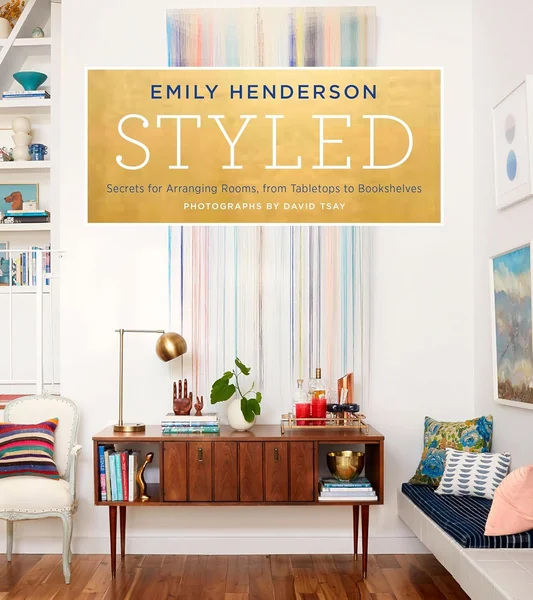
Styled: Secrets for Arranging Rooms, from Tabletops to Bookshelves by Emily Henderson, Angelin Borsics front cover
Styled: Secrets for Arranging Rooms, from Tabletops to Bookshelves is an interior decoration handbook co-authored by Emily Henderson — a working stylist and television personality — and Angelin Borsics, published by Potter Style in October 2015. The book's central promise, stated plainly in its own promotional copy, is that finding personal style confidence is achievable once readers understand a repeatable system. To deliver on that promise, Henderson and Borsics build the guide around ten steps to styling any space, applicable whether the challenge is an entire room or a single bookshelf corner. With 1,000 design ideas packed across its pages, the book functions as a handbook and idea library in one volume, catalogued with an index for ongoing reference.

The Central Argument: Styling as a Learnable Skill

The intellectual core of Styled is its insistence that the "pulled-together" look — the quality that separates a room that reads as intentional from one that simply contains furniture — is not a matter of innate taste or unlimited budget, but of method. Henderson and Borsics present their ten-step framework as a transferable toolkit rather than a showcase of aspirational spaces belonging to someone else's life. The stated goal is for readers to walk away with a process they can apply independently, across scales as different as a full living room and a tabletop arrangement. That focus on transferable method, rather than pure inspiration, is the book's defining editorial choice and the clearest differentiator from coffee-table design books that prioritize photography over instruction.

Scope and Significance in the Genre

Interior design books broadly divide into two camps: the photographic showcase meant to inspire through beautiful imagery, and the instructional guide meant to equip through actionable technique. Styled stakes its ground firmly in the second camp while drawing on Henderson's credentials in the first. Her background as a professional stylist gives the instructional content an industry-practitioner authority that distinguishes it from books written primarily from an editorial or journalistic perspective. The book's New York Times bestseller status confirms that it found a substantial readership — one seeking exactly this blend of visual richness and genuine instruction. Its scope — tabletops to full rooms, small tweaks to complete transformations — is broad enough to serve a wide range of decorating ambitions and confidence levels.

Genuine Strengths the Record Supports

The 1,000 design ideas figure is not marketing shorthand for a slim tip list; the book's 304 pages and indexed structure support the claim of genuine density. The ten-step framework gives readers a consistent spine to return to, making the book usable as a reference rather than a one-time read. Co-authorship with Angelin Borsics brings an additional editorial perspective to what could otherwise have been a purely personality-driven project. The handbook and manual classification — confirmed by the Internet Archive's subject cataloguing — signals a document designed for repeated consultation, not passive reading. For readers who have felt stymied by the gap between pinning inspirational images online and achieving a coherent look in an actual room, the book's stated mission addresses that precise frustration directly.

Limitations and Readers Who May Want More

No handbook built around a ten-step universal framework can fully account for the idiosyncrasies of every space, and readers dealing with unusually constrained or architecturally complex rooms may find that the system requires more personal adaptation than the book explicitly guides them through. The book's focus is arranging and styling — the placement and composition of what already exists — rather than sourcing, budgeting, or structural renovation, so readers hoping for a soup-to-nuts decorating manual covering procurement and project management will need to supplement it elsewhere. Additionally, because the book was published in 2015, specific product references or trend-driven examples within it reflect the design moment of that period; readers should treat those as illustrative rather than prescriptive for current sourcing.

Who This Book Is genuinely For

Styled is most squarely aimed at readers who feel confident about their taste in the abstract but uncertain about how to execute it in a specific room — people who know what they like when they see it but struggle to reproduce that quality themselves. The ten-step framework and the handbook structure make it equally useful for a first-time apartment decorator tackling a living room and for a more experienced home owner trying to finally get a bookshelf or dining table arrangement to feel finished. Readers who enjoy process-oriented design guides in the tradition of accessible professional-insider instruction will find Henderson and Borsics's approach well-matched to that appetite. It is not a book for readers seeking purely visual inspiration with minimal text, nor for those looking for architectural or renovation guidance — but within its stated scope, its bestseller record reflects a genuine fit between promise and audience.

Sources & Further Reading

The key facts and claims in this review are grounded in the retrieved, verified sources listed below.

  1. 1
  2. 2
  3. 3
  4. 4
  5. 5
  6. 6
  7. 7
  8. 8
Related Reviews

Reviews of books we picked for readers who enjoyed Styled.