BOOKS
Published

Read Time

3 min read

Curated & edited by

LuvemBooks Editorial

How we create our reviews →
Share This Review

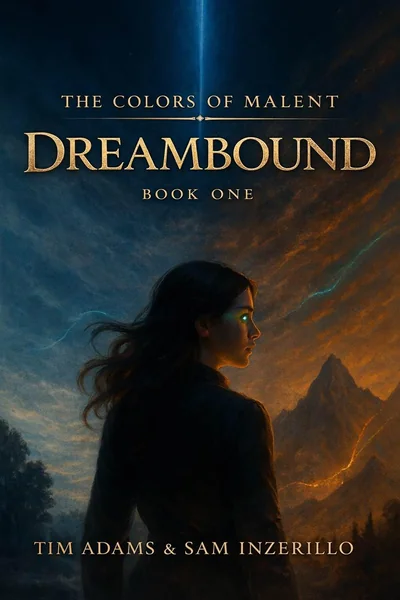
DreamBound (The Colors of Malent Book 1) by Tim Adams & Sam Inzerillo Review: A YA Fantasy Built on Vivid World-Building

DreamBound, the first book in The Colors of Malent series by co-authors Tim Adams and Sam Inzerillo, is a young adult fantasy novel that follows fifteen-year-old Alara Martin as escalating dreams of a distant world collide with a shocking revelation about her origins — launching her into an otherworldly conflict she never anticipated. Originally published in an earlier edition and now reissued in a second Kindle edition (March 2026), the novel offers a compelling blend of identity mystery, fantasy world-building, and adventure for readers aged 12–18.

LuvemBooks Verdict

Best for

YA fantasy readers aged 12–18 who enjoy series-format world-building centred on a young female protagonist wrestling with identity, belonging, and destiny across multiple volumes.

Worth it if

You're willing to invest through a slow-burn opening to reach a richly populated secondary world, layered characters, and a cliffhanger that makes the second volume feel genuinely necessary.

Skip if

You prefer self-contained fantasy novels with fast openings and tidy resolutions — DreamBound ends on a deliberate cliffhanger and takes patience to fully ignite.

Reader commentary retrieved from Amazon UK describes the novel as "creative and well written," praising the layering of Malent's characters and the storytelling from start to finish. Missysproductreviews1.wordpress.com notes the opening is slow to engage but ultimately calls the book a "must read" once the story finds its pace.

Sources: Amazon UK, missysproductreviews1.wordpress.com
In This Review
  • What Works & What Doesn't
  • What the Book Is and What It's About
  • Premise and Its Place in YA Fantasy
  • Strengths: Character Layering and Narrative Drive
  • Honest Limitations: A Slow Opening
  • Who This Book Is For

What Works & What Doesn't

What Works
  • Centers on a richly developed secondary world, Malent, populated with distinct characters who carry real narrative function
  • Alara Martin's identity crisis — adoption reveal, escalating dreams, and questions of belonging — gives the protagonist a layered emotional arc
  • Reader responses describe the writing as creative and humorous, with strong overall storytelling once the narrative finds its stride
  • The cliffhanger ending is designed to build genuine momentum into the second volume of the series
What Doesn't
  • Multiple reader accounts note the opening chapters are slow to build pace, requiring patience before the story fully engages
  • The cliffhanger structure means readers seeking a self-contained resolution will find the first book deliberately incomplete
A YA fantasy that builds its world steadily from the inside out, DreamBound earns its momentum once its mythology fully ignites.

What the Book Is and What It's About

DreamBound centers on Alara Martin, a teenage girl who has spent her whole life haunted by vivid, recurring dreams of a beautiful, faraway world. As she nears her fifteenth birthday, those dreams intensify to the point where she struggles to separate them from waking reality. The story's inciting crisis arrives when a particularly traumatic nightmare triggers a revelation from her parents: Alara is not their biological daughter. That discovery unlocks a cascade of questions — Who are her real parents? Where does she actually belong? Why is the world of Malent calling to her? — and propels her into a conflict she is, by her own reckoning, completely unprepared to face. Co-written by Tim Adams (raised in Groveland, Massachusetts, and now based in Hudson, New Hampshire) and Sam Inzerillo (raised on Long Island and now based in Nashua, New Hampshire), the novel is the opening volume of a two-book series published under The Colors of Malent imprint.
I found this book hard to get into at first and then finally the story picked up to a pace I liked and could not put it down.

Premise and Its Place in YA Fantasy

The foundational premise — a teenager discovering her true heritage through a portal-like dreamworld — draws on well-worn YA conventions, but Adams and Inzerillo distinguish their approach through the texture of the world they construct. Reader commentary retrieved from Amazon UK notes the novel features "creative and clever writing, with a good amount of humor and a really great story," and singles out the "layering of characters and meeting the various individuals from Malent" as a particular strength. The world of Malent itself is populated with figures whose roles and relationships the authors develop with specificity: one Amazon UK reviewer recalled being engaged as early as Chapter 2, where Captain Korten explains the harbormaster stabilizing the waves to a character named Teage — a detail suggesting the authors invest in the mechanics of Malent's society rather than leaving it as pure backdrop. For readers who enjoy secondary-world fantasy where the invented setting carries genuine weight, that investment is a meaningful signal.

Strengths: Character Layering and Narrative Drive

Where DreamBound demonstrates its clearest ambition is in its ensemble construction. The Malent-side cast, with figures like Captain Korten introduced early and apparently given meaningful function in the world's logic, reflects a design intent to build out the fantasy landscape through its inhabitants rather than through exposition alone. Amazon UK reader responses describe the story as one they "loved from start to finish," crediting both the character depth and the overall storytelling as its primary draws. The novel also closes on a cliffhanger, a structural choice that, per the same source, generated genuine anticipation for the second volume's exploration of both the world of Malent and Alara's continuing development as a protagonist.

Honest Limitations: A Slow Opening

A candid assessment of DreamBound must acknowledge one recurrent note in reader responses: the opening sections present a barrier to entry for some. A review from missysproductreviews1.wordpress.com states plainly, "I found this book hard to get into at first and then finally the story picked up to a pace I liked and could not put it down." This is not an isolated impression — it points to a genuine structural reality for a novel that earns its energy over time rather than arriving at full speed. Readers accustomed to fast-burn fantasy openings may need to commit through the early chapters before the story fully claims their attention. That said, the same reviewer ultimately described the book as a "must read," suggesting the payoff justifies the patience required.

Who This Book Is For

DreamBound is positioned for readers between the ages of 12 and 18 — a range the publisher has designated for the Kindle edition — and it fits comfortably within the tradition of coming-of-age fantasy focused on a young female protagonist navigating questions of identity, belonging, and destiny. The dual-author format (a relatively uncommon arrangement in YA fiction) does not appear to fragment the narrative based on available reader response; the book is described in consistent terms as a unified, coherent story. Readers who enjoy series-format fantasy with layered world-building, humor woven into adventure, and an unresolved arc designed to carry across volumes will find DreamBound a rewarding first installment. Those who prefer self-contained fantasy novels with tidy resolutions should note that the book ends on a deliberate cliffhanger, setting the stage for Book 2.

Sources & Further Reading

The key facts and claims in this review are grounded in the retrieved, verified sources listed below.

  1. Cited in this review
  2. 1
  3. 2
  4. Further reading
  5. 3