BOOKS
Published

Read Time

8 min read

Reader rating

4.5

· 369 Amazon ratings
reader ratings, not a LuvemBooks score
Curated & edited by

LuvemBooks Editorial

How we create our reviews →
Share This Review

Air Fryer Revolution by Urvashi Pitre Review: Fresh Takes Beyond the Breaded Basket

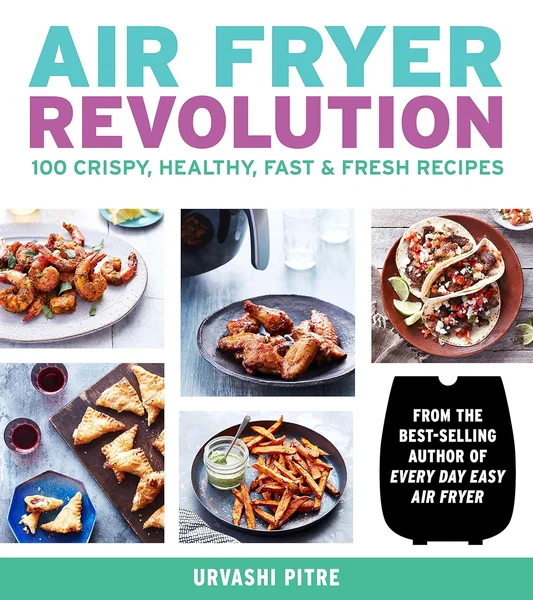
Air Fryer Revolution: 100 Crispy, Healthy, Fast & Fresh Recipes is a cookbook by best-selling author Urvashi Pitre, published by Harvest (an imprint of HMH Books) on October 22, 2019. A follow-up to her hit Every Day Easy Air Fryer, it delivers 100 recipes designed to push the appliance well beyond frozen and breaded staples, drawing on fresh ingredients and Pitre's background in bold, internationally influenced flavors.
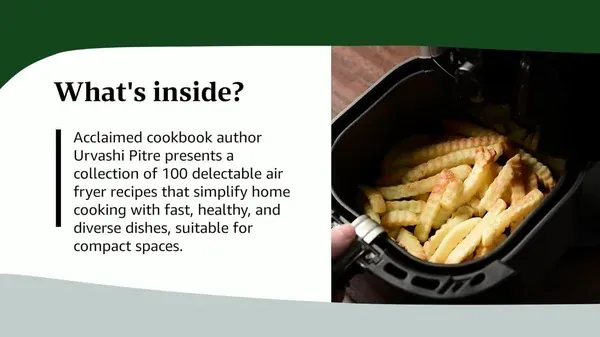
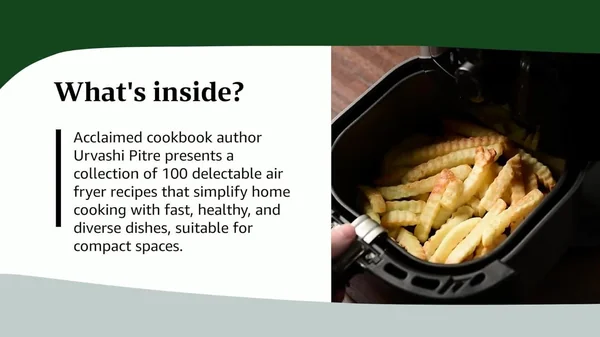
Interior page showing a "What's inside?" section with air fryer chicken recipe example and description of 100 recipes.Tap to enlarge

LuvemBooks Verdict

Best for

Small-space cooks — in city apartments, dorm rooms, or RVs — who already own an air fryer and want a globe-spanning, fresh-ingredient recipe collection that moves well beyond the usual frozen-and-breaded playbook.

Worth it if

You want 100 internationally influenced, fresh-ingredient recipes that treat the air fryer as a legitimate everyday cooking tool, and you're open to a cookbook whose underlying philosophy leans low-carb and keto.

Skip if

Skip it if you're looking for a foundational technique guide to the air fryer, or if carbohydrate-forward cooking is central to your kitchen — Pitre's keto-aligned sensibility shapes the book throughout, even where individual recipes diverge.

TCU Magazine notes that Pitre directly challenges the assumption that air fryers are only for breaded and packaged goods, and highlights her reputation for being "unfailingly courteous and prompt" in her home-cook community as a key ingredient to her success (magazine.tcu.edu). Retailer and bookseller listings across bookshop.org, McNally Robinson, and Barnes & Noble consistently describe the book as a follow-up to her hit Every Day Easy Air Fryer, positioning it as an all-new collection that demonstrates how the air fryer makes fresh home cooking easier than ever.

Sources: TCU Magazine, Bookshop.org, McNally Robinson, Barnes & Noble
4.5from 369 Amazon ratings— reader ratings, not a LuvemBooks score
In This Review
  • What Works & What Doesn't
  • What the Book Is and What It Sets Out to Do
  • Scope, Range, and the Recipes on Offer
  • Pitre's Standing and the Book's Place in the Genre
  • Strengths: Accessibility and the Small-Space Pitch
  • Honest Limitations and Who May Be Underserved

What Works & What Doesn't

What Works
  • 100 recipes built around fresh ingredients, pushing back against the air fryer's frozen-food reputation
  • Wide international flavor range — from Korean Beef Tacos to French Garlic Chicken to Queso Fundido — in a single volume
  • Written by a best-selling author with an established, engaged home-cook community via her Two Sleevers blog
  • Explicitly designed for small-space cooks: city kitchens, dorm rooms, and RVs
  • Draws on Pitre's own experience with low-carb, keto-aligned eating, giving the health angle personal grounding
What Doesn't
  • Oriented toward recipe variety rather than deep technique instruction, which may leave readers seeking foundational air-fryer education underserved
  • Pitre's keto and low-carb background shapes the book's overall philosophy, which may not align with cooks who favor carbohydrate-forward cuisines
  • As a sequel to Every Day Easy Air Fryer, first-time Pitre readers enter mid-series, though the content is described as entirely new
A follow-up to Every Day Easy Air Fryer that makes a convincing case for the air fryer as a genuine fresh-cooking tool, not merely a reheating shortcut.

What the Book Is and What It Sets Out to Do

Interior page showing a "What's inside?" section with air fryer chicken recipe example and description of 100 recipes.
Air Fryer Revolution is Urvashi Pitre's second dedicated air-fryer cookbook, published by Harvest on October 22, 2019. Its central argument — stated plainly in the book's own positioning — is that air fryers are not simply machines for crisping breaded and packaged goods. The book's 100 recipes are built around fresh ingredients, with the machine positioned as the vehicle that does the heavy lifting once thoughtful prep is done. Pitre's own story shapes the book's sensibility: she moved to the United States from India with $20, two suitcases, a scholarship, and a head full of family recipes, and she later lost 80 pounds following a low-carb, keto-aligned approach. Her blog, Two Sleevers, grew from that personal journey into a large home-cook community, and this cookbook is, in many ways, an extension of that platform in printed form.

Scope, Range, and the Recipes on Offer

The 100-recipe collection spans a notably wide flavor map. The publisher's descriptions name specific dishes: Smoky Ham and Cheese Party Biscuits, French Garlic Chicken, Russet and Sweet Potato Gratin, Queso Fundido, Korean Beef Tacos, and Bang Bang Shrimp all appear as representative examples. That range — from a Southern-inflected biscuit to a Korean-inspired taco to a Mexican queso — reflects Pitre's internationally influenced palate, itself a product of her globe-trotting professional life running a Dallas-based global consulting firm. The recipes are written with the intent that cooks start from fresh ingredients rather than processed shortcuts, which is the book's clearest point of difference from the category standard at the time of publication.

Pitre's Standing and the Book's Place in the Genre

By the time Air Fryer Revolution appeared, Pitre was already a known quantity in the appliance-cookbook space. She had authored Indian Instant Pot Cookbook, The Keto Instant Pot Cookbook, Every Day Easy Air Fryer, Instant Pot Fast & Easy, and Keto Fat Bombs, Sweets, and Treats — all published with Houghton Mifflin Harcourt. Multiple sources describe her as a best-selling author, and her TCU Magazine profile notes that her accessibility to home cooks — answering community questions "unfailingly courteous and prompt" — has been central to her following. That direct-to-reader credibility distinguishes her from cookbook authors whose profiles exist purely on the page: the recipes here arrive with an established community context.

Strengths: Accessibility and the Small-Space Pitch

One of the book's clearest design strengths is its pitch to cooks working with limited kitchen real estate. The publisher explicitly positions the air fryer — and by extension this cookbook — as ideal for tiny city kitchens, dorm rooms, and RVs. For that readership, a cookbook organized around a single compact appliance that produces 100 distinct, fresh-ingredient results has obvious practical value. The international breadth of the recipe list also means the book is not siloed into a single cuisine, giving it broader appeal than many appliance-specific titles. Pitre's challenge to the "frozen and breaded" assumption is the book's most meaningful contribution to the air-fryer cookbook category: it asks readers to think of the machine as a legitimate everyday cooking tool rather than a novelty.

Honest Limitations and Who May Be Underserved

Readers seeking deep technique instruction or a comprehensive introduction to air-fryer mechanics may find the book oriented more toward recipe execution than culinary education. The book's strength lies in its recipe collection and Pitre's flavor range; it is not positioned as a foundational technique guide. Additionally, because Pitre's own dietary history tilts toward low-carb and keto eating, readers who favor carbohydrate-forward cooking may find the overall philosophy less aligned with their preferences, even if individual recipes diverge from that pattern. The book is also a sequel — readers entirely new to Pitre's air-fryer approach may benefit from knowing that Every Day Easy Air Fryer preceded it, though Air Fryer Revolution is described by its publisher as an all-new collection and not a revision of that earlier work.

Sources & Further Reading

The key facts and claims in this review are grounded in the retrieved, verified sources listed below.

  1. Cited in this review
  2. 1
  3. 2
  4. 3
  5. Further reading
  6. 4
  7. 5
  8. 6
  9. 7