BOOKS
Published

Read Time

9 min read

Reader rating

4.5

· 55,674 Amazon ratings
reader ratings, not a LuvemBooks score
Curated & edited by

LuvemBooks Editorial

How we create our reviews →
Share This Review

Lord of the Flies by William Golding Review: A Dark Classic of Collapsed Order

William Golding's debut strands a group of British schoolboys on an uninhabited island and traces their disastrous attempts at self-government into savagery. A staple of classrooms for decades, it remains one of fiction's starkest studies of civility versus chaos.

LuvemBooks Verdict

Best for

Students, teachers, and first-time readers (customer guidance puts it at ages 12 and up) encountering a landmark postwar allegory in a compact, affordable Penguin edition that includes E. L. Epstein's classroom-standard afterword.

Worth it if

Worth reading if you want the short, still-potent source behind the cultural shorthand — an allegory whose descent is engineered from small, plausible failures, with symbolism legible to a young reader yet layered enough to reward adult re-reading.

Skip if

Skip it if you need psychologically rounded, individually motivated characters rather than embodiments of ideas, if unrelenting cruelty between children is a dealbreaker, or if this small 4 x 7.5-inch mass-market format leaves you no room to annotate.

Kirkus Reviews' original 1955 notice called the debut "originally conceived and convincingly sustained," and a teen reviewer on The Guardian's children's books site praised how Golding seeds subtle hints early that darken into the barbaric as the plot escalates. Book bloggers echo the standing: Julia's Books notes it is "widely considered to be one of the all-time great novels," while Luke Harkness calls it a fascinating, gripping story even before you read it allegorically.

A first novel, originally conceived and convincingly sustained, this should find an audience as vulnerable as its young derelicts.

Kirkus Reviews

Every chapter leaves you hungry for more… Golding drops subtle hints that become more apparent as the book progresses.

The Guardian
Sources: The Guardian, Kirkus Reviews, Julia's Books, Luke Harkness
4.5from 55,674 Amazon ratings— reader ratings, not a LuvemBooks score
Buy on Amazon

Age & Reading Level

Recommended age

Ages 12–18

Reading level

Young adult

Content to know about

violence and cruelty among children
on-page deaths of children
bullying and mob violence
bleak view of human nature

Best for: Ages 12+ — violence and cruelty among children, and an allegorical structure that suits secondary-school readers

Skip if you want psychologically realistic characters or a hopeful view of human nature — the boys are deliberately schematic and the book is unrelentingly bleak

Trending Now
Trending

Lord of the Flies by William Golding is Trending

Updated Sep 22, 2026
In This Review
  • What Works & What Doesn't
  • What the Novel Actually Is
  • Origins and Standing
  • What It Does Well
  • Where It May Frustrate
  • Who This Edition Is For

What Works & What Doesn't

What Works
  • Masterfully engineered escalation: the descent into savagery builds from small, plausible failures rather than sudden shocks
  • Layered but legible symbolism (the conch, the beast, the signal fire) that works for young readers and rewards adult re-reading
  • A debut novel of lasting cultural standing — a staple school text by a future Nobel laureate that coined a durable cultural shorthand
  • This Penguin reissue includes an afterword by scholar E. L. Epstein, adding critical context for student readers
  • Short at 224 pages, with customer guidance placing the reading level at ages 12 and up
What Doesn't
  • Allegorical design means characters often function as embodiments of ideas, which can read as schematic to readers wanting psychological realism
  • Unrelentingly bleak, with violence and cruelty among children that may disturb sensitive younger readers
  • Compact mass-market format (roughly 4 x 7.5 inches) offers small pages with little margin room for annotation
  • The thesis-driven plot moves some characters toward savagery at the speed the argument requires
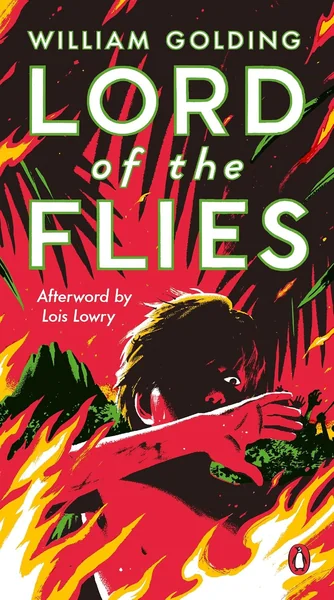
Lord of the Flies endures because its premise — schoolboys stranded, order collapsing — is a delivery system for one of fiction's bleakest arguments about human nature, and this Penguin reissue packages it accessibly for the student readers who keep it alive.
Lord of the Flies by William Golding front cover

What the Novel Actually Is

Lord of the Flies opens in the aftermath of an evacuation: "The boy with fair hair lowered himself down the last few feet of rock and began to pick his way toward the lagoon." That fair-haired boy is Ralph, one of a group of prepubescent British schoolboys stranded on an uninhabited island after their plane goes down during a wartime evacuation. With no adults surviving, the boys attempt to govern themselves — electing Ralph as leader, using a conch shell to confer the right to speak, and tasking the choirboys under Jack Merridew with keeping a signal fire alive. The arrangement disintegrates. Jack's hunters grow obsessed with the kill, fear of a supposed "beast" corrodes reason, and the fragile civility of the assembly gives way to tribal violence. The novel's themes, as the standard critical record summarizes them, include morality, leadership, and the tension between civility and chaos.
The boy with fair hair lowered himself down the last few feet of rock and began to pick his way toward the lagoon.
The book's architecture is allegorical by design. Ralph embodies order and democratic legitimacy; Jack embodies the appetite for power and violence; Piggy, the fat, asthmatic intellectual, embodies rationality and becomes its most vulnerable casualty; Simon carries the novel's mystical, moral insight. Readers approaching it as a straightforward adventure story will find something much darker — as one teen reviewer for critical coverage's children's books site put it, the surface suggests "a deserted island suddenly inhabited by a group of reckless school boys," but the story's inner meaning is very dark indeed.

Origins and Standing

Lord of the Flies was William Golding's debut novel, published in 1954, and it was written in deliberate opposition to a sunnier predecessor. Golding drew the plot's setup from The Coral Island, a Victorian children's adventure novel premised on Christianity and the supposed civilizing influence of British colonialism — and inverted it. Where The Coral Island's boys civilize, Golding's boys descend into savagery. The inversion was not academic: Golding wrote the novel just a few years after experiencing the horrors of the Second World War, a period during which, he said, he had "discovered what one man could do to another – vileness beyond all words." That conviction — that barbarism is not imported from outside but carried within — is the book's engine.
The novel's standing has only grown since. It was generally well received and has become one of the most popularly assigned books in schools, and Golding went on to win the Nobel Prize in Literature in 1983. Its cultural footprint extends well beyond classrooms: Stephen King named his fictional town of Castle Rock after a location in Golding's novel. Few debuts of the twentieth century have so thoroughly entered the common vocabulary — "Lord of the Flies" now functions as shorthand for any breakdown of order among the unsupervised.

What It Does Well

The novel's greatest strength is the way it escalates. The Guardian's teen reviewer highlighted exactly this quality, noting that Golding drops subtle hints from the beginning that grow more apparent as the book progresses, as actions turn from worse to barbaric and bloody — and recommending it to readers who want "gripping and believable characters with a plot second to none." The descent is engineered rather than announced: a missed signal fire, a painted face, a chant that starts as play. By the time the island burns, the catastrophe has been assembled from small, individually plausible failures, which is what gives the allegory its force rather than reducing it to a lecture.
It is also unusually teachable without being simple. The central symbols — the conch, the beast, the signal fire, the titular "lord of the flies" itself — are legible enough for a young reader to grasp and layered enough to sustain adult re-reading. That dual address explains its durability as a set text: it poses a genuine question (is civilization a thin veneer over innate savagery, or a real achievement that must be defended?) rather than supplying a settled answer. This edition adds value for exactly that readership: it includes an afterword by E. L. Epstein, the scholar whose commentary has long accompanied American classroom editions of the novel.

Where It May Frustrate

The same allegorical design that makes the book teachable is its most common sticking point. Because the boys function as embodiments of ideas, readers who prefer psychologically rounded, individually motivated characters may find the cast schematic — Jack's embrace of savagery, in particular, moves at the speed the thesis requires. The novel is also unrelenting in its bleakness: it offers violence, cruelty between children, and a view of human nature with almost no counterweight until the abrupt final rescue. Sensitive younger readers — and adults reading alongside them — should know the darkness is the point, not an incidental feature. And as a mass market paperback measuring roughly 4 by 7.5 inches, this is a compact, portable format; readers who want large print or generous margins for annotation will want a different edition.

Who This Edition Is For

This is Penguin's 2003 reissue of a novel that has never really left print, and it is aimed squarely at its natural audience: students, teachers, and general readers encountering a landmark of postwar fiction for the first time or returning to it. Customer-supplied guidance places the reading level at ages 12 and up, which tracks with its long life as a secondary-school text. At 224 pages it is a short novel by any measure, and the Epstein afterword gives first-time readers a critical framework without requiring a separate study guide. For anyone who has absorbed the phrase "Lord of the Flies" secondhand without reading the source — or who read it at fourteen and wondered whether it holds up — the book rewards the attention. Its central question, how thin the line between order and barbarism really runs, has not dated.

Sources & Further Reading

The key facts and claims in this review are grounded in the retrieved, verified sources listed below.

  1. Cited in this review
  2. 1
  3. 2
  4. 3
  5. Further reading
  6. 4
  7. 5
  8. 6
  9. 7
  10. 8
  11. 9
  12. 10
  13. 11
  14. 12