BOOKS
Published

Read Time

9 min read

Reader rating

4.6

· 45,176 Amazon ratings
reader ratings, not a LuvemBooks score
Curated & edited by

LuvemBooks Editorial

How we create our reviews →
Share This Review

Of Mice and Men by John Steinbeck Review: A Lean Depression-Era Tragedy

John Steinbeck's novella follows migrant ranch workers George Milton and Lennie Small across Depression-era California as their shared dream of a small farm collides with reality. A hundred-page parable of friendship and loss that remains one of the most taught — and most powerful — works in American fiction.

LuvemBooks Verdict

Best for

Readers who want a landmark of American literature in a single evening — students encountering it for class, and adults returning to (or finally picking up) Steinbeck's devastating Depression-era novella about friendship, loneliness, and a fragile shared dream.

Worth it if

You're willing to sit with an unrelentingly bleak, heavily foreshadowed tragedy in exchange for one of the most affecting friendships in American fiction, rendered with extraordinary compression in barely a hundred pages.

Skip if

You need uplift, suspense, or contemporary language — the slide toward the ending can feel oppressive, and the 1937-era racial slurs, treatment of Curley's wife, and portrayal of Lennie's disability can jar modern readers.

Kirkus Reviews praised the story's "simplicity, a directness, a poignancy" that gives it "a singular power," calling Steinbeck "a genius and an original," while eNotes records that the novella drew the most positive critical reception of any Steinbeck work up to its 1937 publication, selling 117,000 advance copies as a Book of the Month Club selection. Modern reader-reviewers echo the enduring impact: booksonthe747 calls it "a perfectly plotted book" with a "beautifully tragic ending," though a TeenInk reviewer found the writing difficult and the characters hard to connect with.

There's a simplicity, a directness, a poignancy in the story that gives it a singular power, difficult to define.

Kirkus Reviews
Sources: Kirkus Reviews, eNotes, Books on the 747, The Hungry Reader, TeenInk
4.6from 45,176 Amazon ratings— reader ratings, not a LuvemBooks score

Age & Reading Level

Recommended age

Ages 14+

Reading level

Adult

Content to know about

racial slurs of the period aimed at the character Crooks
animal deaths, including a puppy and an old dog shot on-page
on-page killing of a woman (neck broken)
a mercy killing in the final scene
cognitive disability depicted through outdated 1930s language and attitudes

Best for: Ages 14+ (the Penguin edition's customer-suggested reading age) — racial slurs of the period, on-page deaths, and a mercy-killing ending require mature readers

Skip if you want uplift, suspense, or an unpredictable ending — the novella is unrelentingly bleak and its tragedy is heavily foreshadowed from the first pages

Trending Now
Trending

Of Mice and Men by John Steinbeck is Trending

Updated Sep 14, 2026
In This Review
  • What Works & What Doesn't
  • What the Book Is
  • Its Place in American Literature
  • What It Does Well
  • Where It Divides Readers
  • This Edition, and Who It's For

What Works & What Doesn't

What Works
  • George and Lennie's friendship is one of the most affecting bonds in American fiction, per the publisher's own description and generations of readers
  • Extraordinary compression: the Depression, race, loneliness and disability packed into barely a hundred pages
  • Grounded in Steinbeck's own years working California ranches and farms
  • A landmark of American literature by the 1962 Nobel Prize winner, and a long-standing classroom staple
  • Compact, inexpensive Penguin mass-market format — the whole novella in one evening
What Doesn't
  • Unrelentingly bleak, with a heavily foreshadowed tragic ending that some readers find oppressive
  • Period language and attitudes — racial slurs, the treatment of Crooks and Curley's wife, Lennie's disability rendered through a 1937 lens — can jar modern readers
  • Supporting characters, especially the unnamed Curley's wife, are thin by design
  • A frequently challenged and banned title, so sensitive readers should know its content is confronting
A small, devastating novella that has lost none of its force — essential reading, but go in braced for tragedy.
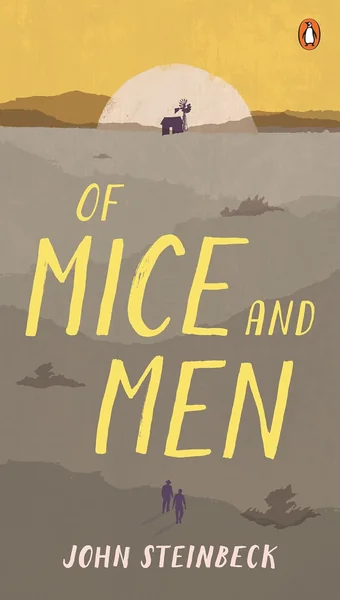
Of Mice and Men (Penguin Great Books of the 20th Century) by John Steinbeck front cover

What the Book Is

Of Mice and Men is John Steinbeck's 1937 novella about George Milton and Lennie Small, two displaced migrant ranch workers drifting through California in search of jobs during the Great Depression. They are an unlikely pair: George, in the publisher's description, is "small and quick and dark of face"; Lennie is a man of tremendous size with the mind of a young child. What binds them is mutual dependence and a shared dream — a few acres of their own, a place where Lennie can tend the rabbits. That dream, fragile from the first page, is the engine of everything that follows when the two men take work on a ranch and collide with the people there: the boss's aggressive son Curley, Curley's restless and unnamed wife, the aging swamper Candy, and the isolated Black stable hand Crooks. The title itself is drawn from Robert Burns's poem "To a Mouse" — the best-laid schemes of mice and men often go awry — and the novella is built to prove the line.
you can't prepare yourself for the magnitude and emotional impact of this powerful novel

Its Place in American Literature

Few books this short carry this much cultural weight. Steinbeck, who received the Nobel Prize in Literature in 1962, is remembered as one of the most celebrated American writers of the twentieth century, the author of The Grapes of Wrath, Cannery Row, and The Pearl — and Of Mice and Men remains among his most-read works, a fixture of school curricula for generations. Its setting is grounded in lived experience: as the introduction to Penguin's edition recounts, Steinbeck dropped out of Stanford and spent nearly two years roaming California, working ranches and harvesting wheat and sugar beets alongside the kind of men he would later write about. The book's very composition has entered literary folklore — Steinbeck's setter puppy famously chewed up roughly half of an early draft, forcing him to rewrite months of work from scratch. Its stature is also measured in opposition: it has appeared on the American Library Association's lists of banned and challenged books, which says something about how uncomfortable its honesty still makes some readers.

What It Does Well

The novella's great strength is compression. At barely a hundred pages, it packs in the Depression, loneliness, race, sex, disability, and the economics of itinerant labor without ever feeling crammed — readers reviewing the book note how much Steinbeck manages to fit into so little time on the page. The structure is famously tight and stage-like, built from a handful of scenes that echo and tighten around one another. Above all, there is the central relationship: the publisher describes the book as "a parable of commitment, loneliness, hope and loss," and that is exactly its register. George's exasperated guardianship and Lennie's guileless devotion form one of the most affecting friendships in American fiction, and the novella's ending lands with the force it does because Steinbeck has made readers invest completely in both men. John Irving, in the endorsement carried on this Penguin edition, warns that "you can't prepare yourself for the magnitude and emotional impact of this powerful novel" — and the warning is fair.

Where It Divides Readers

Honesty requires noting what some readers find hard going. The book is bleak: its tragedy is heavily foreshadowed, and readers who prefer suspense or uplift may find the slide toward the ending oppressive rather than moving. Its period attitudes are also genuinely confronting. The novella depicts racism and sexism as lived realities of the ranch — Crooks is segregated and addressed with racial slurs, Curley's wife is never given a name — and while readers discussing the book recognize this as Steinbeck exposing the prejudices of his setting rather than endorsing them, the language and treatment can still jar modern readers, particularly younger ones encountering it in a classroom. Lennie's cognitive disability, similarly, is rendered through a 1937 lens, well before modern understanding or terminology. Finally, the same compression that gives the book its power leaves its supporting cast thin by design; Curley's wife in particular functions more as a catalyst than a fully realized person, a point of longstanding critical debate.

This Edition, and Who It's For

This listing is the Penguin Great Books of the 20th Century mass-market paperback reissue, published by Penguin Books on September 1, 1993 — a compact 107-page volume, sized to slip into a bag, with a customer-suggested reading age of 14 and up. It is a reading copy in the plainest sense: the full text of a landmark novella in an inexpensive, portable format. Who is it for? Students assigned it, certainly, but also any adult who never read it or hasn't returned since school; it repays a second reading enormously, and at this length it asks only an evening. Readers who want Depression-era America rendered with compassion and without sentimentality will find it here. Readers seeking comfort, or a story whose sympathies are expressed in contemporary language, should know what they are walking into — and will likely find the discomfort is the point.

Sources & Further Reading

The key facts and claims in this review are grounded in the retrieved, verified sources listed below.

  1. Cited in this review
  2. 1
  3. 2
  4. Further reading
  5. 3

    John Steinbeck, Wikipedia

  6. 4
  7. 5
  8. 6
  9. 7
  10. 8
  11. 9
  12. 10
  13. 11
  14. 12
  15. 13
  16. 14
  17. 15
  18. 16