BOOKS
Published

Read Time

3 min read

Curated & edited by

LuvemBooks Editorial

How we create our reviews →
Share This Review

M.B.A.: Discover the Truth About Leadership by D.M. Christensen Review: A Sharp Satirical Skewer of Credential Culture

D.M. Christensen's M.B.A.: Discover the Truth About Leadership is a satirical nonfiction work that takes aim at the credential economy, workplace culture myths, and the gap between the appearance of leadership and its substance — a pointed, humor-laced argument for professionals who feel stuck despite doing everything "right."

LuvemBooks Verdict

Best for

Professionals who feel stuck despite following the conventional career playbook — especially those already skeptical of credential culture and drawn to contrarian, satirically delivered critiques of MBA mythology and workplace performance rituals.

Worth it if

You're frustrated by corporate buzzwords and the gap between credentials and genuine competence, and you're open to having professional received wisdom punctured with dry humor rather than dismantled through traditional business-book frameworks.

Skip if

Skip it if you want a balanced, evidence-rich leadership manual that engages counterarguments in good faith — the satirical posture and heavy bullet-point structure are better suited to the already-converted than to readers seeking nuanced, sustained argumentation.

What readers & critics say

Literary Titan characterises the book as "a satirical broadside against the credential economy, the mystique of leadership language, and the institutional habit of confusing polish with substance," praising the combination of barbed humor and analytical clarity. Blue Ink Review confirms the broad topical sweep — covering workplace miscommunication, false leadership beliefs, and misguided management — while signalling that certain areas would benefit from further development.

Sources: Literary Titan, Blue Ink Review, NetGalley, Bookshop.org
4.5from 19 Amazon ratings— reader ratings, not a LuvemBooks score
In This Review
  • What Works & What Doesn't
  • What the Book Is and What It Argues
  • Scope and Structure
  • Satirical Voice and Tone
  • Strengths and What Works
  • Limitations and Who May Be Frustrated

What Works & What Doesn't

What Works
  • Combines dry humor with analytical clarity to make its critique of credential culture both entertaining and pointed, per NetGalley and Literary Titan
  • Covers a wide range of relevant professional topics — from miscommunication and management myths to the economics of the MBA degree — giving it broad applicability
  • Bullet-point structure keeps the material direct and accessible, consistent with the book's own argument against unnecessary complexity
  • The satirical voice distinguishes it from conventional business books, offering a genuinely contrarian perspective for professionals questioning the standard career playbook
What Doesn't
  • Blue Ink Review signals that certain areas would benefit from further development, suggesting the treatment of some topics is thinner than it could be
  • Heavy reliance on bullet-point formatting may frustrate readers seeking sustained, evidence-rich argument rather than punchy assertions
  • The book's satirical posture is better suited to readers already skeptical of credential culture than to those looking for a balanced or persuasive case that engages counterarguments in depth
A pointed satirical nonfiction work, M.B.A.: Discover the Truth About Leadership argues that the institutions and habits most professionals trust to advance their careers are built on performance rather than genuine competence.

What the Book Is and What It Argues

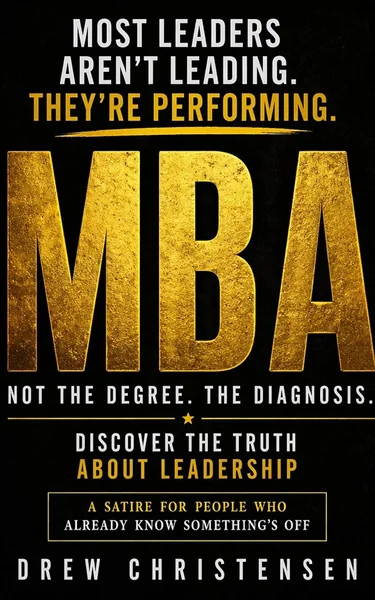
M.B.A. : Discover the truth about leadership by D.M. Christensen front cover
D.M. Christensen's M.B.A.: Discover the Truth About Leadership is a satirical nonfiction broadside against the credential economy, the mystique surrounding leadership language, and the institutional tendency to confuse polish with substance, as Literary Titan describes it. The book's central argument, drawn out across its roughly 273 pages in Kindle edition, is that the MBA degree and the broader professional mythology around it teach compliance rather than leadership, and that the cost of a degree purchases a credential rather than an education. Christensen further contends that freely available resources — YouTube, podcasts, audiobooks — can provide what expensive graduate programs claim to offer exclusively. The target audience is clear: smart, capable professionals who have done everything they were told would lead to success and still find themselves stuck.

Scope and Structure

The book casts a wide net. According to Blue Ink Review, the text covers a broad spectrum of workplace and institutional topics, including miscommunication in the workplace, false beliefs about leadership, and misguided management practices. Much of the material is organized largely in bullet points, a structural choice that reflects the book's design intent to deliver digestible, direct arguments rather than extended narrative. NetGalley's listing describes the approach as combining dry humor with analytical clarity, with the book challenging myths surrounding higher education, management, teamwork, and the concept of "hard work." Bookshop.org characterizes it as "a sharp, unapologetic satire that pulls back the curtain on modern leadership, MBAs, workplace culture, and the rituals we perform to look competent instead of becoming competent."

Satirical Voice and Tone

The book's distinguishing quality, noted consistently across sources, is its satirical register. Literary Titan frames it as a "satirical broadside," and the NetGalley description points to dry humor as one of the primary vehicles for the book's arguments. This tone positions M.B.A. closer to works of cultural critique delivered with comedic edge than to a conventional business or management guide. Readers drawn to contrarian takes on professional culture — and who are receptive to having received wisdom punctured with wit — are the natural audience. Those expecting a prescriptive leadership manual with frameworks and case studies will find the book's satirical posture a departure from that form.

Strengths and What Works

The book's strongest asset, according to the sources available, is the directness and clarity of its central critique. Literary Titan praises Christensen's analytical clarity alongside the humor, suggesting the arguments are rendered with enough precision to hold up beyond mere provocation. The breadth of topics covered — from credential inflation to workplace miscommunication to the performance of leadership — means the book addresses multiple pain points that resonate with a broad professional readership. The bullet-point structure, as noted by Blue Ink Review, keeps the pacing brisk and the arguments accessible rather than buried in academic language, which aligns with the book's own thesis about the overcomplication of professional knowledge.

Limitations and Who May Be Frustrated

Blue Ink Review notes that the book would benefit from further development in certain areas — a partial snippet that nonetheless signals a structural or depth concern from a reviewing outlet. The heavy reliance on bullet points, while efficient, may leave readers who want sustained argument or richer supporting evidence unsatisfied. The book's satirical stance is also a double-edged quality: it gives Christensen license to be provocative and entertaining, but readers seeking nuanced engagement with the genuine value of advanced business education, or counterarguments addressed in good faith, may find the format better suited to preaching to the converted than to persuading skeptics. Professionals who have found meaningful value in an MBA program may read the book's framing as more polemic than balanced critique.

Sources & Further Reading

The key facts and claims in this review are grounded in the retrieved, verified sources listed below.

  1. Cited in this review
  2. 1
  3. 2
  4. 3
  5. Further reading
  6. 4

    D.M. Christensen, Wikipedia

  7. 5
  8. 6