9 min read
4.2
· 22 Amazon ratingsShare This Review
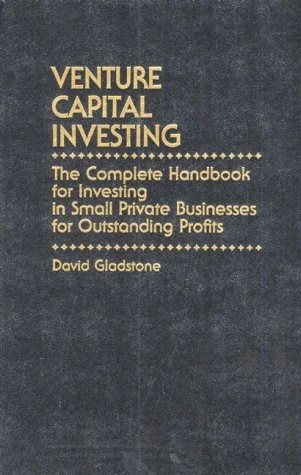
Venture Capital Investing by David Gladstone Review: A Practical Investor's Reference for Deal-Makers
David Gladstone's Venture Capital Investing is a comprehensive reference handbook that reorients the lens of his earlier classic, Venture Capital Handbook, away from the entrepreneur seeking funding and toward the investor deploying it — covering everything from evaluating business proposals and management teams to assessing financial statements and building portfolio partnerships. This review is based on the book's contents and published reception, not hands-on application.
LuvemBooks Verdict
Best for
Angel investors and early-stage VC professionals who want a structured, practitioner-built methodology for evaluating business proposals, assessing management teams, and making investment decisions — rather than a theoretical or founder-facing introduction to venture capital.
Worth it if
Worth reading if you want a single-volume reference grounded in real operational experience — covering financial assessment, market evaluation, and management vetting — written by someone who has actually run major investment funds at scale.
Skip if
Skip it if your focus is on the very earliest speculative seed investments, deep tech, crypto, or platform-economy deal structures, as the framework — even in its 2003 revised form — predates significant shifts in those areas and will require meaningful supplementation.
What readers & critics say
Thriftbooks reader commentary describes the book as detailed, direct, and useful for both investors and entrepreneurs trying to understand how proposals are evaluated from the investor's side, while Open Library positions it as essential reading for start-to-finish advice on identifying winning opportunities and evaluating management, finance, and exit strategies.
Sources: Thriftbooks, Open LibraryAsk LuvemBooks
Was this helpful?
- Is it worth reading?
- For angel investors and early-stage VC professionals seeking a structured methodology for deal evaluation, Venture Capital Investing delivers well on its ambition — it is broadly described as a thorough, practical resource rooted in genuine practitioner authority. Reader commentary at Thriftbooks calls it 'a fantastic book to read — simple and comprehensive with lots of good examples and discussions, good for novices as well as finance professionals.' The main caveat is temporal: the 2003 revised edition predates significant shifts in technology markets and deal mechanics, so readers focused on contemporary investment landscapes will need to supplement it with more current sources.
- Who should read this?
- Venture Capital Investing is best suited to angel investors, early-stage VC professionals, and finance practitioners who want a structured, practitioner-grounded methodology for evaluating deals rather than a theoretical survey of the field. Reader commentary at Thriftbooks confirms the book works for both newcomers to venture investing and experienced finance professionals. Those seeking guidance on the most speculative seed or pre-product investments, or on contemporary deal structures in deep tech, crypto, or platform-economy sectors, will need to supplement it with more current sources.
- Similar books
- Readers drawn to Venture Capital Investing often find value in a cluster of foundational business and investing titles. Benjamin Graham's The Intelligent Investor shares the handbook's emphasis on disciplined, criteria-driven evaluation of investments — a complementary perspective from the public-markets side. Jim Collins' Good to Great addresses what separates high-performing businesses from the rest, directly relevant to the management and competitive-environment assessment Gladstone covers. Clayton Christensen's The Innovator's Dilemma is essential context for understanding the technology market dynamics that Gladstone's framework must be applied to today. For those interested in the acquisition and entrepreneurship angle, Walker Deibel's Buy Then Build and Eric Ries' The Lean Startup round out the shelf with perspectives on how businesses are built and acquired rather than purely funded.
- About David Gladstone
- David Gladstone is the author of Venture Capital Investing, a foundational text in the Business & Economics category that addresses investment strategies and practices in the venture capital sector. The book serves as a practical guide for understanding the investor's perspective on deal evaluation and portfolio management.
- What is Gladstone's 'acid test' for management?
- Gladstone's 'acid test' is his framework for determining whether a management team clears the bar for investment. It breaks down into sub-dimensions including honesty and integrity, relevant experience, and demonstrated achievement — criteria that reflect his practitioner background as much as any theoretical model. The acid test sits at the human center of the book's organizing logic, which moves from the mechanical evaluation of a deal to the people driving it.
- What are the book's main limitations?
- Venture Capital Investing has two clearly documented limitations. First, its depth lies in evaluating deals at relatively mature early stages rather than the most speculative seed or pre-product investments — as one Thriftbooks reviewer noted, the book focuses on deals at 'slightly later than sexy stage,' and no book can teach an investor to pick winners in a trend that has not yet emerged. Second, the original 1987 edition and even the 2003 revised edition predate significant shifts in technology markets, regulatory environments, and deal mechanics; readers focused on deep tech, crypto, or platform-economy investing will find the framework useful but will need to supplement it with more current sources.
- What's this book about?
- Venture Capital Investing is a reference handbook that teaches investors — not entrepreneurs — how to evaluate business proposals and make sound venture capital decisions. Written by David Gladstone, who founded Gladstone Capital and chaired two of the largest publicly traded investment funds of their kind, the book covers how to assess business propositions, evaluate financial statements, scrutinize market niches and competitive environments, assess management teams through frameworks like the 'acid test,' and build effective partnerships with portfolio companies. It was developed as a reorientation of Gladstone's earlier Venture Capital Handbook, shifting from the entrepreneur's fundraising perspective to the investor's deal-selection perspective.
- Who is it for?
- The book is primarily designed for venture capital investors and angel investors seeking a structured, practitioner-grounded approach to deal evaluation. Reader commentary at Thriftbooks confirms it serves both newcomers to venture investing and experienced finance professionals — a range that reflects Gladstone's deliberate use of concrete examples and step-by-step exposition. Those whose primary focus is very early-stage seed investing or contemporary deal structures in sectors like deep tech or crypto will find the framework valuable as a foundation but will need to supplement it.
- What format or source is it?
- Venture Capital Investing is a structured reference handbook in the Business & Economics category, designed for repeated consultation rather than linear narrative reading. The standard edition is a print volume; the most widely referenced version is the revised edition published in 2003, which updated the original 1987 text. Reader reception data cited in the review is drawn from commentary aggregated at Thriftbooks.
Summarize this book
Follow up
Synthesized from verified book data & published reviews · How we review
Press Enter to ask. Answers come from our editorial Q&A — start typing to see related questions.
Age & Reading Level
Recommended age
Adult
Reading level
Adult
Skip if you are seeking cutting-edge guidance on seed-stage, deep tech, crypto, or platform-economy deal structures and expect fully current market coverage.
Our Review
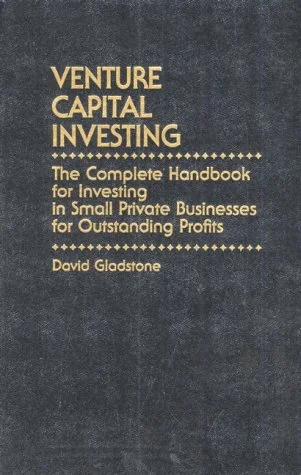
What the Book Is and What It Sets Out to Do
The Central Framework: Evaluating Deals and People
Gladstone's Credentials and the Book's Place in the Field
Strengths: Accessibility Across Experience Levels
Limitations and Who May Find It Incomplete
Sources & Further Reading
The key facts and claims in this review are grounded in the retrieved, verified sources listed below.
- Cited in this review
- 1
Open Library
- 2
- Further reading
- 3
David Gladstone, Wikipedia
- 4
Books like Venture Capital Investing
Curated picks for readers who enjoyed Venture Capital Investing, with our reasoning for each match.
If you liked Venture Capital Investing