BOOKS
Published

Read Time

8 min read

Reader rating

4.5

· 27 Amazon ratings
reader ratings, not a LuvemBooks score
Curated & edited by

LuvemBooks Editorial

How we create our reviews →
Share This Review

The Personal MBA by Josh Kaufman Review: A Sweeping Single-Volume Business Education

Josh Kaufman's The Personal MBA: Master the Art of Business is an international bestseller that sets out to distill the core knowledge of entrepreneurship, marketing, sales, negotiation, operations, productivity, and systems design into one comprehensive, buzzword-free volume — making the case that a costly business school degree is not a prerequisite for business mastery. Published by Portfolio, an imprint of Penguin Random House, the book has drawn praise from celebrated figures including Seth Godin, David Allen, and Derek Sivers, and a Hindi-language edition makes its mental-model-driven framework accessible to a broader global readership.

LuvemBooks Verdict

Best for

Aspiring entrepreneurs, career-changers, and curious generalists — including Hindi-language readers — who want a single integrated command of business fundamentals across every major domain without enrolling in a formal MBA programme.

Worth it if

Worth it if you want a jargon-free, systems-level map of the entire business landscape — from value creation and marketing to operations and productivity — that you can apply directly to real-world challenges.

Skip if

Skip it if you already have deep expertise in a specific business discipline and are looking for advanced, specialist-level treatment — the breadth-first structure means any single field gets surface coverage only.

Davidseah.com describes the book as presenting a business model "meticulously constructed from common sense and real relationships with customers," drawing its authority from Kaufman's filtered, practical sense of what makes a business work. Healthydayhacks.com highlights its emphasis on real-world application, noting that Kaufman integrates examples and case studies that illustrate how concepts can be applied directly to the reader's own experiences.

Sources: davidseah.com, healthydadhacks.com, thepowermoves.com, williammeller.com
4.5from 27 Amazon ratings— reader ratings, not a LuvemBooks score

Look inside the book

Preview the actual pages, via Google Books
In This Review
  • What Works & What Doesn't
  • What the Book Actually Is and Does
  • Significance and Place in the Genre
  • Strengths: Breadth, Accessibility, and the Mental-Model Framework
  • Genuine Limitations and Who May Find It Frustrating
  • Who It Is For and How It Reads Today

What Works & What Doesn't

What Works
  • Covers the full spectrum of business — entrepreneurship, marketing, sales, negotiation, operations, productivity, and systems design — in a single integrated volume
  • Organizes knowledge into memorable mental models designed for real-world application rather than academic abstraction
  • Praised by prominent voices including Seth Godin, David Allen, Derek Sivers, and Kevin Kelly for its clarity and freedom from jargon
  • International bestseller with sustained relevance across multiple editions, including a 10th Anniversary Edition
  • Hindi-language edition makes the framework accessible to a wide readership beyond English-language markets
What Doesn't
  • Breadth-over-depth structure means specialists in any single domain are unlikely to find advanced or nuanced treatment of their field
  • Functions best as a foundational overview and reference map — readers seeking expert-level mastery in a specific discipline will need additional, more focused sources
Josh Kaufman's The Personal MBA is an international bestseller that argues a formal MBA is unnecessary for achieving business success — and then attempts to prove it in a single volume covering entrepreneurship, marketing, sales, negotiation, operations, productivity, and systems design.

What the Book Actually Is and Does

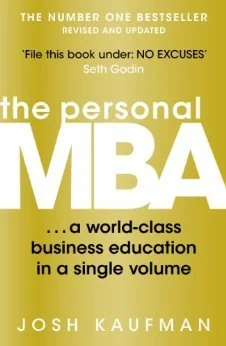
The Personal MBA by Josh Kaufman front cover
The Personal MBA: Master the Art of Business grew out of Kaufman's PersonalMBA.com, a blog he founded as a deliberate alternative to the business school model. The book's central premise is direct: the most valuable business knowledge can be distilled into clear, memorable mental models and applied to real-world challenges without the debt or years of coursework that a traditional MBA demands. Rather than deep-diving into a single discipline, it surveys every major domain of business — from how value is created and sold, to how organizations are structured, to how individuals manage their own productivity and decision-making. The result, by design, is a map of the entire business landscape in one place.
If you combine reading this book with actually trying stuff, you'll be far ahead in the business game.

Significance and Place in the Genre

Business self-education books are a crowded field, but The Personal MBA carved out a distinctive position by being explicitly comprehensive rather than narrowly prescriptive. Kaufman's research and writing have, according to the book's official record, helped millions of people worldwide learn the fundamentals of modern business. The volume has achieved international bestseller status and has been issued in multiple editions — including a 10th Anniversary Edition — and in multiple languages, among them this Hindi-language paperback edition published under ISBN 978-0670919536. Its reach across languages and editions speaks to a sustained demand that goes well beyond a single cultural or professional market.

Strengths: Breadth, Accessibility, and the Mental-Model Framework

The book's most praised quality is its ability to synthesize an enormous range of material without becoming bloated or jargon-heavy. Derek Sivers, founder of CD Baby, called it "an amazing overview of everything you need to know," adding that it covers "all of the basics, minus buzzwords and fluff." Amy Hoy, founder of Noko and Stacking the Bricks, highlighted what sets it apart structurally: "Most books focus on a single part of business in isolation, but The Personal MBA walks you through every moving part, and gives you the tools to understand how those parts work together to create a complete system." This systems-level framing is central to Kaufman's approach — ideas are presented not as isolated tips but as interconnected principles. Seth Godin described the book as leaving readers with "no excuses," writing that after reading it, one is no longer open to the argument that they lack the knowledge to do meaningful work.

Genuine Limitations and Who May Find It Frustrating

The book's defining strength — breadth — is also the source of its most legitimate criticism. By covering every moving part of business in a single volume, it necessarily trades depth for range. Readers who already have substantial expertise in one or more domains (say, seasoned marketers or experienced operations managers) may find the treatment of their specialty too surface-level to offer new insight. The mental-model format works best as an orientation and reference framework; it is not designed as a specialist deep-dive into any single field. Practitioners seeking advanced, domain-specific knowledge will need to supplement it with more focused texts. The book openly acknowledges this trade-off in its structure — it is a starting point and an integrated overview, not a final word on any one subject.

Who It Is For and How It Reads Today

David Allen, author of Getting Things Done, observed that Kaufman conceptually understands "how to get things done" better than almost anyone he has encountered — a nod to the book's practical, application-oriented voice. Kevin Kelly, founding executive editor of Wired, put it plainly: "If you combine reading this book with actually trying stuff, you'll be far ahead in the business game." That framing captures the intended audience well: curious generalists, aspiring entrepreneurs, career-changers, and self-educators who want an integrated command of business fundamentals without the credential pathway. The availability of a Hindi-language edition extends that mission to readers for whom English-language business literature has historically posed a barrier — bringing Kaufman's mental-model framework to a vast and growing entrepreneurial audience on its own terms.

Sources & Further Reading

The key facts and claims in this review are grounded in the retrieved, verified sources listed below.

  1. Cited in this review
  2. 1
  3. 2
  4. Further reading
  5. 3
  6. 4
  7. 5
  8. 6
  9. 7
  10. 8