Share This Review

Before The Bestseller by Alex Strathdee, Laura Russom & Steve Sarner Review: A Practical Playbook for Aspiring Nonfiction Authors

Before The Bestseller: Your Proven Path to Book Sales Without Wasting Time & Money is a nonfiction guide co-authored by Alex Strathdee, Laura Russom, and Steve Sarner, designed to walk nonfiction authors through the process of building an audience and generating consistent book sales — with or without an existing platform. Anchored by the real-world case study of Joseph Nguyen, who went from having no platform, no followers, and no brand in January 2022 to becoming a New York Times bestselling author with over one million copies sold by December 2024, the book positions itself as an actionable playbook rather than a motivational overview. With a rating of 4.8 out of 5 stars across 56 ratings on Amazon, early reception points to strong reader resonance among its target audience of working and aspiring nonfiction authors.

LuvemBooks Verdict

Best for

Nonfiction authors — especially first-timers with no existing platform, followers, or industry connections — who want a concrete, step-by-step commercial playbook for selling books and building an audience rather than craft or editorial guidance.

Worth it if

You're a nonfiction author ready to engage seriously with the marketing and sales mechanics of publishing and want a structured, actionable framework grounded in a documented real-world success story rather than generic platform-building theory.

Skip if

You write fiction, poetry, or work in experimental forms, or you're primarily seeking craft, editorial, or writing-process guidance — the playbook's framework is explicitly scoped to nonfiction commercial strategy and will not translate to those needs.

What readers & critics say

Retrieved source pages (books.google.com and books.apple.com) present the book's own framing of its central case study — Joseph Nguyen going from no platform in January 2022 to a New York Times bestselling author with over one million copies sold by December 2024 — as the book's core proof of concept. No independent critical reviews were among the retrieved sources.

Sources: books.google.com, books.apple.com
4.7from 146 Amazon ratings— reader ratings, not a LuvemBooks score
In This Review
  • What Works & What Doesn't
  • What the Book Actually Is and Does
  • The Central Case Study: Joseph Nguyen's Journey
  • Significance and Place in the Genre
  • Genuine Strengths
  • Limitations and Who It May Not Serve

What Works & What Doesn't

What Works
  • Grounded in the verified, real-world case study of Joseph Nguyen — from zero platform to New York Times bestseller with over one million copies sold — giving the playbook a concrete, named anchor
  • Directly addresses authors who have no pre-existing platform, filling a gap that much conventional publishing advice overlooks
  • Three-author collaboration brings multiple areas of expertise to a guide that spans strategy, audience-building, and book sales mechanics
  • Holds a 4.8 out of 5 stars rating on Amazon across 56 ratings, reflecting strong early reader resonance
  • Framed as an actionable, step-by-step playbook rather than a motivational or theoretical overview
What Doesn't
  • Explicitly scoped to nonfiction — fiction authors, poets, and writers in other forms will find the strategies largely inapplicable to their publishing realities
  • The central case study, while documented and compelling, represents an exceptional outcome that may not map cleanly to every nonfiction category or author situation
  • Focused squarely on the commercial and marketing dimensions of publishing — authors seeking craft, editorial, or writing-process guidance will need additional resources
Before The Bestseller positions itself squarely as a field manual for nonfiction authors — not a theory text — and that intent shapes every dimension worth evaluating here.

What the Book Actually Is and Does

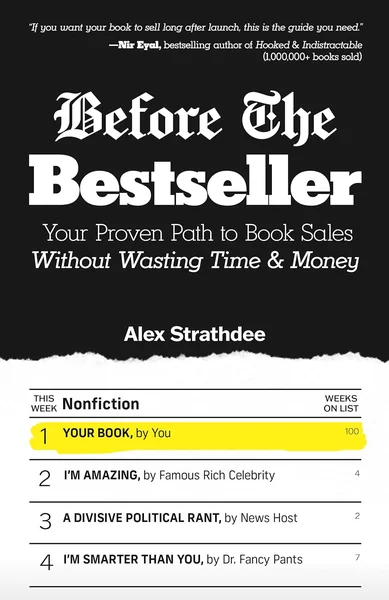
Before The Bestseller: Your Proven Path to Book Sales Without Wasting Time & Money by Alex Strathdee, Laura Russom, Steve Sarner front cover
Before The Bestseller: Your Proven Path to Book Sales Without Wasting Time & Money is a nonfiction how-to guide authored by Alex Strathdee, Laura Russom, and Steve Sarner. Its stated mission is precise: to equip nonfiction authors with a step-by-step playbook for selling books and building an audience, positioned explicitly as a path that does not require wasting time or money. The subtitle signals a pragmatist's promise — this is not a book about the dream of writing but about the mechanics of reaching readers. The book's subtitle further identifies its scope as helping authors "create a nonfiction bestseller that never stops selling," framing long-term, compounding book sales as the end goal rather than a single launch spike.

The Central Case Study: Joseph Nguyen's Journey

The book's most concrete and recurring anchor is the documented story of Joseph Nguyen. In January 2022, Nguyen had no platform, no followers, and no established brand — only an idea for a book. By December 2024, he had become a New York Times bestselling author with over one million copies sold. The authors use this trajectory as both proof of concept and structural spine for the playbook. It gives the guide something many books in the crowded author-marketing space lack: a specific, verifiable, high-stakes example against which the strategies can be measured. For readers who are skeptical of generic publishing advice, Nguyen's arc from zero to over one million copies sold provides a grounded, named reference point rather than abstract encouragement.

Significance and Place in the Genre

The author-marketing and book-launch nonfiction space is densely populated, and books within it frequently recycle the same platform-building orthodoxies. Before The Bestseller attempts to differentiate itself by addressing authors who have no pre-existing audience — a meaningful distinction, since much conventional publishing advice implicitly assumes some baseline of followers or industry connections. By centering its playbook on a case where that baseline was entirely absent, the book speaks directly to a gap that many first-time or platform-free nonfiction authors experience. The three-author collaboration also brings a multi-perspective voice to the material, reflecting the kind of team-based approach that professional book-launch strategy increasingly requires. The book carries an Amazon rating of 4.8 out of 5 stars from 56 ratings, reflecting strongly positive early reception.

Genuine Strengths

The book's primary strength, as its structure and marketing make clear, is specificity. Rather than offering a general philosophy of authorship, it promises a "proven path" — language that implies documented steps, measurable actions, and replicable outcomes. The Nguyen case study is not held in reserve as a closing inspiration; it is woven into the book's argument as living evidence. For nonfiction authors who have struggled with the abstract advice that dominates much of the publishing self-help genre, a guide built around a concrete, named, and verifiable success story offers something more actionable. The three-author structure also suggests breadth of expertise across the different competencies — strategy, audience-building, and sales mechanics — that a comprehensive launch playbook requires.

Limitations and Who It May Not Serve

The book's tight focus on nonfiction is a feature for its intended audience but a firm boundary for anyone else. Fiction authors, poets, or those working in hybrid or experimental forms will find the playbook's framework largely inapplicable — the strategies for building a nonfiction audience and the metrics for "bestseller" status differ substantially from fiction publishing realities. Additionally, the book's framing around the Nguyen case study, while compelling, centers an exceptional outcome. Some readers may find that a single marquee example, however well-documented, does not fully address the range of nonfiction categories, markets, or author starting points they encounter in practice. The book is designed for authors who are ready to engage with the commercial and marketing dimensions of publishing; those seeking craft-focused or editorially-oriented guidance will need to look elsewhere.

Sources & Further Reading

The key facts and claims in this review are grounded in the retrieved, verified sources listed below.

  1. Cited in this review
  2. 1
  3. 2
  4. Further reading
  5. 3
  6. 4