
8 min read
4.2
· 698 Amazon ratingsShare This Review
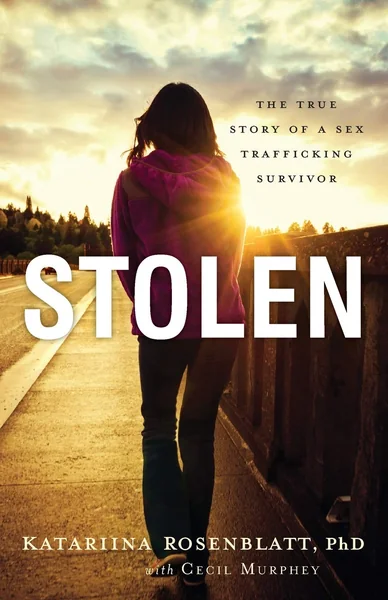
Stolen: The True Story of a Sex Trafficking Survivor by Katariina Rosenblatt PhD & Cecil Murphey Review: A Harrowing, Hope-Filled Survivor Memoir
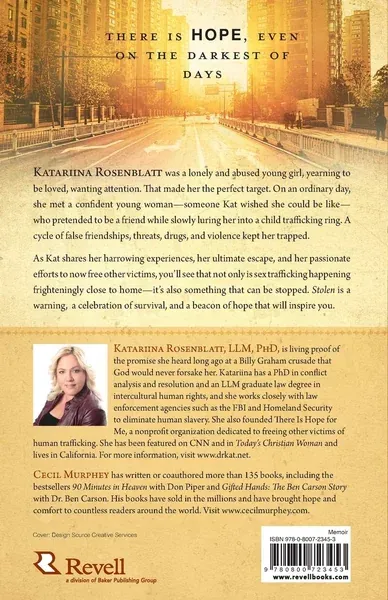
Stolen is a memoir co-written by Katariina Rosenblatt, PhD, and prolific collaborator Cecil Murphey, tracing Rosenblatt's repeated escapes from a child sex-trafficking ring and her journey toward advocacy and healing. Published by Revell in October 2014, it is designed to function simultaneously as a personal testimony, a warning about the realities of domestic trafficking, and an argument that survival and recovery are possible — an argument Rosenblatt's own career in law enforcement collaboration and nonprofit work makes concrete.
 Tap to enlarge
LuvemBooks Verdict
Best for
Survivors, parents, educators, and advocates who want the domestic sex trafficking crisis made viscerally concrete through a single, documented personal story rather than policy abstraction — especially readers for whom a faith-rooted survival narrative will resonate.
Worth it if
You want survivor testimony that moves beyond victimization into a forward arc of recovery, professional credentialing, and activism — evidence that what was stolen can be reclaimed.
Skip if
Skip it if you need a secular or purely policy-driven account, or if unflinching depictions of childhood sexual exploitation are more than you can engage with right now.
What readers & critics say
At christianbook.com, the memoir holds a 4.5 out of 5 stars rating across reader reviews, reflecting strong audience reception. The book blog beverlylynnt.wordpress.com describes it as "a warning, a celebration of survival, and a beacon of hope," noting its three-part structure moving from personal story through abuse to a message of resilience.
Sources: christianbook.com, beverlylynnt.wordpress.comAsk LuvemBooks
Was this helpful?
- Is it worth reading?
- For readers drawn to survivor memoirs, advocacy literature, or first-person accounts of domestic trafficking, Stolen delivers something rare: a traceable personal narrative from a survivor who not only escaped multiple times — remarkable given that an estimated 90 percent of trafficking victims are never rescued — but went on to build a credentialed professional life in the field. Cecil Murphey's co-authorship brings proven craft to a difficult subject, and strong reader reception at christianbook.com reflects broad audience resonance. The key caveat is twofold: the explicit Christian faith framework is load-bearing in how survival is narrated, and the subject matter is by design harrowing — both are features, not flaws, but they determine readerly fit.
- Similar books
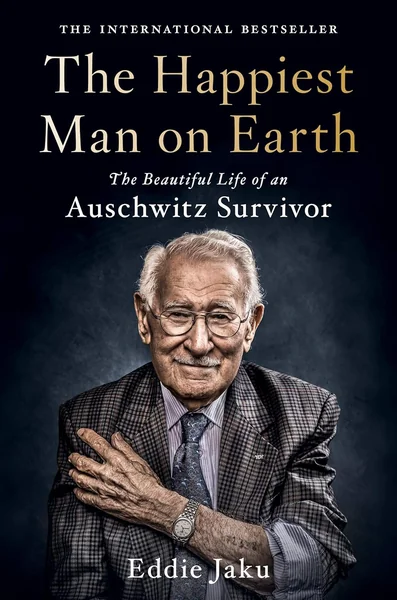
- Readers drawn to Stolen's blend of harrowing personal testimony and survival-into-advocacy will find strong company in several memoirs curated below. Yeonmi Park's In Order to Live: A North Korean Girl's Journey to Freedom shares the DNA most directly — a young woman escaping systemic exploitation and constructing a new life, told with the same unflinching specificity. Malala Yousafzai's I Am Malala: The Girl Who Stood Up for Education and Was Shot by the Taliban and Ishmael Beah's A Long Way Gone: Memoirs of a Boy Soldier similarly anchor global crises in one person's lived experience, making abstract dangers immediate. For readers drawn to the faith-grounded resilience thread in Stolen, Eddie Jaku's The Happiest Man on Earth: The Beautiful Life of an Auschwitz Survivor offers a comparable arc — unimaginable suffering transformed, through deliberate choice, into a life of meaning and advocacy.
- Who should read this?
- LuvemBooks identifies four overlapping audiences for Stolen: survivors who may recognize their own experience in Rosenblatt's account; parents and educators seeking to understand how trafficking recruitment actually operates (the mechanism of false friendship and manufactured trust is detailed specifically); advocates, social workers, and policy-minded readers who need statistics grounded in individual testimony; and general readers drawn to survival narratives. The book is least suited to readers who want a detached, data-first treatment of the subject or who would find a central Christian faith framework at odds with their approach to the material.
- Why is this book trending?
- Stolen is experiencing a resurgence in reader interest driven by a wave of true-story kidnapping and abduction dramas landing on Netflix and Disney+. As those productions bring trafficking and abduction narratives to a mainstream audience, readers are seeking out first-person accounts that go deeper than a TV adaptation can — and Rosenblatt's memoir, rooted in documented survivor testimony rather than dramatization, fits that demand precisely. The book's combination of authentic firsthand detail, a recognizable American setting (Miami Beach), and a survival-into-advocacy arc gives it staying power beyond a single news cycle.
- What are the main themes?
- The central themes of Stolen are the mechanics of exploitation (specifically how false trust is manufactured to recruit vulnerable young people), the cyclical nature of trafficking victimization, and the possibility of survival and recovery. Running through all of these is a faith-grounded argument that identity and dignity can be reclaimed after profound violation — a theme Rosenblatt embodies through her own post-survival trajectory rather than simply asserting. The book also advances a pointed argument about proximity: sex trafficking is framed not as a foreign or distant crisis but as a present domestic reality, with an estimated 300,000 American children at risk annually.
- Who is Cecil Murphey and what does he bring?
- Cecil Murphey is a prolific co-author and ghostwriter with more than 130 books to his credit, including the bestselling 90 Minutes in Heaven with Don Piper and Rebel with a Cause, the autobiography of Franklin Graham. His specific expertise lies in shaping difficult personal narratives — particularly survivor and faith-based accounts — for broad readerships, which is directly relevant to how Stolen is constructed. LuvemBooks notes his practiced hand as meaningful context for understanding why the book works as a readable, structured memoir rather than raw testimony alone.
Summarize this book
Follow up
Synthesized from verified book data & published reviews · How we review
Press Enter to ask. Answers come from our editorial Q&A — start typing to see related questions.
Age & Reading Level
Recommended age
Adult
Reading level
Adult
3 content notes · who it suits
Content to know about
Best for: Adults / mature older teens with guidance — depicts childhood sexual exploitation and repeated trafficking victimization in unflinching detail.
Skip if you want a detached, data-driven treatment of trafficking rather than unflinching first-person survivor testimony.
Our Review
What the Book Actually Recounts

The Book's Place in the Conversation on Domestic Trafficking
Strengths: Testimony with a Trajectory
The Faith Dimension
Who This Book Is For and What It Demands
Sources & Further Reading
The key facts and claims in this review are grounded in the retrieved, verified sources listed below.
- Cited in this review
- 1
- 2
- Further reading
- 3
- 4
- 5
Books like Stolen
Curated picks for readers who enjoyed Stolen, with our reasoning for each match.
If you liked Stolen

Why It’s Trending
Trafficking Survivor Memoirs Are Back in the Conversation as True-Crime Content Surges
Rosenblatt's memoir is getting fresh attention as audiences are actively consuming kidnapping and trafficking stories across streaming platforms. With Netflix and Disney+ both running high-profile content in this space right now, readers are naturally looking for the real stories behind the headlines.