9 min read
4.5
· 24,711 Amazon ratingsShare This Review
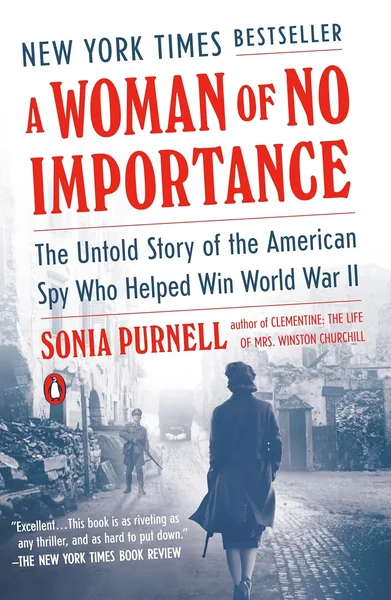
A Woman of No Importance by Sonia Purnell Review: A Gripping, Meticulously Researched WWII Biography
Sonia Purnell's A Woman of No Importance rescues Virginia Hall — one of the most consequential Allied spies of World War II — from undeserved obscurity, building a richly detailed biography around meticulous research and a subject whose true-life exploits rival anything in fiction.
LuvemBooks Verdict
Best for
Readers of narrative nonfiction and WWII history who want a rigorously sourced, argument-driven biography that restores a systematically overlooked operative — Virginia Hall — to her rightful place in the front rank of the war's protagonists.
Worth it if
Worth reading if you want a biography that combines meticulous primary-source research with genuine narrative propulsion, and that makes a documented, operation-by-operation case for why gender and institutional bias kept one of the war's most consequential spies out of the history books for so long.
Skip if
Skip it if you're looking for a broad institutional history of the SOE and OSS or an equally weighted account of the many Resistance figures Hall coordinated — the tight biographical focus keeps both in a supporting role.
What readers & critics say
Kirkus Reviews awarded the book a starred verdict, calling it "a significant biography" of a trailblazer whose meticulous research shows that a man with Hall's record would now be "as famous as James Bond." NPR, which named it a Best Book of the Year, called it "a very smooth read about a rocky life" — a gripping account that traces Hall's career in the context of hurdles she faced from allies as much as from enemies. The Washington Independent Review of Books described it as "an engrossing, even spectacular, true story that reads like a thriller," and bookcritics.org (the National Book Critics Circle) noted that Purnell elevates the phrase "gripping narrative" to a whole new level in telling the true story of Virginia Hall.
“Meticulous research results in a significant biography of a trailblazer who now has a CIA building named after her.”
— Kirkus Reviews“If Hall had been a man… she would now be as famous as James Bond.”
— Kirkus ReviewsAsk LuvemBooks
Was this helpful?
- Is it worth reading?
- For readers drawn to narrative nonfiction, WWII history, or the history of women in intelligence, A Woman of No Importance makes an overwhelming case for its subject. Kirkus Reviews awarded it a starred verdict, calling it 'a significant biography,' while NPR praised it as 'a very smooth read about a rocky life' — a phrase that captures Purnell's ability to sustain narrative momentum without sacrificing scholarly rigor. The book's credentials are broad: a New York Times bestseller, a National Book Critics Circle finalist, and a Best Book of the Year selection from NPR, the New York Public Library, Amazon, the Seattle Times, and several other major outlets. The key caveat is scope — readers expecting an equally weighted account of the SOE's institutional history or the wider Resistance figures Hall worked alongside will find this a tightly focused biography rather than a comprehensive theater history.
- Similar books
- Readers who respond to A Woman of No Importance's combination of rigorous sourcing and narrative drive will find strong companions in several related titles. Judith Pearson's The Wolves at the Door: The True Story of America's Greatest Female Spy covers Virginia Hall's story from a different angle. Elizabeth Wein's Code Name Verity approaches wartime female courage through fiction rather than biography. Ben Macintyre's A Spy Among Friends: Kim Philby and the Great Betrayal applies a similarly propulsive biographical lens to British intelligence betrayal. Clare Mulley's The Spy Who Loved: The Secrets and Lives of Christine Granville profiles another remarkable female operative of the same era. For readers drawn to the recovery of overlooked women's histories beyond the intelligence world, Eliza Hamilton: The Extraordinary Life by Tilar J. Mazzeo offers a comparable project of historical reclamation.
- Who should read this?
- A Woman of No Importance will resonate most strongly with readers drawn to narrative nonfiction and WWII history, those interested in the history of women in intelligence and combat-adjacent roles, and readers whose appetite for the genre runs toward the rigorously sourced rather than the dramatized. NPR's designation as a Best Book of the Year reflects how widely the book travels across readerships — from military history enthusiasts to readers primarily interested in feminist historical recovery. Those seeking a broad institutional history of the SOE and OSS, or an equally weighted account of the Resistance figures Hall coordinated alongside, will find the biography's tight focus on Hall both its greatest strength and its primary constraint.
- About Sonia Purnell
- Sonia Purnell is a British writer and journalist who has worked at The Economist, The Daily Telegraph, and The Sunday Times.
- What are the main themes?
- A Woman of No Importance operates on two levels simultaneously: as a documented account of Virginia Hall's covert operations across Vichy France and occupied Europe, and as a sustained argument about how gender and institutional discrimination suppressed her recognition for decades. Purnell tracks the disparity between Hall's record and her treatment operation by operation, from the March 1942 Mauzac prison breakout to her management of Resistance networks across Lyon and Paris, showing how good-old-boy office politics overrode field intelligence and how allies presented as many obstacles as enemies. The book also engages directly with the SOE's institutional chaos — the fatal mistakes caused by sending undertrained operatives into occupied territory — giving the biography a critical dimension that prevents its moral clarity from flattening complexity.
- How well-researched is it?
- Research is one of the biography's most praised attributes. Purnell draws on new primary sources to reconstruct Hall's complete covert career for the first time — a claim Kirkus Reviews substantiated in awarding the book a starred verdict and calling it 'a significant biography.' The operational details — safe houses, courier networks, the Mauzac breakout, the Gestapo's pursuit of the 'Limping Lady' — are grounded in documented history rather than dramatized reconstruction. The book's recognition as a National Book Critics Circle finalist further reflects its standing in a competitive field where WWII histories are held to rigorous evidential standards.
Summarize this book
Follow up
Synthesized from verified book data & published reviews · How we review
Press Enter to ask. Answers come from our editorial Q&A — start typing to see related questions.
Age & Reading Level
Recommended age
Adult
Reading level
Adult
3 content notes · who it suits
Content to know about
Skip if you're looking for a broad institutional history of Allied intelligence rather than a tightly focused biography.
Our Review
Who Virginia Hall Was and What She Did

Significance: A Long-Overdue Historical Recovery
Craft and Strengths: Research, Pace, and Moral Clarity
Limitations: Focus and Scope
Who Should Read It
Sources & Further Reading
The key facts and claims in this review are grounded in the retrieved, verified sources listed below.
- Cited in this review
- 1
washingtonindependentreviewofbooks.com
- 2
kirkusreviews.com
- 3
- Further reading
- 4
Sonia Purnell, Wikipedia
- 5
- 6
bookbrowse.com
- 7
- 8
- 9
Books like A Woman of No Importance
Curated picks for readers who enjoyed A Woman of No Importance, with our reasoning for each match.