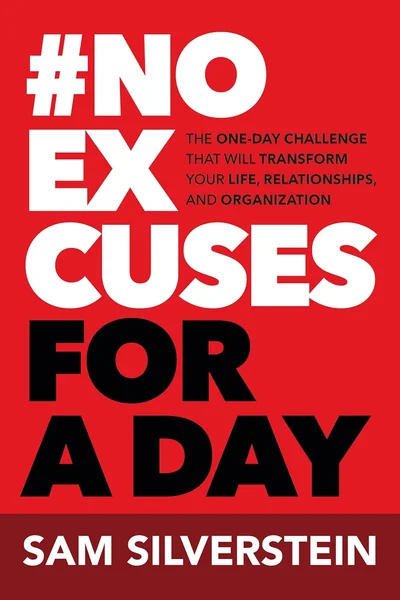
The Foundation of Excuse-Free Thinking
Silverstein builds his methodology around a fundamental observation that pervades modern organizational culture: excuses have become our default response to challenges. Rather than attacking symptoms through time management or productivity hacks, he targets the root behavior that undermines personal and professional effectiveness.
The author distinguishes between explanations and excuses with surgical precision. Explanations acknowledge circumstances while maintaining responsibility; excuses transfer blame and surrender agency. This distinction forms the intellectual backbone of the entire challenge, providing readers with a clear framework for recognizing their own patterns.
The one-day constraint isn't arbitrary—it leverages psychological principles around habit formation and behavioral change. By limiting the commitment to 24 hours, Silverstein removes the overwhelming nature of permanent lifestyle changes while creating space for participants to experience the benefits directly.
Practical Implementation Beyond Theory
Unlike leadership books that remain trapped in abstract concepts, Silverstein provides specific protocols for executing the challenge. The framework addresses common scenarios where excuses typically emerge: missed deadlines, communication breakdowns, relationship conflicts, and organizational dysfunction.
The book outlines preparation strategies that participants can implement before beginning their excuse-free day. These include identifying personal excuse patterns, establishing accountability partners, and creating response protocols for challenging situations. The practical exercises guide readers through real-world applications rather than theoretical discussions.
Silverstein acknowledges that eliminating excuses for one day will surface uncomfortable truths about personal and organizational behavior. He provides tools for processing these insights constructively rather than defensively. The approach recognizes that sustainable change requires both awareness and practical alternatives to excuse-making behavior.
Organizational Culture and Leadership Impact
The book extends beyond individual transformation to address organizational dynamics. Silverstein argues that excuse cultures create cascading effects throughout entire organizations, undermining trust, accountability, and performance. For leaders implementing culture change initiatives, this offers a concrete starting point that doesn't require massive restructuring.
The organizational applications focus on how leaders can model excuse-free behavior and create environments where team members feel safe taking responsibility without fear of punishment. This addresses a critical tension in many workplace cultures where accountability is preached but blame is practiced.
Silverstein presents case studies of organizations that have implemented the challenge collectively, though specific company names and outcomes would benefit from additional verification. The examples suggest that group participation amplifies individual results while creating shared language around accountability.
Where the Approach Shows Limitations
The main weakness lies in Silverstein's assumption that behavioral change can be sustained beyond the initial 24-hour period without addressing underlying systemic issues. While one day of excuse-free living may create awareness, translating that into lasting transformation requires ongoing support structures that the book addresses only superficially.
The methodology may prove challenging for individuals dealing with genuine external constraints or systemic barriers. While Silverstein emphasizes personal agency, the approach risks oversimplifying complex situations where structural changes are necessary alongside individual accountability.
Some readers may find the premise overly simplistic, particularly those familiar with organizational development literature. The book's strength in accessibility could be perceived as intellectual limitation by audiences seeking deeper psychological or management theory.
Strategic Value for Different Audiences
This book is ideal for leaders who need a concrete starting point for culture change without overwhelming their teams with complex programs. The simplicity becomes an asset when introducing accountability concepts to resistant audiences or organizations with previous failed change initiatives.
Individual readers struggling with personal accountability patterns will find immediate value in the structured approach. The time-bounded nature removes the intimidation factor while providing clear success metrics. However, those seeking comprehensive personal development strategies may need to supplement this with additional resources.
Teams and organizations can use the challenge as a shared experience that creates common vocabulary around accountability. The collective aspect transforms individual growth into team-building while establishing baseline expectations for future interactions.
The bottom line: Silverstein delivers a focused tool rather than a comprehensive philosophy. Its power lies in execution simplicity and immediate applicability, making it valuable for readers ready to act rather than analyze. While the transformation claims may be overstated, the practical impact of even temporary excuse elimination can create meaningful awareness and behavioral shifts.