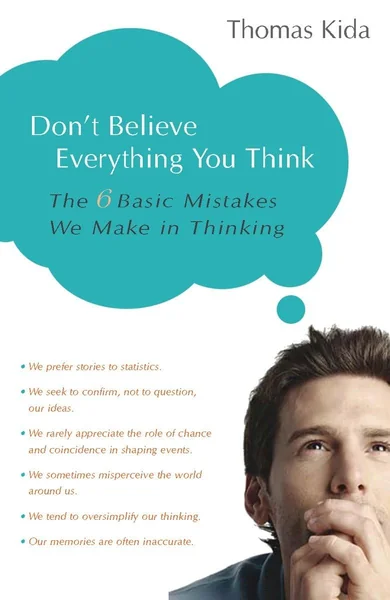
Is Don't Believe Everything You Think worth reading? If you've ever wondered why smart people make terrible decisions or why your own reasoning sometimes leads you astray, Thomas E. Kida's exploration of cognitive errors might be exactly what you need. This isn't just another pop psychology book promising easy answers—it's a rigorous examination of the systematic ways our minds deceive us.
Unlike Thinking, Fast and Slow or Predictably Irrational, which focus heavily on behavioral economics, Kida takes a broader approach to thinking errors. His background allows him to dissect everything from everyday decision-making blunders to the kind of logical fallacies that derail entire organizations.
The Six Fundamental Flaws in Human Reasoning
Kida structures his analysis around six core mistakes that plague human thinking. Rather than overwhelming readers with dozens of cognitive biases, he focuses on the most pervasive errors: our tendency to prefer stories over statistics, our attraction to confirming evidence while ignoring contradictions, and our inability to think probabilistically about uncertainty.
The strength of this framework lies in its practical focus. Where academic psychology might get lost in experimental details, Kida connects each thinking error to real-world consequences. He demonstrates how these mental shortcuts that once helped humans survive now sabotage us in modern contexts requiring careful analysis and probabilistic reasoning.
The coverage feels comprehensive without being encyclopedic. Each mistake gets thorough treatment with concrete examples drawn from business disasters, medical misdiagnoses, and personal financial decisions gone wrong.
Kida's Analytical Approach
The author's methodology sets this book apart from purely anecdotal treatments of cognitive bias. Rather than relying solely on colorful stories, Kida builds his arguments systematically, explaining both the psychological mechanisms behind each error and the evolutionary reasons these thinking patterns developed.
His writing strikes an effective balance between accessibility and intellectual rigor. Complex psychological concepts get explained clearly without oversimplification, and the prose maintains momentum even when tackling dense material about probability theory and statistical reasoning.
Where this approach particularly shines is in Kida's treatment of confirmation bias. Instead of simply warning readers about cherry-picking evidence, he provides frameworks for actively seeking disconfirming information and structuring decisions to counteract this natural tendency.
Practical Applications and Real-World Impact
The book's emphasis on actionable advice distinguishes it from purely theoretical discussions of cognitive psychology. Kida doesn't just diagnose thinking problems—he provides specific strategies for improving reasoning in professional and personal contexts.
His recommendations range from simple techniques like deliberately seeking contradictory evidence to more sophisticated approaches for handling uncertainty and probability. The medical and business examples feel particularly valuable, showing how systematic thinking errors contribute to professional disasters that could have been avoided.
For readers struggling with decision-making, the practical exercises embedded throughout each chapter provide genuine value. These aren't superficial self-help activities but thoughtful applications of psychological research to everyday reasoning challenges.
The Research Foundation and Evidence Quality
Kida's analysis rests on solid psychological research, drawing from decades of studies in cognitive science and behavioral psychology. The book cites relevant experiments without getting bogged down in academic minutiae, and the author demonstrates familiarity with both classic studies and more recent findings.
However, the research landscape around cognitive bias has evolved significantly since the book's 2006 publication. Some findings that seemed definitive then have been subject to replication challenges, and new research has added nuance to our understanding of when and why these thinking errors occur.
The evidence presentation feels trustworthy even if some specific claims might benefit from updating. Kida avoids the common trap of overstating research conclusions while still making clear, practical recommendations based on the best available evidence.
Where the Analysis Falls Short
Despite its strengths, the book suffers from several limitations that prevent it from being the definitive guide to thinking errors. The most significant weakness lies in its treatment of individual differences—Kida writes as though all people make these mistakes equally, ignoring research showing that education, expertise, and personality factors significantly influence susceptibility to various cognitive biases.
The cultural assumptions also feel dated. Many examples draw from American business and medical contexts without acknowledging how different cultural backgrounds might influence both the prevalence and expression of these thinking errors.
The book also oversells the effectiveness of awareness as a solution. While understanding cognitive biases certainly helps, research has consistently shown that simply knowing about thinking errors doesn't reliably prevent them. Kida acknowledges this briefly but doesn't fully grapple with the implications for his practical recommendations.
A Valuable but Imperfect Guide to Better Thinking
Don't Believe Everything You Think succeeds as an introduction to systematic thinking errors and provides genuinely useful strategies for improving reasoning. The six-mistake framework offers a memorable structure for understanding cognitive bias, and Kida's practical approach makes complex psychological research accessible to general readers.
The bottom line: This book works best as a starting point for readers new to cognitive psychology who want practical tools for better decision-making. The content remains valuable despite its age, though readers interested in the latest research should supplement it with more recent works. If you're looking for research-backed strategies to improve your reasoning and avoid common mental traps, Kida delivers solid guidance grounded in psychological science.
Where to Buy
You can find Don't Believe Everything You Think at Amazon, your local bookstore, or through most major online retailers.