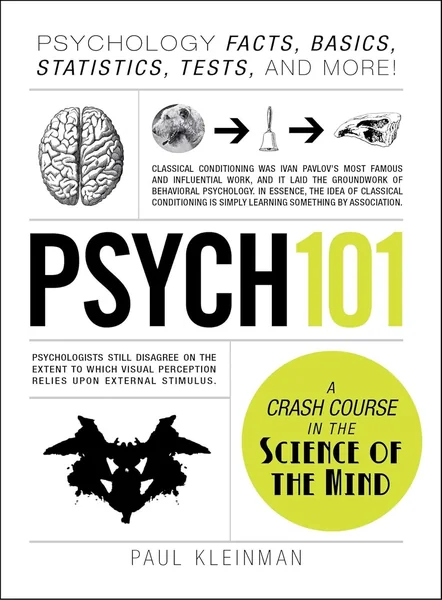
A Beginner's Gateway to Psychology
Is Psych 101 worth reading for someone new to psychology? Paul Kleinman's entry in the Adams 101 Series promises to make psychology accessible through bite-sized explanations of core concepts, famous experiments, and statistical basics. The book's colorful brain-themed cover immediately signals its approachable intent, positioning itself as a friendly introduction rather than an intimidating academic text.
Kleinman structures the material around digestible chunks that mirror how psychology is actually taught in introductory courses. Rather than diving deep into any single area, he provides a survey approach that touches on cognitive psychology, behavioral theories, developmental stages, and research methods. This breadth-over-depth strategy makes sense for readers who want to understand what psychology encompasses before committing to more specialized study.
The writing style stays conversational throughout, avoiding the dense jargon that can make psychology textbooks feel impenetrable. Kleinman explains concepts like classical conditioning and cognitive dissonance using everyday examples that stick in memory. For absolute beginners, this accessibility proves invaluable in building foundational understanding.
Breaking Down Complex Theories
Where Kleinman succeeds most is in his ability to distill complex psychological theories into understandable explanations. He tackles major schools of thought – from Freudian psychoanalysis to modern cognitive behavioral approaches – without getting bogged down in academic debates. The book covers landmark experiments like Milgram's obedience studies and Pavlov's dogs, providing historical context that helps readers understand how psychological knowledge developed.
The statistical section deserves particular praise for making research methods comprehensible to non-academic readers. Psychology students struggling with research design will find the explanations of correlation versus causation, sampling methods, and basic statistical concepts genuinely helpful. Kleinman avoids the mathematical complexity that intimidates many readers while still conveying why statistical literacy matters in psychology.
However, the simplified approach sometimes sacrifices nuance. Complex debates within the field get reduced to basic explanations that may leave more curious readers wanting deeper exploration. The book works better as a starting point than a comprehensive resource.
Practical Applications and Real-World Connections
Unlike most introductory psychology books, Kleinman consistently connects theoretical concepts to everyday situations. He explains how understanding cognitive biases can improve decision-making, how knowledge of memory formation aids in studying, and how awareness of social psychology principles helps navigate relationships and workplace dynamics.
The book includes practical exercises and self-assessment tools that encourage readers to apply concepts to their own experiences. These interactive elements prevent the material from feeling purely academic and help cement understanding through personal relevance. Readers learn about personality theories by taking simplified assessments, and explore perception through optical illusions and thought experiments.
This practical focus makes the book valuable for readers interested in psychology for personal development rather than academic study. The applications feel genuine rather than forced, arising naturally from the material rather than being tacked on as afterthoughts.
Where the Simplicity Shows Its Limits
The book's greatest strength – its accessibility – also creates its primary limitation. The main weakness lies in oversimplification that occasionally borders on misleading. Complex psychological phenomena get reduced to bullet-point summaries that lose important subtleties and ongoing debates within the field.
For example, the discussion of mental health conditions relies heavily on older diagnostic categories without acknowledging how understanding has evolved. The treatment of controversial topics like multiple intelligence theory presents them as settled science when significant debate continues among professionals. More advanced readers may find these omissions frustrating.
The book also shows its age in some references and examples, though the core psychological principles remain relevant. Some sections feel dated in their approach to topics like gender and cultural differences in psychology, reflecting perspectives that have since been refined or challenged.
Worth the Investment for the Right Reader
Should you read Psych 101? The answer depends entirely on your goals and background. For someone with zero psychology knowledge who wants a gentle introduction, Kleinman delivers exactly what he promises. The book succeeds as a gateway text that can spark interest in further study or provide practical insights for personal use.
Readers with some psychology background will likely find the material too basic, though it might serve as a useful refresher or reference. The bottom line is that this works best as a first psychology book rather than a comprehensive resource. It's the psychological equivalent of a survey course – broad coverage designed to help readers discover which areas interest them most.
Students preparing for introductory psychology courses will find it a helpful supplement, though it shouldn't replace a proper textbook. General readers interested in understanding human behavior without academic commitment will appreciate its practical focus and readable style.