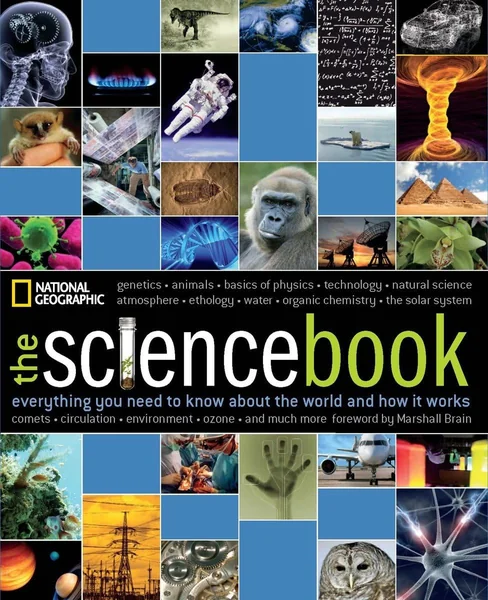
A Visual Feast of Scientific Knowledge
National Geographic's greatest strength lies in their ability to transform complex information into visually compelling content. The Science Book follows this tradition, presenting scientific concepts through a carefully curated blend of photographs, illustrations, and infographics. The publication employs their signature style of breaking down intimidating subjects into digestible segments.
The book's approach differs significantly from traditional science textbooks. Rather than following a linear progression through specific disciplines, it organizes information thematically. This structure allows readers to jump between topics based on interest rather than following a prescribed educational sequence.
Perfect for visual learners, the content relies heavily on diagrams and illustrations to explain phenomena ranging from cellular processes to astronomical events. The design philosophy clearly prioritizes accessibility over academic depth, making scientific principles comprehensible to readers without extensive background knowledge.
Comprehensive Coverage Across Disciplines
The scope of topics covered is genuinely impressive. The book tackles physics, chemistry, biology, earth sciences, and space exploration with equal attention. Each section provides foundational knowledge while highlighting current scientific understanding and recent discoveries.
What sets this publication apart from other science overviews is its integration of cutting-edge research with established principles. The content acknowledges that science is an evolving field, presenting current theories while noting where knowledge continues to develop. This approach gives readers a realistic sense of how scientific understanding progresses.
Research-backed explanations draw from peer-reviewed sources, though the book prioritizes clarity over citations. The writing assumes an intelligent but non-specialist audience, explaining technical concepts without drowning readers in jargon or mathematical formulas.
Where Depth Meets Accessibility
National Geographic faces the inherent challenge of balancing comprehensiveness with readability. The Science Book succeeds in making complex topics approachable, but this accessibility comes with trade-offs. The main weakness lies in the necessarily superficial treatment of many subjects.
Readers seeking deep dives into specific scientific areas may find the coverage frustratingly brief. The book excels as an introduction or reference guide but cannot replace specialized texts for serious study. Topics that deserve entire books receive only pages or sections.
The writing style maintains National Geographic's characteristic enthusiasm for discovery, though it occasionally veers toward oversimplification. Complex controversies in scientific fields receive minimal attention, potentially giving readers an overly neat impression of scientific consensus.
A Family-Friendly Science Resource
Ideal for families with curious children and adults, this book works well as a shared learning experience. The visual presentation engages younger readers while providing enough substance to satisfy adult curiosity. Parents seeking to encourage scientific literacy will find it a valuable household reference.
The book's organization supports casual browsing as effectively as focused research. Topics are cross-referenced, allowing readers to follow connections between different scientific disciplines. This interconnected approach helps readers understand science as a unified endeavor rather than isolated subjects.
For readers who want a single volume that covers scientific fundamentals without requiring prior expertise, The Science Book delivers effectively. However, those with specific scientific interests would benefit more from dedicated books in their areas of focus.
Our Take
The Science Book represents National Geographic's visual storytelling expertise applied to scientific education. While it cannot match the depth of specialized texts, it succeeds admirably as an accessible introduction to scientific knowledge. Highly recommended for households wanting a quality science reference, educators seeking visual aids, and curious readers preferring illustrated explanations to dense academic prose.
Not recommended for readers seeking advanced scientific analysis or those who prefer purely text-based learning. The emphasis on visual presentation may not appeal to all learning styles, and the broad scope means no topic receives truly comprehensive treatment.