The Core Institutional Framework
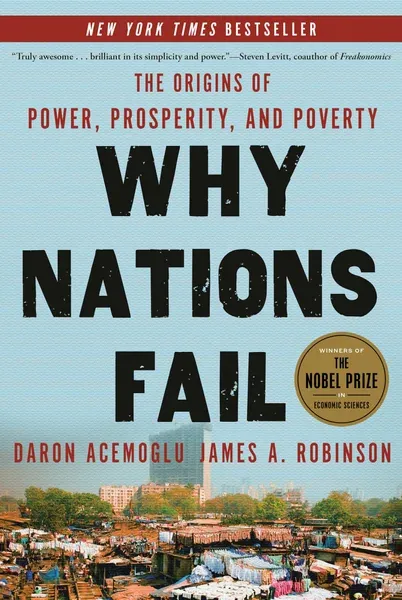
Daron Acemoglu and James A. Robinson construct their argument around a fundamental distinction between extractive and inclusive institutions. Extractive institutions concentrate power and wealth in the hands of elites, creating systems designed to benefit the few at the expense of the many. These might include plantation economies built on slave labor, monopolistic trading companies, or authoritarian regimes that stifle innovation and entrepreneurship.
Inclusive institutions, by contrast, provide broad-based property rights, equal access to education and economic opportunities, and constraints on executive power. The authors argue these create positive feedback loops: secure property rights encourage investment, competitive markets reward innovation, and broad-based growth creates constituencies for further institutional improvement.
This framework allows them to explain why seemingly similar countries—East and West Germany, North and South Korea, or Nogales on either side of the US-Mexico border—can experience dramatically different economic outcomes. The institutional lens cuts across traditional explanations rooted in climate, natural resources, or cultural values.
Historical Evidence and Case Studies
The book's strength lies in its vast historical sweep. Acemoglu and Robinson examine the Roman Empire's decline, the Maya civilization's collapse, and the contrasting colonial strategies in the Americas. They argue that Spanish conquistadors established extractive institutions focused on precious metal extraction, while English settlers in North America developed more inclusive systems that eventually supported broad-based economic growth.
Their analysis of the Industrial Revolution proves particularly compelling. Rather than treating technological innovation as exogenous, they show how Britain's inclusive institutions—relatively secure property rights, patent systems, and competitive markets—created incentives for sustained innovation. Meanwhile, countries like China and the Ottoman Empire, despite possessing superior technology and resources, failed to sustain growth because extractive institutions discouraged the creative destruction necessary for continued progress.
The authors also tackle more recent examples, examining why some post-colonial nations prospered while others stagnated. Their comparison of Botswana's success with other African countries highlights how leadership choices in building inclusive institutions can overcome seemingly insurmountable geographic and historical disadvantages.
The Methodology and Academic Rigor
As academic economists, Daron Acemoglu and James A. Robinson bring serious analytical firepower to their argument. They engage extensively with competing theories, from Jeffrey Sachs's geography hypothesis to cultural explanations for development differences. Their use of natural experiments—situations where similar populations face different institutional arrangements—provides compelling evidence for institutional causation rather than mere correlation.
The Acemoglu Robinson book draws on the authors' previous academic work, including influential papers on colonial origins of comparative development. They present complex econometric evidence in accessible language, though readers should expect detailed discussions of statistical methodology and historical data analysis.
However, the academic rigor sometimes creates accessibility challenges. The book assumes familiarity with economic concepts and historical periods that may challenge general readers. The density of historical examples, while impressive, can overwhelm the central argument at times.
Strengths and Notable Limitations
The institutional framework provides genuine explanatory power for global development patterns. Unlike monocausal theories that reduce complex historical processes to single factors, Acemoglu and Robinson acknowledge the interactive effects between economic and political institutions while maintaining analytical clarity.
Their historical range is genuinely impressive, spanning millennia and continents to build their case. The book succeeds in showing how institutional arrangements persist over centuries, creating path dependencies that shape contemporary outcomes.
Yet the framework faces significant limitations. Critics have noted that the extractive-inclusive distinction sometimes obscures more than it illuminates. Many successful developing countries—from South Korea to Singapore—achieved rapid growth under decidedly non-inclusive political systems. The authors acknowledge this but argue these represent transitional arrangements rather than sustainable long-term models.
The book also struggles with the endogeneity problem: if institutions determine outcomes, what determines institutions? While the authors point to critical junctures in history where institutional paths diverge, their explanation for why some societies choose inclusive paths remains incomplete.
Who Should Engage With This Dense Academic Work
Why Nations Fail rewards readers willing to grapple with complex historical arguments and economic reasoning. Students of economics, political science, or development studies will find essential reading that has shaped academic debates for over a decade. Policy makers and development practitioners can benefit from the institutional perspective on why some interventions succeed while others fail.
General readers interested in understanding global inequality will find valuable insights in this development economics book, though they should prepare for academic prose and extensive historical detail. The book works best for those comfortable with economic concepts and curious about long-term historical patterns rather than contemporary policy prescriptions.
The institutional theory has become foundational in development economics, making this essential reading for anyone seeking to understand scholarly debates about global prosperity and poverty. While not without limitations, Daron Acemoglu and James A. Robinson have crafted an influential framework that continues to shape how economists and political scientists think about the deep roots of national success and failure.