
7 min read
4.6
· 133 Amazon ratingsShare This Review

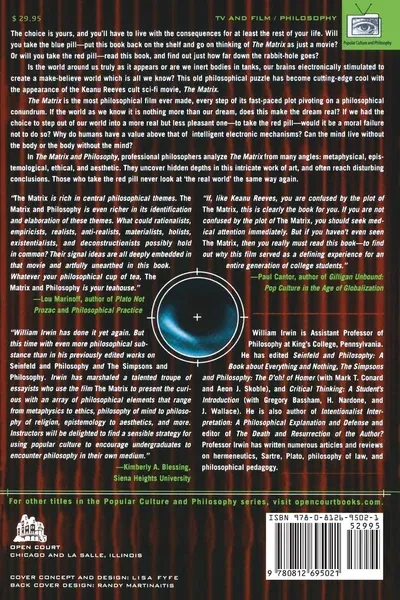
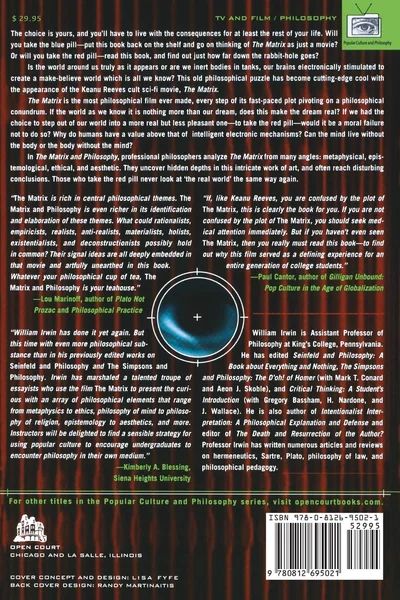
The Matrix and Philosophy: Welcome to the Desert of the Real by William Irwin Review: A Rigorous Pop-Culture Philosophy Anthology
Edited by William Irwin and published by Open Court in 2002, this anthology marshals a team of academic philosophers to probe the deepest questions raised by the Wachowskis' landmark film — from Cartesian skepticism and Platonic allegory to questions of mind, matter, fate, and existential authenticity — making it a substantial entry point for readers who want rigorous philosophical engagement with popular cinema.
 Tap to enlarge
LuvemBooks Verdict
Best for
Philosophy-curious readers who want a rigorous, multi-perspective introduction to Western philosophical traditions — epistemology, metaphysics, ethics, existentialism — organised around a film they already know and care about.
Worth it if
Worth engaging with if you're an undergraduate philosophy student, a self-directed reader willing to be stretched, or a fan of the original 1999 film who wants genuine philosophical depth rather than a light fan-companion read.
Skip if
Skip it if you come to it primarily as a franchise fan expecting coverage of the sequels, have no prior philosophy background and want something entirely accessible, or prefer a single sustained argument over an episodic anthology.
What readers & critics say
Readers at berniegourley.com awarded the collection four out of five stars, noting that — as expected of twenty essays squeezing philosophy out of a two-hour film — quality varies across chapters. AbeBooks' editorial summary, drawing on publisher copy, describes the book's tacit goal as making philosophy fun for general readers through pop-culture reference points, while cautioning that some articles contain "rather dense philosophical jargon" even as most are pitched at the level of a freshman introductory course. ThriftBooks reader reviews single it out as the best of Irwin's early pop-culture-and-philosophy volumes, recommending it explicitly to students, teachers, and the philosophically curious alike.
Sources: berniegourley.com, abebooks.com, thriftbooks.comAge & Reading Level
Recommended age
Adult
Reading level
Adult
who it suits
Skip if you want a single unified philosophical argument or a fan guide that covers the full Matrix franchise.
In This Review
- What Works & What Doesn't
- What the Book Actually Is and Contains
- The Central Philosophical Argument and Its Film Grounding
- Significance and Place in the Series
- Genuine Strengths
- Limitations and Who May Find It Frustrating
What Works & What Doesn't
What Works
- Broad philosophical range: essays draw on Plato, Descartes, Kant, Sartre, and philosophy of mind, offering a genuine survey of Western thought organized around a shared cultural text
- Strong scholarly apparatus — bibliographical references and a full index — elevates it above lighter pop-philosophy titles and supports further independent study
- William Irwin's framing essay anchors the collection in the Platonic allegory of the cave, giving the anthology a coherent intellectual through-line
- Published at a culturally resonant moment in 2002, the volume engages the original film's philosophical questions before the franchise's later installments shifted the conversation
- Multi-contributor format brings distinct academic voices to bear on epistemology, metaphysics, ethics, existentialism, and nihilism — avoiding a single-perspective echo chamber
What Doesn't
- As an anthology, consistency of depth and argumentative rigor varies across contributors, making the reading experience episodic rather than cumulative
- Essays drawing on Kant and technical philosophy-of-mind debates may prove more demanding than the pop-culture framing suggests, potentially frustrating readers with no prior philosophy background
- The volume engages exclusively with the 1999 original film, offering no philosophical framework for readers who come to it through the broader franchise
- The format does not build toward a single synthesized conclusion, which may leave readers who prefer a unified argument unsatisfied
What the Book Actually Is and Contains
The Central Philosophical Argument and Its Film Grounding
Significance and Place in the Series
Genuine Strengths
Limitations and Who May Find It Frustrating
Frequently Asked Questions
Sources & Further Reading
The key facts and claims in this review are grounded in the retrieved, verified sources listed below.
- Cited in this review
- 1
- 2
- 3
- 4
- Further reading
- 5
William Irwin, Wikipedia
- 6
- 7
Related Reviews
Reviews of books we picked for readers who enjoyed The Matrix and Philosophy.



Reader Comments
No comments yet
Be the first to share your thoughts!