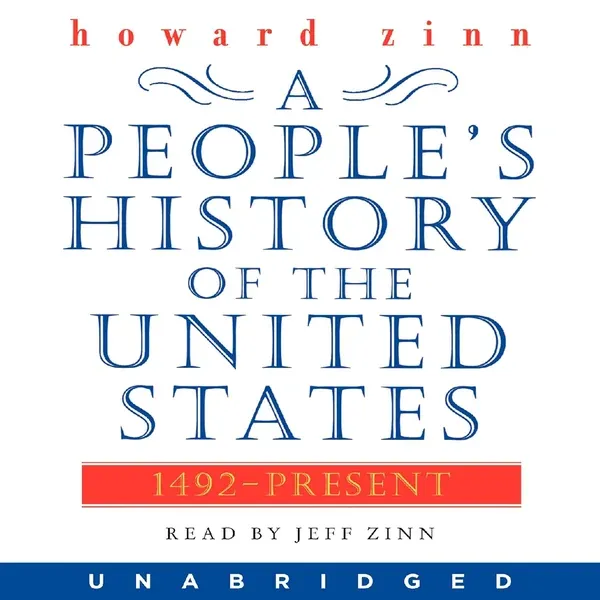
Is A People's History of the United States worth reading despite the controversy? Howard Zinn's groundbreaking 1980 work fundamentally challenges how Americans understand their past. Rather than focusing on presidents, generals, and founding fathers, Zinn deliberately amplifies voices that traditional textbooks silence: enslaved people, factory workers, women fighting for suffrage, and indigenous communities resisting colonization.
This isn't your typical high school history textbook. Zinn, a historian and political scientist, openly rejected what he called "fundamental nationalist glorification of country." Instead, he presents American history as a continuous struggle between ordinary people and elite power structures. The result is both illuminating and polarizing—a book that has sparked classroom debates and legislative battles for over four decades.
Readers familiar with Lies My Teacher Told Me by James Loewen will recognize similar themes of historical myth-busting, though Zinn takes a more explicitly activist approach to his scholarship.
Zinn's Radical Methodology
Zinn's approach represents a conscious departure from traditional historical narrative. Where conventional histories might dedicate chapters to presidential administrations or major wars, Zinn organizes his account around class conflict and social movements. He draws extensively from diaries, letters, newspapers, and government documents—but interprets them through a lens that consistently favors the oppressed over the oppressor.
The author's background as both scholar and activist infuses every page. Zinn participated in the civil rights movement and protested the Vietnam War, experiences that clearly shaped his historical perspective. He doesn't pretend to objectivity; instead, he argues that all history is biased and historians should be transparent about their viewpoint.
This methodology produces compelling revelations about familiar events. The American Revolution becomes not just a fight for independence, but a conflict where wealthy colonists manipulated working-class grievances for their own benefit. The Civil War emerges as a complex struggle where even Lincoln's administration prioritized preserving the Union over ending slavery until political necessity demanded otherwise.
Key Figures in America's Hidden History
Rather than the usual parade of presidents and generals, Zinn spotlights figures typically relegated to footnotes. Native American leaders like Tecumseh and Black Hawk appear not as obstacles to progress, but as defenders of their people against genocidal policies. Labor organizers like Mother Jones and Eugene Debs receive the same detailed treatment usually reserved for industrialists like Carnegie or Rockefeller.
Zinn particularly excels at revealing how ordinary people shaped historical moments. During the Great Depression, he doesn't just chronicle New Deal policies—he documents sit-down strikes, rent protests, and unemployed councils that pressured Roosevelt's administration into action. The real protagonists of American history, in Zinn's telling, are collective movements rather than individual leaders.
Women's stories permeate the narrative in ways that feel integral rather than tokenistic. From Anne Hutchinson challenging Puritan authority to the Lowell mill girls organizing America's first industrial strikes, Zinn demonstrates how women consistently fought for rights and recognition despite systematic exclusion from political power.
America Through the Bottom-Up Lens
The book's central thesis emerges clearly: American progress results from popular struggles, not elite benevolence. When workers gain rights, when minorities achieve equality, when democratic institutions expand—these victories come through grassroots organizing and protest, often against fierce resistance from those in power.
Zinn's treatment of slavery exemplifies this approach. Rather than portraying abolition as the inevitable result of moral progress, he documents how enslaved people themselves resisted bondage through everything from work slowdowns to armed rebellion. The Underground Railroad becomes not just a humanitarian network, but an early form of civil disobedience that helped force the slavery question into national politics.
This perspective fundamentally challenges American exceptionalism. Zinn argues that the United States, like other nations, built its prosperity through exploitation and violence. The difference lies not in America's inherent virtue, but in how successfully its mythology obscures these uncomfortable truths.
The Controversy and the Criticism
Critics have consistently challenged Zinn's work on multiple fronts. Conservative historians argue he cherry-picks evidence to support predetermined conclusions, while some progressive scholars contend he oversimplifies complex historical forces. The most serious criticism involves factual accuracy—several historians have identified errors and questionable interpretations in Zinn's account.
The main weakness involves Zinn's tendency to present complex historical actors as either heroes or villains. His portrayal of figures like Christopher Columbus or Andrew Jackson veers toward caricature, potentially undermining his otherwise powerful arguments about structural inequality. Additionally, some chapters feel repetitive, as if Zinn is making the same point about elite manipulation across different time periods.
More problematically, critics argue that Zinn's approach can lead to historical nihilism. If American institutions are fundamentally corrupt and American progress merely illusory, what hope exists for meaningful reform? Zinn addresses this concern by highlighting successful popular movements, but his overwhelmingly dark view of American power structures can feel paralyzing rather than empowering.
Worth the Intellectual Investment?
Despite its limitations, A People's History serves an essential function in American historical education. For readers raised on traditional narratives, Zinn's perspective provides necessary corrective balance. The book succeeds brilliantly at humanizing historical victims and revealing the agency of supposedly powerless groups.
The writing remains accessible throughout, avoiding academic jargon while maintaining analytical rigor. Zinn's journalist background serves him well—he knows how to craft compelling narratives from historical evidence. This isn't dry academic prose; it's engaged storytelling with a clear moral vision.
The book works best as a supplement rather than a replacement for traditional histories. Readers benefit from understanding both conventional narratives and Zinn's alternative perspective. The tension between these viewpoints creates more sophisticated historical understanding than either approach provides alone.
For educators, the book raises crucial questions about historical methodology and the politics of knowledge. Even readers who reject Zinn's conclusions might appreciate his transparency about bias and his challenge to supposedly neutral scholarship.