BOOKS
Published

Read Time

4 min read

Reader rating

4.8

· 6,755 Amazon ratings
reader ratings, not a LuvemBooks score
Curated & edited by

LuvemBooks Editorial

How we create our reviews →
Share This Review

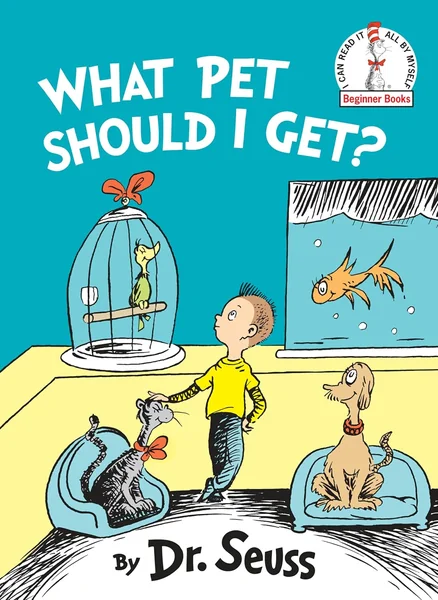
What Pet Should I Get? by Dr. Seuss Review: A Remarkable Posthumous Discovery for Young Readers

What Pet Should I Get? Is a posthumously published Dr. Seuss picture book, originally written between 1958 and 1962, that follows siblings Jay and Kay as they wrestle with an impossible choice inside a pet store — reconstructed from a rediscovered manuscript and published by Random House in July 2015, with a later edition in 2019.
LuvemBooks Verdict

Best for

Seuss fans and parents of early readers (ages 3–6) who want to explore a fascinating piece of literary history and an authentic, if unfinished, addition to the Seuss canon — especially those already familiar with One Fish, Two Fish, Red Fish, Blue Fish.

Worth it if

You're drawn to the remarkable backstory of a posthumously recovered manuscript and want a genuinely Seussian early-reader that connects meaningfully to an existing classic.

Skip if

You're hoping for top-tier, fully polished Seuss — this is a careful reconstruction of an unfinished manuscript, not a revised final work, and its pet-shop-as-shopping premise will feel dated to readers attentive to modern attitudes around animal adoption.

The Guardian found the reconstruction "an almost spookily precise addition to the Seuss canon" that slots effortlessly onto the shelf with his other works, while Kirkus Reviews judged it a more satisfying posthumous release than other Seuss publications but ultimately of "more lasting interest to scholars than children." The New York Times praised it as a strong example of Seuss's genius for capturing both the spirit of his times and the timeless mindset of children, though noted it falls short of his very best work.

Out of black-and-white drawings and faded typed rhymes, the team recreated an almost spookily precise addition to the Seuss canon.

The Guardian

Of more lasting interest to scholars than children — a tantalizing glimpse, and a far more satisfying experience than other posthumous Seuss publications.

Kirkus Reviews

Shows Dr. Seuss's particular genius for distilling both the spirit of his times and the timeless mind-set of children.

nytimes.com
Sources: The Guardian, Kirkus Reviews, nytimes.com
4.8from 6,755 Amazon ratings— reader ratings, not a LuvemBooks score
In This Review
  • What Works & What Doesn't
  • What the Book Is and What It Contains
  • The Remarkable Story Behind Its Discovery
  • Its Significance in the Seuss Canon
  • Strengths: Authentic Seussian Voice and Reception
  • Genuine Limitations to Consider

What Works & What Doesn't

What Works
  • A genuine literary discovery — reconstructed from a manuscript Seuss wrote between 1958 and 1962, offering an authentic addition to his body of work
  • Features familiar characters Jay and Kay from the beloved 1960 classic One Fish, Two Fish, Red Fish, Blue Fish, giving the story a satisfying connection to the broader Seuss canon
  • Critical coverage critic Maria Russo praised it as a strong example of Seuss's genius for capturing both the era and the timeless mindset of children
  • The central dilemma — choosing just one pet under time pressure — draws directly on a universal childhood experience that resonates with the target age group of 3–6
What Doesn't
  • The pet-store shopping premise is dated by contemporary standards; as critics noted, treating animals as interchangeable commodities clashes with modern adoption norms
  • As an unfinished manuscript never fully revised by Seuss himself, published reviews placed it below his top-tier work — it is a remarkable recovery rather than a polished final creation
A genuinely extraordinary publishing event, What Pet Should I Get? offers Seuss fans a rare window into a lost chapter of one of children's literature's most beloved canons.

What the Book Is and What It Contains

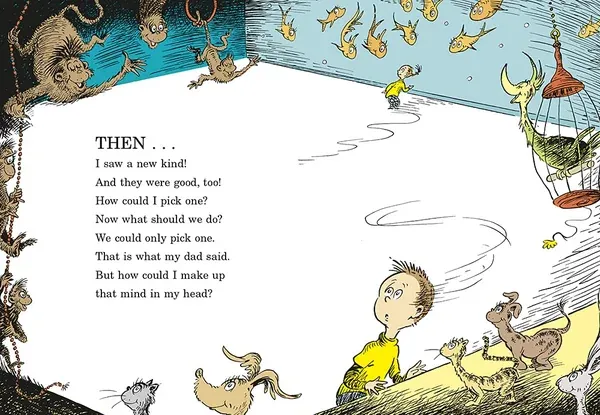
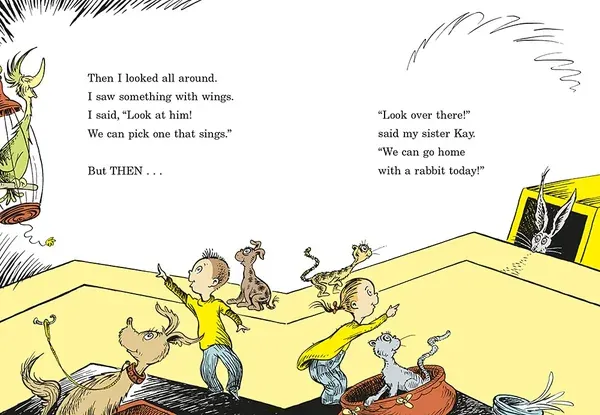
Interior spread showing children in yellow clothing discovering various animals, illustrating the decision-making process of choosing pets.
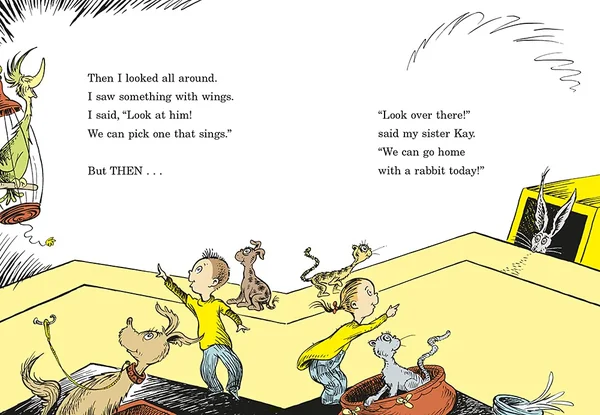
What Pet Should I Get? is a Dr. Seuss picture book aimed at early readers ages three to six. It follows Jay and Kay — the same brother-and-sister duo who appear in Seuss's classic One Fish, Two Fish, Red Fish, Blue Fish — on a visit to a pet store where they must choose just one pet before the clock strikes noon. As Wikipedia's entry on the book notes, the pair consider a vast array of possible animals, building to a deadline-driven tension before ultimately settling on a choice whose identity is left tantalizingly unrevealed. The story is structured as a classic Seussian dilemma: the simple, universal childhood experience of wanting everything and having to pick only one thing.
a very good example of his particular genius for distilling both the spirit of his times and the timeless mind-set of children

The Remarkable Story Behind Its Discovery

The book's backstory is as compelling as its contents. After Theodor Seuss Geisel died in 1991, his wife Audrey Geisel and assistant Claudia Prescott eventually sorted through his papers, donating the bulk of his archive to the University of California, San Diego. A small box of unfinished material was set aside rather than donated, and it was not until October 2013 that Geisel and Prescott examined those remaining items closely. Among them — alongside alphabet flash card illustrations and a folder Seuss himself had labeled "Noble Failures" — was the most complete project in the box: a manuscript called The Pet Shop, comprising 16 illustrations and accompanying typed text. Cathy Goldsmith, a Random House associate publishing director who had served as art director on the previous six Seuss books and is reportedly the last Random House executive to have worked directly with Seuss, authenticated the manuscript and dated it to between 1958 and 1962, partly on the basis of the Jay and Kay characters matching those in One Fish, Two Fish. Goldsmith then reconstructed the manuscript for publication and colored the original black-and-white illustrations, and Random House published it in July 2015 as What Pet Should I Get?
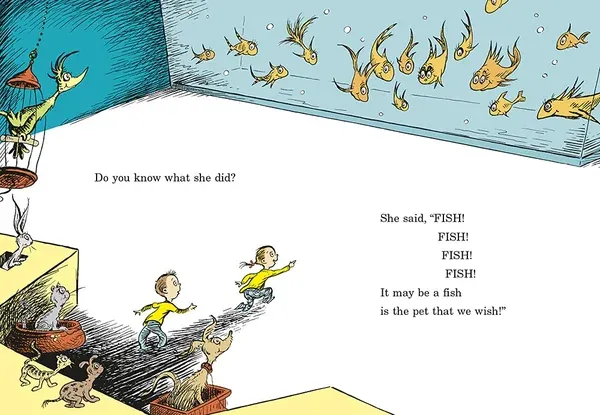
Interior spread showing children discovering a fish in water, with text about choosing it as a pet.

Its Significance in the Seuss Canon

The book's place in Seuss's body of work is genuinely fascinating. Wikipedia's account raises the possibility that Seuss may have conceived The Pet Shop before One Fish, Two Fish, Red Fish, Blue Fish, later deciding to use Jay and Kay in a less narrative-structured book instead. Whether or not that sequence holds, the connection between the two books gives What Pet Should I Get? a retroactive depth for readers already familiar with the 1960 classic — it functions both as a standalone early reader and as an unofficial companion to one of Seuss's most enduring titles. As part of the Classic Seuss and Beginner Books series published by Random House Books for Young Readers, the book sits squarely within the tradition Seuss built across decades.

Strengths: Authentic Seussian Voice and Reception

Critical coverage critic Maria Russo gave the book a largely positive review, describing it as "a very good example of his particular genius for distilling both the spirit of his times and the timeless mind-set of children" — a measured but meaningful endorsement from a major outlet. That the reconstructed text reads as authentically Seussian is itself a tribute to both the quality of the original manuscript and the careful work of Goldsmith's reconstruction. For families with young children in the target reading age range, the central tension — wanting every pet but being allowed only one — maps directly onto experiences children know well, which has been a hallmark of Seuss's appeal since the earliest Beginner Books.

Genuine Limitations to Consider

The book does carry a specific limitation that some readers and critics have noted. Critics observed that the pet-store premise — treating animals as items to be browsed and selected — is "thoroughly outmoded," and that the framing of pets as interchangeable commodities clashes with contemporary attitudes toward animal adoption. Random House's own edition addresses this directly with a publisher's note encouraging children to find pets at shelters, but as The Guardian pointed out, that earnest caveat sits in some tension with Seuss's characteristically anarchic spirit. Russo's critical coverage review also drew a mild distinction, noting the book is "if not top-flight Seuss" — suggesting that even admirers place it a step below his very best work, as one would expect of a manuscript that was never fully finished or revised by its author. Readers approaching it as a polished, author-approved final work should calibrate their expectations accordingly: this is a remarkable recovery, not a rediscovered masterpiece on the level of The Cat in the Hat.

Sources & Further Reading

The key facts and claims in this review are grounded in the retrieved, verified sources listed below.

  1. Cited in this review
  2. 1
  3. 2
  4. 3
  5. 4
  6. Further reading
  7. 5
    Dr. Seuss — author profileHigh-authority source

    Dr. Seuss, Wikipedia

  8. 6
  9. 7
  10. 8
  11. 9
  12. 10
  13. 11