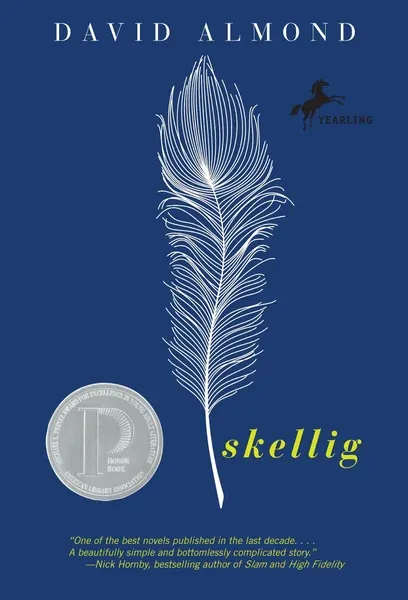
Skellig by David Almond Review: Right for Middle Graders?
David Almond's Skellig earned the Carnegie Medal and Whitbread Children's Book of the Year for good reason—this isn't your typical middle-grade fantasy. Published in 1998, this haunting novel blends magical realism with profound themes of mortality, transformation, and hope. For parents wondering if Skellig is appropriate for middle grade readers, the answer depends on your child's emotional maturity and comfort with darker themes. Like Bridge to Terabithia or A Monster Calls, this book doesn't shy away from life's difficult questions.
The story follows ten-year-old Michael, whose family moves into a dilapidated house while his newborn sister fights for her life in the hospital. In the crumbling garage, Michael discovers Skellig—a mysterious, owl-like creature who might be angel, might be man, and might be something else entirely. With help from his home-schooled neighbor Mina, who introduces him to William Blake's mystical poetry, Michael embarks on a journey that challenges everything he understands about life, death, and transformation.
A Story Built on Blake's Mystical Foundation
Almond weaves William Blake's poetry and philosophy throughout Skellig with remarkable sophistication. Mina, Michael's unconventional neighbor, serves as both guide and catalyst, sharing Blake's poems about angels, tigers, and the intersection of innocence and experience. The famous lines "How do you know but ev'ry Bird that cuts the airy way, Is an immense world of delight, clos'd by your senses five?" become more than literary decoration—they're the philosophical heart of the novel.
This isn't surface-level name-dropping. Almond uses Blake's vision of transformation and spiritual awakening to structure his entire narrative. The garage where Skellig dwells becomes a liminal space between worlds, much like Blake's own artistic vision that saw eternity in everyday moments. Teachers often appreciate how naturally the book introduces young readers to serious poetry without feeling like a literature lesson.
The Uncomfortable Beauty of Mortality
What sets Skellig apart from typical middle-grade fantasy is its unflinching examination of death and vulnerability. Michael's baby sister hovers between life and death throughout the novel, creating genuine tension that isn't neatly resolved with magical solutions. Skellig himself embodies this fragility—he's neither fully alive nor dead, existing in a state of beautiful decay that mirrors the crumbling house and Michael's emotional state.
Almond refuses to offer easy answers about suffering or divine intervention. Instead, he presents transformation as a messy, uncertain process that requires both courage and acceptance. The novel's handling of mortality feels honest rather than traumatic, but parents should know that death is a central presence throughout the story. Children who've experienced loss in their families often find Skellig particularly meaningful, though it might also trigger difficult emotions.
Michael and Mina's Authentic Friendship
The relationship between Michael and Mina anchors the novel's emotional authenticity. Mina isn't just the quirky girl next door—she's a fully realized character whose home-schooling allows Almond to explore alternative approaches to learning and creativity. Her mother's decision to educate her at home feels organic to the story rather than politically motivated, and her deep knowledge of Blake's poetry emerges naturally from her unconventional education.
Michael's character development feels genuine as he struggles with fear for his sister, resentment about the family's upheaval, and confusion about Skellig's true nature. His interactions with other characters help reveal his growth throughout the story, showing how his extraordinary experience shapes his understanding of the world.
Magical Realism That Respects Young Readers
David Almond's approach to fantasy elements demonstrates remarkable restraint and sophistication. Skellig never fully explains himself—he might be an angel, an evolutionary throwback, or something else entirely. This ambiguity elevates the novel above typical fantasy fare, asking readers to grapple with uncertainty rather than providing clear-cut magical rules.
The transformation sequences, where characters literally grow wings and fly, could feel ridiculous in less skilled hands. Almond grounds these moments in emotional truth rather than spectacular effects. The flying scenes become metaphors for transcendence and connection rather than simple wish-fulfillment fantasy.
Literary Craft and Emotional Depth
David Almond's prose achieves that rare quality of being simultaneously accessible to young readers and sophisticated enough for adults. His sentences flow with poetic rhythm without becoming overly ornate, and his pacing allows quiet moments to build emotional resonance. The novel's structure mirrors its themes—like Skellig himself, it occupies a liminal space between realistic fiction and fantasy.
The book's exploration of art, poetry, and creative expression feels integral rather than forced. When Mina shares Blake's artwork or discusses the importance of really seeing the world, these moments illuminate character and theme rather than feeling like educational insertions.
Age Appropriateness and Emotional Readiness
Skellig works best for readers aged 10-14 who can handle complex emotions and ambiguous endings. The novel's 182 pages move quickly, but the themes require emotional sophistication. Children who prefer clear-cut adventures might find the philosophical elements challenging, while those drawn to deeper stories will find it rewarding.
Parents should know that death, illness, and transformation are central themes. The book doesn't traumatize, but it doesn't sugarcoat life's difficulties either. Children dealing with family illness or recent loss might find the story particularly resonant—or potentially overwhelming.
You can find Skellig at most major bookstores or order it through Amazon, where it remains consistently in print more than 25 years after publication.