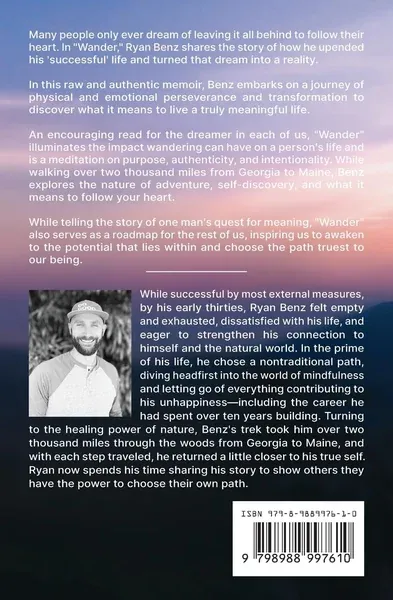
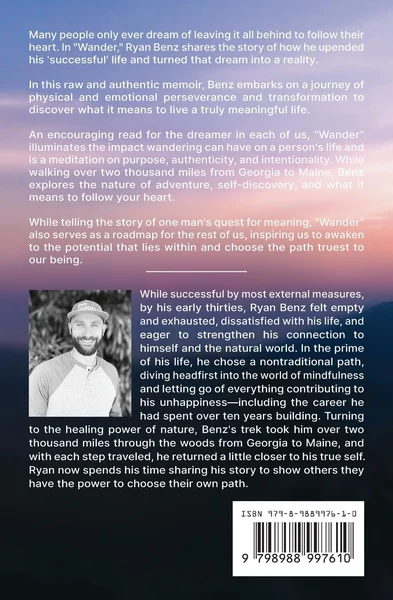
A Journey Born from Crisis
Benz opens with brutal honesty about the life he was living before his walk. The details of his personal and professional breakdown feel authentic rather than manufactured for dramatic effect. Unlike memoirs that romanticize rock-bottom moments, Benz presents his crisis as messy and unglamorous—exactly how such moments actually unfold. His decision to walk from Mexico to Canada isn't portrayed as enlightened; it's described as desperate, which makes the subsequent transformation more credible.
The author's prose style matches his emotional state throughout different phases of the journey. Early chapters feel cramped and anxious, mirroring his pre-walk mindset. As the miles accumulate, his sentences begin to breathe. This isn't accidental—Benz demonstrates genuine skill in using writing technique to mirror psychological change. For readers familiar with hiking memoirs like Wild or A Walk in the Woods, this book offers similar terrain but with a distinctly masculine perspective on vulnerability and transformation.
The Physical and Emotional Landscape
Benz excels at weaving together external landscape with internal terrain. His descriptions of desert solitude, mountain challenges, and small-town encounters serve the larger narrative without becoming travelogue filler. He has an eye for the telling detail—a conversation with a gas station clerk that reveals something essential about human connection, or the way physical exhaustion strips away psychological defenses.
The practical aspects of long-distance walking receive proper attention without overwhelming the memoir's deeper themes. Benz explains gear failures, weather challenges, and the simple logistics of walking thousands of miles, but these details support rather than dominate the emotional journey. Readers interested in the mechanics of such undertakings will find enough information to satisfy curiosity without getting bogged down in equipment lists.
Confronting the Internal Mile Markers
Where Benz distinguishes himself from other transformation memoirs is in his honest examination of what doesn't change through dramatic life experiences. He acknowledges that walking 2,000 miles doesn't magically solve deep-seated patterns or instantly create new ways of being. Instead, he presents the journey as creating space—physical and mental—for different thoughts to emerge.
His exploration of letting go feels earned rather than prescribed. Rather than offering readers a blueprint for their own dramatic life changes, Benz focuses on the small, daily practice of releasing control over outcomes. This approach makes the memoir valuable for readers who aren't planning their own cross-country walks but are interested in the psychological mechanics of major life transitions.
Where the Trail Gets Rocky
The memoir's structure occasionally mirrors the monotony Benz experiences on long stretches of trail—some sections feel repetitive, particularly in the middle portions where daily routines begin to dominate. While this may be authentic to the walking experience, it occasionally tests reader patience.
Benz also struggles with the inherent privilege question that haunts many "quit everything and find yourself" narratives. He addresses this concern but not deeply enough to fully resolve the tension. Readers looking for social consciousness alongside personal transformation may find this aspect underdeveloped.
The ending, while satisfying, arrives somewhat abruptly. After 2,000 miles of gradual change, the conclusion feels compressed. Benz could have devoted more attention to the integration period—how insights from the trail translate into daily life back home.
Worth the Emotional Investment
Wander works best for readers seeking authentic reflection on major life transitions rather than those wanting adventure thrills or step-by-step transformation guidance. Benz writes with the hard-won wisdom of someone who has genuinely wrestled with questions of meaning and purpose. His solutions aren't universally applicable, but his process of questioning is.
The memoir succeeds because it avoids both cynicism and naive optimism. Benz presents his journey as significant without claiming it as universally transformative. For readers dealing with their own crossroads moments, the book offers companionship rather than answers—which may be exactly what's needed.
The bottom line: This is a thoughtful, well-crafted memoir that treats both physical journey and psychological transformation with appropriate complexity. While it occasionally drags and could dig deeper into certain themes, Benz has created something genuine in a genre often filled with manufactured inspiration.