
In This Article
- What the book argues
- Who is involved and what they have said
- Context and criticism
- What to watch
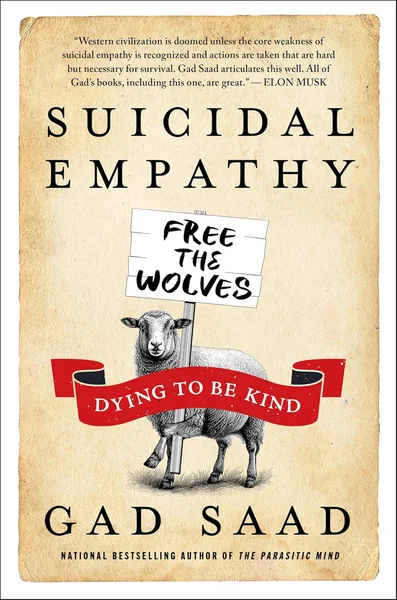
Gad Saad's latest book, Suicidal Empathy: Dying to Be Kind, has attracted high-profile backing from Elon Musk and billionaire investor Bill Ackman — and the endorsements have thrust the Concordia University marketing professor's argument squarely into public debate. As Time reported on May 19, 2026, Musk has said that "suicidal empathy" will "end civilization," while Ackman has also offered public praise for Saad's framework.
The book's central contention — that prioritising compassion over rational self-interest is destroying Western societies — has since circulated across conservative media, left-wing criticism, and mainstream news outlets alike.
What the book argues
Saad coined the term "suicidal empathy" to describe what he calls a pathological and misdirected form of compassion — one in which, according to Wikipedia's entry on the concept, "excessive, misdirected and pathological forms of empathy are claimed to be destructive for the party that exhibits it." In Time's account of the book, Saad frames his targets broadly: open-border immigration policies under both President Biden and Canadian Prime Minister Trudeau, DEI training programmes, soft-on-crime policies, transgender activism, and Canada's universal healthcare system are all cited as examples of empathy gone wrong.
"A society dies when it cares more about exhibiting infinite tolerance and empathy than invoking its survival instinct," Saad writes, as quoted by Time. Saad told Joe Rogan's podcast that he is "not saying that empathy is bad," but that the problem arises when there is "too much of it."
Notably, Time reports that Saad drew on anecdotal examples rather than the academic social-psychology literature on empathy, which he said draws "fine distinctions that are unnecessary for our current treatment."
Who is involved and what they have said
Saad is a professor of marketing at Concordia University in Montreal and a longtime public commentator on evolutionary psychology, previously known for his book The Parasitic Mind. His newest book has attracted endorsements from figures well beyond academia.
Time reports that both Musk and Ackman have "drawn frequent praise" for Saad's ideas — and voz.us notes that venture capitalist Marc Andreessen has also expressed support. The Wikipedia article on suicidal empathy notes that The Wall Street Journal has described Musk and Saad as having a "public bromance," and that Musk's use of the phrase "civilizational suicidal empathy" — deployed in a 2025 interview with Joe Rogan — helped popularise the term before the book's publication.
According to that same entry, Musk has characterised the concept as referring to "weaponized empathy" used to drive political and policy change.
Context and criticism
The phrase has not travelled without controversy. Wikipedia's entry documents that "suicidal empathy" is now commonly used by right-wing commentators and Christian nationalist figures to criticise empathy toward immigrants and racial minorities, and that critics have linked the concept to the Great Replacement conspiracy theory — described there as a "white supremacist conspiracy theory" — given that both posit the imminent destruction of Western societies through immigration.
Writing for The Bulwark, Cathy Young called the phrase "becoming a right-wing buzzword," according to the same Wikipedia source. Pope Francis separately criticised then-Vice President JD Vance in 2025 for invoking the medieval Catholic doctrine of ordo amoris to justify limiting empathy for migrants — a debate that overlaps thematically with Saad's framing, per Wikipedia.
The concept has also been applied outside immigration debates: Scottish commentator Iain Macwhirter used it to critique Britain's net zero energy strategy, arguing the UK was undermining its own industrial base in the name of climate goals.
What to watch
The book's reception is still developing. A National Post interview and a critical review in Jacobin — referenced in earlier reporting on the story — indicate that scrutiny is arriving from multiple directions simultaneously.
MSN's coverage of the Time piece notes that Musk and Ackman view the framework as "a warning against cultural and political self-sabotage," suggesting the billionaires' support is likely to keep the book in political conversation. Whether that translates into sustained policy influence — or whether the backlash from critics linking the concept to far-right ideologies reshapes the public debate — remains to be seen.
For an assessment of the book itself, see our full review.
Frequently Asked Questions
Is Suicidal Empathy: Dying to Be Kind worth buying in 2026?
It depends on your existing familiarity with Saad's work and evolutionary psychology. The book is accessible, fast-paced, and introduces a genuinely useful conceptual framework, earning 3.5 out of 5 stars in our review. However, readers looking for rigorous engagement with counterarguments may find it falls short.
What is the main message of Suicidal Empathy: Dying to Be Kind?
Gad Saad argues that empathy, when applied without rational discrimination, becomes self-destructive — enabling harmful behaviors under the guise of compassion. He draws on evolutionary psychology to suggest that what he calls 'suicidal empathy' weakens individuals and societies over time.
Who should read Suicidal Empathy: Dying to Be Kind?
The book is best suited to readers already sympathetic to evolutionary psychology frameworks or critical of progressive political culture. Those who enjoyed Saad's earlier work, The Parasitic Mind, or books by Jonathan Haidt and Jordan Peterson will find familiar and engaging territory here.
Why are Elon Musk and Bill Ackman promoting Gad Saad's book?
As reported by Time in May 2026, both Musk and Ackman have publicly endorsed Suicidal Empathy: Dying to Be Kind, framing it as a significant work in conservative intellectual circles. Both figures have a history of amplifying books that challenge progressive orthodoxies, lending the book unusual political visibility.
What are the biggest criticisms of Suicidal Empathy: Dying to Be Kind?
Critics, including our own reviewers, note that Saad's rhetorical confidence often outpaces his analytical rigor, and that he rarely engages seriously with counterarguments. The evolutionary psychology framework is also applied too broadly in places, stretching its explanatory power beyond what the evidence supports.
How does Suicidal Empathy: Dying to Be Kind compare to Gad Saad's earlier books?
Suicidal Empathy extends the project Saad began with The Parasitic Mind, applying similar evolutionary and psychological arguments to the specific concept of misdirected compassion. It is considered more focused in scope but shares the same rhetorical style and ideological orientation as his earlier work.

No Discussion Yet
Be the first to share your thoughts on this news article.