

Francis Fukuyama has returned to the public stage with a memoir that doubles as an intellectual reckoning. In the Realm of the Last Man, published by Farrar, Straus and Giroux in September 2026, has generated a sustained wave of critical attention, with reviews appearing in Reason, Quillette, Prospect Magazine, and New York Magazine within weeks of publication. As Reason's October 5 review notes, the memoir finds Fukuyama revisiting his famous end-of-history thesis while grappling with the forces — populism, authoritarianism, and transhumanism — that have strained it in the decades since.
The timing makes the memoir something more than a personal retrospective. Fukuyama's 1989 essay arguing that western liberal democracy represented "the final form of human government" became one of the most cited — and contested — ideas in modern political thought. Now 73, and writing at a moment when, as New York Magazine observed, authoritarian regimes are resurgent and the number of liberal democracies is declining worldwide, Fukuyama is being asked to answer for that thesis in real time. Notably, a 2026 Jacobin interview cited in his Wikipedia entry reports that Fukuyama now describes himself as a "classic social democrat" — a significant ideological reposition that gives the memoir an added charge for readers across the political spectrum.
What Political Order and Political Decay Established — and Why It Still Anchors the Conversation
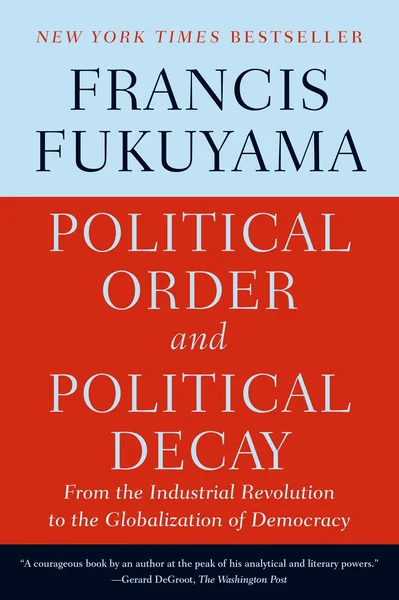
The memoir's reception is inseparable from Fukuyama's body of work, particularly Political Order and Political Decay: From the Industrial Revolution to the Globalization of Democracy, his 2014 study of how state institutions develop — and begin to erode — across different political cultures. The book, the second volume in a landmark series that began with The Origins of Political Order, argued that a functioning modern state requires three pillars held in careful balance: executive state capacity, the rule of law, and democratic accountability. Crucially, Fukuyama warned that liberal democracies were not immune to internal decay — that the very interest groups and bureaucratic rigidities thriving within democratic systems could hollow them out from within. That warning, which struck some readers in 2014 as overly cautious, looks considerably more urgent in 2026.
Among his specific concerns in that work was what he called "repatrimonialization" — the tendency for political systems to revert toward serving narrow elite interests rather than the public good — and the democratic deficit created when policy authority migrates away from elected governments toward technocratic bodies. These are not abstract anxieties. As Wikipedia's summary of the book notes, Fukuyama pointed explicitly to trends in the United States and in European Union governance as examples of accountability eroding at institutional scale. The memoir, by all accounts, revisits this framework through the lens of what has actually transpired since.
A Thinker Re-examined: The Stakes of Fukuyama's Self-Reassessment
What makes the current critical moment distinctive is not merely that Fukuyama is publishing a memoir — it is that the memoir seems designed to do genuine intellectual work rather than simply defend a reputation. Quillette's September 2026 review frames the book as an assessment of why citizens of prosperous liberal democracies turn against the very systems that sustain their prosperity — a question that sits at the direct intersection of the memoir and the political theory Fukuyama developed across his career. Georgetown University Press, which published an earlier Fukuyama retrospective, similarly noted that with populism rising and liberal democracy under pressure, Fukuyama's body of thought demands fresh scrutiny rather than simple reassessment.
For readers coming to his ideas for the first time, Political Order and Political Decay and its predecessor The Origins of Political Order remain the most systematic entry points into his political theory — ambitious in geographical and historical scope, and now directly implicated in the debates the memoir is generating. The critical conversation around In the Realm of the Last Man is, in effect, a referendum on whether the analytical framework built across those books was prescient, incomplete, or both.
Want the full verdict on the political theory that underlies this moment? Read our review of Political Order and Political Decay for a detailed assessment of what the book gets right, where it strains, and whether it holds up as a guide to the present.
Dark
Melancholy
Leisurely
Power & politics
Justice
Frequently Asked Questions
Is Political Order and Political Decay: From the Industrial Revolution to the Globalization of Democracy worth reading in 2026?
It remains one of the most serious and comprehensive analyses of how modern states succeed or fail available in political science. With Fukuyama's new memoir renewing debate over his core theories, readers curious about the intellectual foundation of that debate will find this book essential background. It is particularly valuable for understanding his arguments about institutional decay within liberal democracies.
What is the main argument of Political Order and Political Decay?
Fukuyama argues that a healthy modern state requires three institutions in balance: a capable executive state, the rule of law, and democratic accountability. The book traces how different societies developed these institutions at different times and warns that liberal democracies are vulnerable to internal decay — through interest-group capture, bureaucratic rigidity, and eroding accountability — even when they appear stable.
Who should read Political Order and Political Decay: From the Industrial Revolution to the Globalization of Democracy?
The book is aimed at readers with a serious interest in political history, comparative government, and the future of liberal democracy. It rewards those willing to engage with broad historical sweep and institutional analysis. It is also the logical companion read to Fukuyama's 2026 memoir, In the Realm of the Last Man, which revisits and applies the same theoretical framework.
How does Fukuyama's new memoir relate to Political Order and Political Decay?
In the Realm of the Last Man (FSG, 2026) functions as an intellectual autobiography that explicitly revisits the theories Fukuyama developed across his political theory work, including his analysis of political decay within liberal democracies. Reviewers in Reason, Quillette, and elsewhere have treated the memoir as a direct continuation of — and in some ways a reckoning with — the arguments he made in Political Order and Political Decay.
What has changed in Fukuyama's political views since Political Order and Political Decay was published?
According to a 2026 Jacobin interview noted in his Wikipedia entry, Fukuyama now describes himself as a "classic social democrat" — a notable shift from his earlier positioning. His 2026 memoir, In the Realm of the Last Man, appears to be the fullest account of how his thinking has evolved in response to rising populism, democratic backsliding, and other developments that have tested his earlier optimism about liberal democracy.
Should I read The Origins of Political Order before Political Order and Political Decay?
Political Order and Political Decay is a direct sequel to The Origins of Political Order, which covers the development of political institutions from prehistoric times to the French Revolution. While Political Order and Political Decay can be read on its own, reading the first volume first gives fuller context for Fukuyama's three-pillar framework and enriches the argument of the second book considerably.



No Discussion Yet
Be the first to share your thoughts on this news article.