BOOKS
Published

Read Time

9 min read

Reader rating

4.2

· 125,251 Amazon ratings
reader ratings, not a LuvemBooks score
Curated & edited by

LuvemBooks Editorial

How we create our reviews →
Share This Review

Our review

Yesteryear by Caro Claire Burke Review: A Biting Debut Satire That Stings

Yesteryear is Caro Claire Burke's debut novel about Natalie Heller Mills, a "tradwife" influencer with 8 million followers who wakes one morning to find herself stranded in 1855, forced to live the pre-industrial life she only ever performed online. A #1 New York Times bestseller and GMA Book Club pick, it earns its buzz with a razor-sharp premise that cuts to the core of authenticity, fame, and womanhood.

LuvemBooks Verdict

Best for

Readers who enjoy darkly comedic, socially sharp literary fiction and want a debut that uses a high-concept satirical premise — a tradwife influencer hurled into authentic 1855 domestic life — as a vehicle for probing the performance of femininity, identity, and modern myth-making.

Worth it if

You're drawn to fiction that blends cultural critique with genuine menace and black comedy, and you're willing to sit with sustained narrative ambiguity rather than a genre-neat resolution.

Skip if

You're expecting a straightforward time-travel thriller with a clear-cut answer, or you find satire of influencer culture and tradwife ideology an inherently tiresome or one-sided target — in which case the novel's terrain may feel unrewarding even though critics note it resists simple mockery.

Kirkus Reviews awarded the novel its "Get It" verdict, calling it "a remarkable debut — both a book for the moment and one that will endure." The New York Times, whose own review page was retrieved, described Natalie as "an electric antiheroine" whose "bitterness burns like the lye soap on her fingers" while also noting the novel "doesn't revel in her downfall or dunk on tradwives at large," and confirmed the book had spent six weeks on the Times bestseller list at time of review.

“A remarkable debut — both a book for the moment and one that will endure.”

— Kirkus Reviews

“Natalie is an electric antiheroine… her bitterness burns like the lye soap on her fingers as she scrubs laundry the old-fashioned way.”

— nytimes.com
Sources: Kirkus Reviews, The New York Times, Parade, Ink & Imaginings
4.2from 125,251 Amazon ratings— reader ratings, not a LuvemBooks score
Buy on Amazon

Age & Reading Level

Recommended age

Adult

Reading level

Adult

Content to know about

performative domestic ideology and its critique
physical hardship and period-accurate domestic labor

Skip if you want a genre-clear time-travel thriller with a definitive resolution, or find satire of influencer and tradwife culture tiresome or one-sided.

In This Review
  • What Works & What Doesn't
  • The Premise: A Curated Life, Brutally Uncurated
  • Satirical Ambition and Cultural Targeting
  • Reception: A Genuine Cultural Moment
  • Craft and Character: The Antiheroine Problem
  • Who This Is For — and Where It Challenges

What Works & What Doesn't

What Works
  • #1 New York Times bestseller and GMA Book Club pick with documented cross-platform cultural momentum
  • A razor-sharp satirical premise — a tradwife influencer forced into authentic 1855 domestic life — that operates on multiple levels simultaneously
  • Natalie Heller Mills is praised by critical coverage as 'an electric antiheroine' whose complexity sustains the novel beyond its high-concept hook
  • Blends dark comedy, social critique, and genuine menace in a tonal range the publisher and multiple named authors confirm lands effectively
  • A debut from Caro Claire Burke that announces a distinctive, politically and culturally engaged literary voice
What Doesn't
  • The novel's sustained ambiguity about what has actually happened to Natalie — hoax, time travel, or something else — may frustrate readers who expect a genre-clear resolution
  • Its satirical targets (influencer culture, tradwife ideology) are culturally specific, and readers unsympathetic to that framing may find the novel's terrain less rewarding
Yesteryear is a novel that earns every syllable of its accolades — a darkly funny, shrewdly constructed debut that uses one outrageous premise to interrogate some genuinely uncomfortable truths.
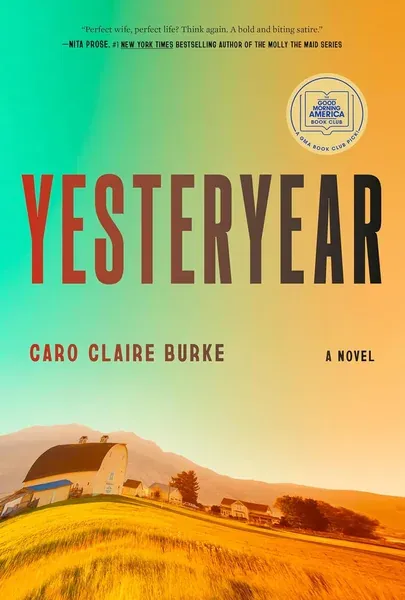
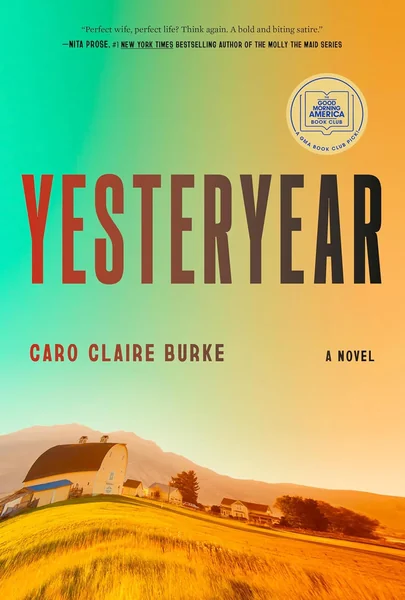
Yesteryear: A GMA Book Club Pick: A Novel by Caro Claire Burke front cover

The Premise: A Curated Life, Brutally Uncurated

Natalie Heller Mills has built an empire on the aesthetics of tradition. Her farmhouse is rustic, her husband is handsome, her six children are delightful, and her 8 million Instagram followers believe every frame of it. Behind the scenes, however, industrial-grade fridges hum behind distressed cabinet doors, nannies manage the children, and her cowboy husband is quietly the heir to a political dynasty. The performance is airtight — until it isn't. One morning Natalie wakes to a kitchen warmed by a sputtering fire, children who are dirty and strange, and a husband whose formerly soft hands have become those of a genuine farmer. The novel's central tension is Natalie's desperate effort to determine what has happened to her: Is she the unwitting star of a ruthless reality show? Has she actually traveled back to 1855? Is this a divine — or diabolical — test? The publisher's synopsis opens with her own voice: "My name was Natalie Heller Mills, and I was perfect at being alive" — a line that captures the black-comic self-mythology Burke constructs and then systematically dismantles.
“bitterness burns like the lye soap on her fingers as she scrubs laundry the old-fashioned way”

Satirical Ambition and Cultural Targeting

Burke, who holds an MFA from the Bennington Writing Seminars and co-hosts the politics-and-culture podcast Diabolical Lies, trained her debut squarely on the intersection of influencer culture, performative domesticity, and the contested meaning of feminism. The "tradwife" phenomenon — in which women publicly embrace traditional gender roles as an aesthetic and ideological statement — is the novel's specific cultural target, and Burke uses it to interrogate what she has called "the grand performance of womanhood," a subject she has described as central to her work as a writer. The conceit is elegant: strip away the Instagram filter and what remains of a lifestyle built for an audience? Natalie's collision with actual 19th-century domestic labor — hauling firewood, handwashing clothes until her fingers bleed — forces that question in visceral, literal terms.

Reception: A Genuine Cultural Moment

The novel arrived as what the critical coverage has called one of the buzziest books of 2026, and its trajectory has matched the hype. It reached the top of the New York Times bestseller list, was named a New York Times Best Book of the Year (So Far), was selected as a GMA Book Club pick, and prompted Burke's appearance on Late Night with Seth Meyers. The critical coverage, in its own review, described Natalie as "an electric antiheroine" whose "bitterness burns like the lye soap on her fingers as she scrubs laundry the old-fashioned way," while also noting that the novel "doesn't revel in her downfall or dunk on tradwives at large." Nita Prose, the #1 New York Times bestselling author of The Maid series, called it "a bold and biting satire" that "will have you cackling and gasping right to the final page." Ashley Audrain, bestselling author of The Push, described it as "a wild, thought-provoking ride," and Anne Hathaway called it "an absolutely unhinged (in a good way) novel." By any measure, the book has moved beyond niche literary buzz into genuine cultural conversation.

Craft and Character: The Antiheroine Problem

Much of what distinguishes Yesteryear from a simpler fish-out-of-water premise is the characterization of Natalie herself. The critical coverage review specifically identified "the origin story" as "the meatiest, most revelatory swath of the novel," suggesting that Burke's interest lies not only in Natalie's ordeal but in excavating how and why a woman constructs so elaborate a public self. The publisher describes the novel as simultaneously "gripping," "darkly funny," and "frightening" — a tonal range that is notoriously difficult to sustain. That the book has spent multiple weeks on the bestseller list and been selected for active book-club discussion by the critical coverage Book Review Book Club indicates the characterization holds readers through to the final pages rather than exhausting its premise early.

Who This Is For — and Where It Challenges

Yesteryear is designed for readers who enjoy socially sharp literary fiction with genre undertones — the novel operates in a space adjacent to speculative fiction while remaining rooted in character study and cultural critique. Its subject matter (influencer culture, tradwife ideology, the performance of femininity) is inherently polarizing, and readers who find satire of those phenomena tiresome or one-sided may find less to engage with here, though the critics noted the novel resists simple mockery. Those who come expecting a straightforward time-travel thriller may also need to recalibrate: the ambiguity of Natalie's situation — hoax, time travel, or something stranger — appears to be a sustained feature of the novel's design, not a mystery quickly resolved. For readers drawn to darkly comedic social fiction with a genuinely dangerous edge, this debut signals a significant new voice.

Sources & Further Reading

The key facts and claims in this review are grounded in the retrieved, verified sources listed below.

  1. Cited in this review
  2. 1
    Yesteryear (novel) - WikipediaHigh-authority source

    en.wikipedia.org

  3. 2
  4. Further reading
  5. 3
  6. 4
  7. 5
  8. 6
  9. 7
  10. 8
  11. 9
  12. 10
  13. 11
  14. 12
  15. 13