At a glance
About the Author
Caro Claire Burke1 book reviewed
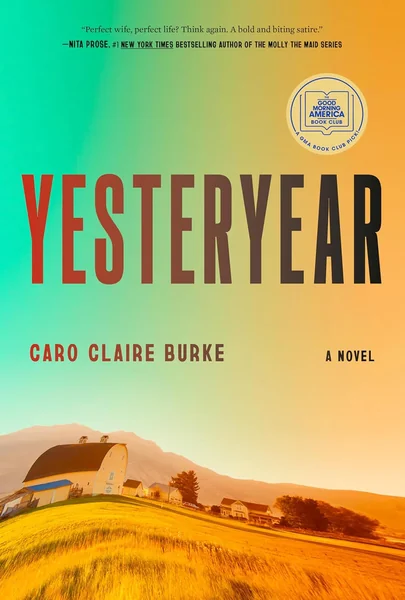
Yesteryear
A GMA Book Club Pick
by Caro Claire Burke
LuvemBooks Verdict
Best for: Readers who enjoy darkly comedic, socially sharp literary fiction and want a debut that uses a high-concept satirical premise — a tradwife influencer hurled into authentic 1855 domestic life — as a vehicle for probing the performance of femininity, identity, and modern myth-making.
Worth it? Skip it? Read the full verdict →Ask LuvemBooks
Was this helpful?
- Is it worth reading?
- For readers drawn to darkly comedic social fiction with a genuinely dangerous edge, Yesteryear delivers on its considerable hype. The satirical premise — a tradwife influencer forced into authentic 1855 domestic life — operates on multiple levels simultaneously, and critical coverage describes Natalie Heller Mills as 'an electric antiheroine' whose complexity sustains the novel well beyond its high-concept hook. The book has earned both commercial validation (#1 New York Times bestseller, GMA Book Club pick) and literary endorsements from Nita Prose, Ashley Audrain, and Anne Hathaway. The key caveat: readers who expect a genre-clear resolution to the central mystery, or who are unsympathetic to satire of influencer and tradwife culture, may find the terrain less rewarding.
- Similar books
- Readers drawn to Yesteryear's blend of time-displacement, sharp social critique, and complex female protagonists will find compelling companions in the curated titles below. Diana Gabaldon's Outlander and Octavia Butler's Kindred are the genre touchstones most obviously adjacent — both place women in radically unfamiliar historical circumstances where survival demands confronting uncomfortable truths about identity and power. Taylor Jenkins Reid's Maybe in Another Life explores a similar fascination with how a single pivot point reshapes a woman's entire life, though with a warmer, more romantic register. Eowyn Ivey's The Snow Child shares Yesteryear's quality of sustained, deliberate ambiguity — a story that resists explaining away its central strangeness — making it a strong pairing for readers who appreciate unresolved mystery as an artistic choice.
- Who should read this?
- Yesteryear is designed for readers who enjoy socially sharp literary fiction with genre undertones — specifically those interested in influencer culture, performative domesticity, and the contested meaning of feminism. Fans of darkly comedic social satire who can tolerate sustained narrative ambiguity will get the most from the novel's deliberate refusal to resolve Natalie's predicament neatly. It is also a natural fit for book clubs looking for a culturally engaged conversation starter, as its subject matter is inherently polarizing and the characterization of Natalie Heller Mills resists easy judgment. Readers who prefer genre-clear plots or who are unsympathetic to satire of tradwife and influencer culture may find less to engage with here.
- What are the main themes?
- Yesteryear's central preoccupation is authenticity versus performance — specifically, what remains of a lifestyle built entirely for an audience when the Instagram filter is stripped away. Burke trains her debut on the intersection of influencer culture, performative domesticity, and the contested meaning of feminism, using the tradwife phenomenon as a specific cultural target. The novel also interrogates the construction of public identity, asking how and why a woman like Natalie Heller Mills builds so elaborate a self — a question the review identifies as the 'meatiest, most revelatory' dimension of the book. Running beneath these social critiques is a thread of genuine menace: Natalie's collision with actual 19th-century domestic labor is both darkly comedic and physically threatening.
- Is this a good book club pick?
- Yesteryear is an exceptionally strong book club selection — it was chosen as a GMA Book Club pick and by the New York Times Book Review Book Club, two of the most prominent reading communities in the country. Its subject matter (influencer culture, tradwife ideology, the performance of femininity and authenticity) is inherently discussion-rich and culturally polarizing in ways that generate substantive conversation rather than easy consensus. The sustained ambiguity about what has actually happened to Natalie — hoax, time travel, or something stranger — also gives groups something genuinely unresolved to debate. The review notes the characterization holds readers through to the final pages, which bodes well for groups completing it together.
- What awards and recognition has it received?
- Yesteryear reached #1 on the New York Times bestseller list and was named a New York Times Best Book of the Year (So Far), signaling both commercial and critical validation. It was selected as a GMA Book Club pick and by the New York Times Book Review Book Club, and prompted Burke's appearance on Late Night with Seth Meyers. Blurbs from Nita Prose (#1 New York Times bestselling author of The Maid series), Ashley Audrain (bestselling author of The Push), and Anne Hathaway further underscore the book's cross-platform cultural reach for a debut novel.
Summarize this book
Follow up
Synthesized from verified book data & published reviews · How we review
Press Enter to ask. Answers come from our editorial Q&A — start typing to see related questions.
Age & Reading Level
Recommended age
Adult
Reading level
Adult
2 content notes · who it suits
Content to know about
Skip if you want a genre-clear time-travel thriller with a definitive resolution, or find satire of influencer and tradwife culture tiresome or one-sided.
Editorial Review
Yesteryear is Caro Claire Burke's debut novel about Natalie Heller Mills, a "tradwife" influencer with 8 million followers who wakes one morning to find herself stranded in 1855, forced to live the pre-industrial life she only ever performed online. A #1 New York Times bestseller and GMA Book Club pick, it earns its buzz with a razor-sharp premise that cuts to the core of authenticity, fame, and womanhood.
Read the Full ReviewBooks like Yesteryear
Curated picks for readers who enjoyed Yesteryear, with our reasoning for each match.