
At a glance

LuvemBooks Verdict
Best for: Readers who enjoy fish-out-of-water expatriate memoirs — particularly fans of Peter Mayle or Frances Mayes — and who are open to a story where Moroccan jinn lore and folkloric belief are treated as seriously as bricks and mortar.
Worth it? Skip it? Read the full verdict →Ask LuvemBooks
Was this helpful?
- Is it worth reading?
- For readers drawn to cross-cultural misadventure, eccentric characters, and the particular pleasures of a crumbling house being coaxed back to life, The Caliph's House delivers handsomely. Shah's self-deprecating wit transforms renovation frustration and cultural bewilderment into sustained comic and emotional payoff, and the integration of Moroccan jinn lore gives the book a cultural specificity that sets it apart from the broader expatriate-memoir genre. The key friction points are its episodic, loosely assembled structure and its narrow domestic focus — readers expecting a tightly plotted arc or a sociological portrait of Casablanca may feel underserved. Those willing to surrender to Shah's chaotic, captivating year will find it substantial, funny, and genuinely transporting.
- Similar books
- Readers who enjoy The Caliph's House will find natural companions in the broader tradition of British writers uprooting to foreign homes. Peter Mayle's A Year in Provence is the closest structural cousin — episodic renovation comedy driven by cultural collision — though Shah's Casablanca is considerably stranger and less culinarily comforting than Mayle's Provence. Paul Theroux's The Pillars of Hercules offers a different mode of Mediterranean and North African travel writing, while Robert Byron's The Road to Oxiana is an earlier touchstone for literary travel in the Islamic world. Tahir Shah's own In Arabian Nights and The Trail of Feathers show the same sensibility applied to different extremes of experience. For those drawn to the warmly comic British-abroad register, Bill Bryson's Notes from a Small Island scratches a similar itch, even if the cultural territory is very different.
- Who should read this?
- The Caliph's House is best suited to readers who enjoy character-driven travel memoirs with a strong comic voice and a genuine appetite for cultural immersion. It will particularly reward those with an interest in Morocco, Moroccan popular belief, and jinn lore, as well as fans of the house-restoration-abroad subgenre (Peter Mayle, Frances Mayes) who are open to something stranger and less culinarily reassuring. Readers who want a tightly plotted narrative, a sociological portrait of modern Casablanca, or who have no patience for sustained engagement with supernatural belief as a cultural reality should approach with adjusted expectations. Shah's established readership from Sorcerer's Apprentice and Trail of Feathers will find familiar pleasures here.
- About Tahir Shah
- Tahir Shah is a British author, journalist, and documentary maker of Afghan-Indian descent.
- What are the main themes?
- The central themes are cultural collision and the limits of the 'rational Westerner' perspective: Shah enters Dar Khalifa as a sceptic and is gradually, reluctantly brought to understand that the compound's jinni must be addressed on its own terms before any restoration can proceed. Tied to this is a sustained exploration of Moroccan popular belief — jinn lore and folkloric practice rendered with specificity and warmth rather than condescension. Family and personal history form a quieter secondary thread, as Shah's grandfather and childhood memories of Morocco surface through figures like the countess. And running through everything is the comedy and frustration of renovation: craftsmen who arrive, vanish, reappear, and eventually produce something beautiful give the memoir both its structural rhythm and much of its emotional payoff.
- How does it fit in the expatriate memoir genre?
- The Caliph's House occupies a well-defined place in the tradition of British writers uprooting themselves to foreign homes — a genre with a long shelf life anchored by works like Peter Mayle's Provence books and Frances Mayes's Tuscany memoirs. What distinguishes Shah's contribution is the specific texture of Moroccan popular belief and the genuinely unusual property at the memoir's centre: Dar Khalifa is stranger and more historically charged than a Provençal farmhouse, and the jinn lore is not decorative but structural. The book is catalogued under travel writing, biography, and Moroccan social life and customs — a range that reflects how fluidly it moves between those modes, and why it feels like more than a straightforward entry in the house-renovation-abroad subgenre.
Summarize this book
Follow up
Synthesized from verified book data & published reviews · How we review
Press Enter to ask. Answers come from our editorial Q&A — start typing to see related questions.
Age & Reading Level
Recommended age
Adult
Reading level
Adult
who it suits
Skip if you want a tightly plotted narrative or a wide-ranging sociological portrait of modern Casablanca rather than a character-driven, domestic-focused memoir.
Editorial Review
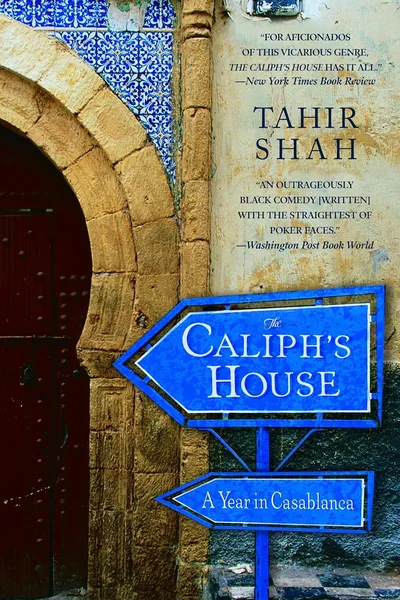
Tahir Shah's memoir chronicles his family's leap from England to Casablanca, where he purchases Dar Khalifa — a crumbling, jinn-haunted compound reputedly once belonging to the city's Caliph — and spends a tumultuous year restoring it, navigating Moroccan customs, and confronting a world where the supernatural and the everyday are inseparable.
Read the Full ReviewRelated reading
Adjacent titles worth exploring. We haven't reviewed these yet, so they link out to Amazon.