Reviewed

Read Time

8 min read

Age & reading levelAdult
Reader rating

4.6

· 2,192 Amazon ratings
reader ratings, not a LuvemBooks score
Curated & edited by

LuvemBooks Editorial

How we create our reviews →
Share This Review
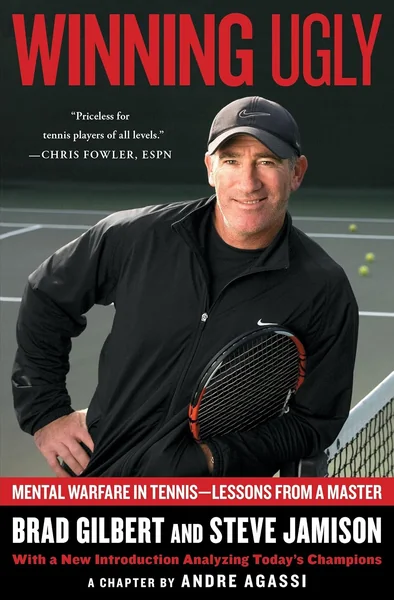
Winning Ugly: Mental Warfare in Tennis--Lessons from a Master by Brad Gilbert, Steve Jamison front cover

Our review

Winning Ugly

Winning Ugly: Mental Warfare in Tennis--Lessons from a Master by Brad Gilbert and Steve Jamison Review: The Thinking Player's Tactical Bible

by Brad Gilbert, Steve Jamison

Winning Ugly: Mental Warfare in Tennis--Lessons from a Master, by Brad Gilbert and Steve Jamison, lays out Gilbert's system for outthinking and outplaying opponents without overhauling your strokes — a framework built on pre-match preparation, reading hidden patterns in play, and ruthless mental discipline. It has become, as the Simon & Schuster edition describes it, "the bible of tennis instruction books for countless players worldwide."

LuvemBooks Verdict

Best for

Recreational club-level tennis players who want to win more matches by sharpening their tactical and mental game, without overhauling their strokes.

Worth it if

Worth reading if you compete at a recreational or club level and want a practical, coach-voiced framework for outsmarting opponents — covering pre-match preparation, nerve management, and exploiting weaknesses — backed by real Tour-level case studies.

Skip if

Skip it if you are a beginner seeking stroke mechanics, serve biomechanics, or footwork drills, or if you want coverage of the modern era's champions without purchasing the separately released third edition.

Simon & Schuster describes the book as "written with clarity and wit" and calls it "the bible of tennis instruction books for countless players worldwide," while Tantor's audiobook page preserves blurbs from Andre Agassi and Pete Sampras, with Sampras calling it "pro tactics that will improve a recreational player's game fast." Reader voices on The StoryGraph praise its analytical depth while noting the book's era-specific frame of reference.

Sources: Simon & Schuster, Tantor, The StoryGraph
4.6from 2,192 Amazon ratings— reader ratings, not a LuvemBooks score

Ask LuvemBooks

Was this helpful?

Winning Ugly: Mental Warfare in Tennis by Brad Gilbert and Steve Jamison delivers a practical, experience-backed framework for outthinking opponents — without changing a single stroke — drawn from Gilbert's Tour career coaching Agassi, Roddick, and Murray. The book's core strength is tactical specificity: real match scenarios against Lendl, McEnroe, Becker, and Sampras ground every principle in recognizable competitive situations. It's essential reading for recreational and club-level players hungry for a mental edge, but those seeking stroke mechanics or footwork drills will need to look elsewhere.
Is it worth reading?
For recreational and club-level players who want more wins without rebuilding their game, Winning Ugly is widely regarded as essential — the Simon & Schuster edition describes it as 'the bible of tennis instruction books for countless players worldwide,' and its three-decade shelf life speaks to that standing. Gilbert's direct coaching voice, grounded in real Tour rivalries and stress-tested through his work with Agassi, Roddick, and Murray, makes the tactical advice feel earned rather than theoretical. The key caveat: players seeking technical stroke correction or footwork instruction will find nothing here — the book's focus is entirely strategic and psychological.
Similar books
Readers drawn to Winning Ugly's mental-game emphasis will find natural companions in several well-regarded tennis titles. W. Timothy Gallwey's The Inner Game of Tennis is the field's other foundational psychological text, approaching concentration and self-interference from a more philosophical angle. John McPhee's Levels of the Game offers a deeply reported portrait of match psychology through a single historic contest. For Agassi's own account of the Gilbert coaching relationship and Tour life, Open: An Autobiography is the obvious next read — it corroborates Gilbert's methods from the player's perspective. David Foster Wallace's essay collection String Theory: David Foster Wallace on Tennis provides a more literary lens on the game's competitive texture. Bill Walsh and Steve Jamison's The Score Takes Care of Itself applies a similar 'process over outcome' philosophy to American football coaching.
Who should read this?
Winning Ugly is explicitly aimed at recreational and club-level competitors who already have basic strokes and want to win more matches through smarter tactical thinking. It will resonate especially with players frustrated by losing to opponents they feel they should beat, since Gilbert's entire framework is built around the idea that the mental and strategic edge — not superior technique — is what decides most recreational matches. Coaches and serious junior players will also find value in the case-study approach, though the primary Tour examples require some translation for those focused on the modern women's game or junior circuits.
What are the main themes?
The book's dominant theme is that competitive tennis is won primarily in the mind — that pre-match preparation, opponent analysis, and mental discipline matter more than technical superiority. Gilbert builds this case around recognizable in-match situations: holding serve, exploiting the deuce court, managing nerves under pressure, and identifying what he calls Hidden Ad Points. A secondary theme is the gap between perceived talent and actual match results — Gilbert's own Tour career, built on beating players who should have dismantled him on paper, is the living proof of concept woven through every chapter.
What is Gilbert's coaching record?
Brad Gilbert coached Andre Agassi, Andy Roddick, and Andy Murray, all of whom won major titles under his guidance — a coaching record that reinforces the credibility of the tactical system laid out in the book. He also built his Tour playing reputation not on textbook technique but on beating higher-ranked, more technically gifted opponents, making his own match results the proof of concept behind the book's central argument. The Simon & Schuster edition credits him as 'among the world's foremost tennis analysts,' a standing further supported by his long-running role as an ESPN analyst.
How do the editions differ?
The original 1994 Touchstone paperback contains Gilbert's foundational text in its original form, built around the Tour's early-1990s landscape with case studies drawn from rivals like Lendl, McEnroe, Connors, Becker, Sampras, and Courier. The third edition adds a new introduction that applies the same tactical framework to Roger Federer, Novak Djokovic, Serena Williams, Andy Murray, and Rafael Nadal — demonstrating the system's cross-era durability and, in the publisher's view, transforming a strong debut into a 'tennis classic.' Readers who want the contemporary analysis alongside the core text should seek out the later third edition rather than the 1994 Touchstone printing.
Summarize this book

Summarize this book

Winning Ugly: Mental Warfare in Tennis—Lessons from a Master argues that recreational players can win more matches without overhauling their strokes by mastering pre-match preparation, reading hidden patterns in opponents' play, and maintaining ruthless mental discipline. Brad Gilbert draws on his own Tour experience — beating players who on paper should have dismantled him — to build a chapter-by-chapter tactical framework around situations like holding serve, exploiting the deuce court, managing nerves, and identifying Hidden Ad Points. Specific rivals including Ivan Lendl, John McEnroe, Jimmy Connors, Boris Becker, Pete Sampras, and Jim Courier serve as concrete case studies, while a chapter by Andre Agassi testifies from the inside to how Gilbert's methods work in practice. Later editions extend the system to Roger Federer, Novak Djokovic, Serena Williams, Andy Murray, and Rafael Nadal, confirming the framework's cross-era durability.

Follow up

Does it cover stroke technique at all?
What does Agassi contribute to the book?
Which edition should I buy?

Synthesized from verified book data & published reviews · How we review

Ask LuvemBooks

What would you like to know about Winning Ugly?

Answers come from our editorial notes on this book. If we haven't covered something, we'll say so.

Readers often ask

Our Review

This review covers the book's content and published reception; it does not reflect hands-on application of Gilbert's methods on court.
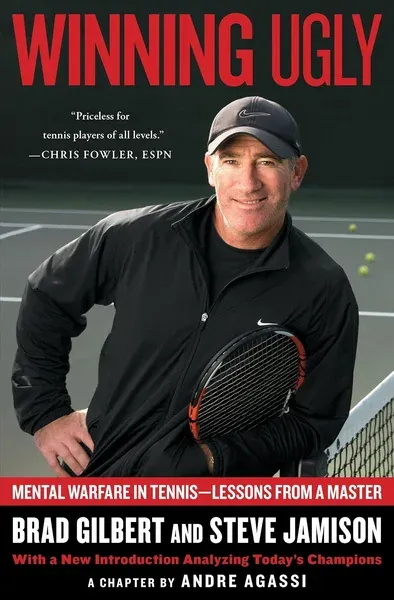
Winning Ugly: Mental Warfare in Tennis--Lessons from a Master by Brad Gilbert, Steve Jamison front cover

What the Book Actually Argues

Brad Gilbert's central claim is deceptively simple: recreational players can win more often without changing their strokes at all.
The competitive edge, Gilbert argues, is almost entirely mental — won before a single ball is struck. The book opens with pre-match preparation as its first full chapter, establishing that the psychological advantage must be seized from the very start of a match.
The framework Gilbert lays out teaches players to study opponents, exploit weaknesses, and dictate terms rather than simply react. Specific Tour rivals — Ivan Lendl, John McEnroe, Jimmy Connors, Boris Becker, Pete Sampras, Jim Courier, and others — are used as case studies to show how tactical thinking translates into actual match strategy.

Why Gilbert Is Qualified to Teach This

Gilbert built his Tour reputation not on textbook technique but on beating players who, on paper, should have dismantled him.
The Simon & Schuster edition credits him as "among the world's foremost tennis analysts," and his coaching record reinforces that standing: he has coached Andre Agassi, Andy Roddick, and Andy Murray, all of whom won major titles under his guidance. He is also an Olympic gold medalist and long-serving ESPN analyst, which means the tactical ideas in the book have been stress-tested at the highest levels of the game.
Steve Jamison, his co-author, brings proven collaborative credentials: he worked with legendary UCLA coach John Wooden on the national bestseller Wooden on Leadership, a background that shapes the book's accessible, plain-spoken structure.

Strengths: Clarity, Wit, and Concrete Specificity

The Simon & Schuster page describes the book as "written with clarity and wit" — and the sourced materials bear that out structurally. Rather than abstract philosophy, the book delivers chapter-by-chapter tactics organized around recognizable situations: holding serve, exploiting the deuce court, managing nerves, and identifying Hidden Ad Points.
One passage preserved in the book's own text — "But only if you care about winning and are willing to push yourself mentally to do it, only if you activate your brain from the 'git go'" — captures the book's no-nonsense, conversational register. It reads as a coach talking directly to a player, not as an academic treatise.
The inclusion of a chapter by Andre Agassi adds a dimension few tennis books can claim: a world No. 1 testifying from the inside to how Gilbert's methods worked in practice. Agassi's blurb, quoted via the Simon & Schuster materials, states that Gilbert "understands the mental part of tennis better than anyone I have ever met."

How Later Editions Update the Core

The original 1994 text was written around the Tour's early-1990s landscape, but later editions have extended Gilbert's framework to more recent generations of champions.
The third edition's new introduction applies the same tactical lens to Roger Federer, Novak Djokovic, Serena Williams, Andy Murray, and Rafael Nadal — demonstrating that the underlying principles hold across eras and playing styles. This ongoing relevance is what transformed a strong debut into what the publisher calls a "tennis classic."
Readers picking up the 1994 Touchstone paperback under review will have the foundational text in its original form, without those later additions; the updated edition is a separate purchase for those who want the contemporary analysis alongside.

Who This Book Is For — and Where It Has Limits

Winning Ugly: Mental Warfare in Tennis--Lessons from a Master is explicitly aimed at recreational club-level players who want to win more matches, not at beginners still assembling basic strokes.
The book does not offer technical instruction on groundstroke mechanics, serve biomechanics, or footwork drills in any depth — its focus is strategic and psychological throughout. Players seeking a stroke-correction manual will need to look elsewhere; this is a book about game plans, not grip changes.
The Tour-era examples, while vivid, are drawn primarily from men's professional tennis, and readers whose frame of reference skews toward the modern women's game or junior competition may need to translate some scenarios. That said, the tactical categories Gilbert defines — dictating play, managing nerves, reading an opponent — are not era-specific, and that transferability is what accounts for the book's three-decade shelf life.


Sources & Further Reading

The key facts and claims in this review are grounded in the retrieved, verified sources listed below.

  1. 1
  2. 2
  3. 3
  4. 4
  5. 5
  6. 6
  7. 7
  8. 8

Age & Reading Level

Recommended age

Adult

Skip if you're looking for technical stroke instruction, serve biomechanics, or footwork drills.

Brad Gilbert, Steve Jamison on Winning Ugly

Tennis coach and author Brad Gilbert shares the backstory and creation of his classic book 'Winning Ugly'.

Uploaded by Tennis Channel, 2025 · Watch on YouTube

The origin story of Winning Ugly

Gilbert explains that co-author Steve Jamison pitched the project and they wrote it in roughly six weeks without a book deal. The inspiration crystallized while watching Jamison play club opponents for 15 years without ever noticing their blatant tactical weaknesses.

From our readers

Reader reviews

Be one of the first readers to answer.

Read it? Was it right for you?

Books like Winning Ugly

Curated picks for readers who enjoyed Winning Ugly, with our reasoning for each match.