BOOKS
Published

Read Time

3 min read

Reader rating

4.6

· 40,187 Amazon ratings
reader ratings, not a LuvemBooks score
Curated & edited by

LuvemBooks Editorial

How we create our reviews →
Share This Review

The Power of Habit by Charles Duhigg Review: A Rigorous, Widely Celebrated Science of Behavior

Charles Duhigg's The Power of Habit, originally published in February 2012 by Random House, is a work of narrative nonfiction that draws on scientific research and real-world case studies to argue that understanding the habit loop—cue, routine, reward—is the foundation of personal and organizational change. It reached bestseller lists at the New York Times, Amazon, and USA Today, and was longlisted for the Financial Times and McKinsey Business Book of the Year Award in 2012. The book is structured to move from individual habits to organizational ones to societal ones, making it relevant to readers ranging from those seeking personal development to business leaders and policymakers. Some readers find the case studies so extensive that the prescriptive guidance can feel secondary, but the book's core framework remains one of the most discussed in the behavioral science genre.

LuvemBooks Verdict

Best for

Curious, analytically minded readers—whether individuals seeking to understand their own behaviour, managers looking to reshape team culture, or business students—who want a research-grounded, narrative-driven framework for understanding how habits operate at every level of human life.

Worth it if

Worth reading if you want a single, coherent intellectual framework—the cue-routine-reward loop—applied rigorously across personal psychology, corporate strategy, and social movements, and are happy to extract your own action plan from richly reported case studies rather than a tidy step-by-step guide.

Skip if

Skip it if you're looking for a concise, prescriptive self-improvement manual and have little patience for extended narrative detours into NFL franchises, consumer packaged goods, or megachurches that only indirectly connect to your personal goals.

Kirkus Reviews called it "a more convincing book than most" in the self-help-adjacent space, noting Duhigg's effective use of cautionary case studies to illustrate the cue-routine-reward loop. Wikipedia records that the book reached the bestseller lists of the New York Times, Amazon, and USA Today simultaneously, and received a longlisting for the Financial Times and McKinsey Business Book of the Year Award in 2012.

For self-help seekers, a more convincing book than most — changing bad habits isn't rocket science, it's brain science.

Kirkus Reviews
Sources: Kirkus Reviews, Wikipedia
4.6from 40,187 Amazon ratings— reader ratings, not a LuvemBooks score

Look inside the book

Preview the actual pages, via Google Books
In This Review
  • What Works & What Doesn't
  • What the Book Actually Argues
  • Scope and Structure: From Individuals to Institutions
  • The "Golden Rule" and the Role of Belief
  • Reception and Cultural Reach
  • Who It's For and Where It Tests Patience

What Works & What Doesn't

What Works
  • Presents a clear, rigorously constructed central framework—the cue-routine-reward habit loop—that is consistently applied across all three sections of the book
  • Draws on a wide range of real-world case studies spanning corporations (Procter & Gamble, Target), social movements (Alcoholics Anonymous), and sports organizations, giving the argument broad applicability
  • Originally published in February 2012 and reached the New York Times, Amazon, and USA Today bestseller lists, with a longlisting for the Financial Times and McKinsey Business Book of the Year Award
  • Addresses a meaningful nuance often missing from behavioral books: the role of belief and community in sustaining habit change, not just mechanical cue-routine-reward manipulation
  • Written by an award-winning New York Times business reporter, bringing journalistic clarity and sourcing discipline to complex neuroscience and behavioral research
What Doesn't
  • The extensive use of narrative case studies can overshadow the book's prescriptive guidance, which some readers find insufficiently consolidated into actionable steps
  • The book's deliberately broad scope—covering individuals, organizations, and societies—means readers seeking a focused personal-change manual may find the corporate and societal sections less directly applicable to their goals
A New York Times bestseller and Financial Times/McKinsey Business Book of the Year Award longlisted title, The Power of Habit makes a compelling, research-grounded case that habits—not willpower or intention alone—are the true architecture of human behavior.

What the Book Actually Argues

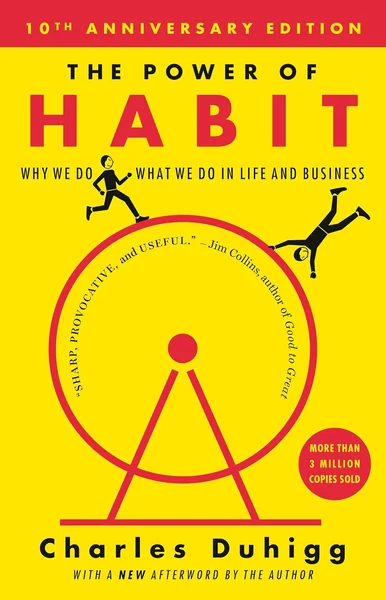
The Power of Habit: Why We Do What We Do in Life and Business by Charles Duhigg front cover
At its core, The Power of Habit advances a single, tightly constructed argument: that the key to exercising regularly, losing weight, raising exceptional children, becoming more productive, building revolutionary companies, and achieving success lies in understanding how habits work. As Duhigg's own author site frames it, "Habits aren't destiny." The vehicle for this argument is the habit loop, a neurological pattern consisting of three elements—a cue that triggers automatic behavior, a routine (mental, emotional, or physical) that constitutes the habit itself, and a reward that signals to the brain whether the loop is worth repeating. According to Wikipedia's detailed summary of the book, craving is the engine that makes this loop self-reinforcing: as Duhigg wrote in an accompanying critical coverage article, "The cue and reward become neurologically intertwined until a sense of craving emerges." This mechanism, Duhigg argues, governs everything from individual morning routines to the supply-chain decisions of Fortune 500 companies.
The cue and reward become neurologically intertwined until a sense of craving emerges.

Scope and Structure: From Individuals to Institutions

Where many self-help-adjacent science books stay focused on the individual, The Power of Habit is deliberately organized to operate at three distinct levels. The book moves from the habits of individuals, to the habits of organizations, to the habits of societies. This architecture gives it unusual range: the same framework that explains a person's struggle with addiction is applied to the transformation of NFL franchises, the operations of Target's data analytics division, and the growth of Rick Warren's Saddleback Church. Duhigg also examines so-called keystone habits—a specific category of high-leverage behaviors that, when changed, can trigger cascading shifts across other areas of life and business. The Wikipedia summary of the book notes the inclusion of Procter & Gamble's development of Febreze as a case study in how corporations deliberately engineer cravings to build new consumer habits, illustrating that the habit loop operates as much in boardrooms as in individual psychology.

The "Golden Rule" and the Role of Belief

Chapter 3 of the book introduces what Duhigg calls the "golden rule" of habit change: to modify a behavior, keep the original cue and the original reward, but insert a new routine in between. This principle, as documented in Wikipedia's summary, is illustrated through multiple case studies, including the story of Bill Wilson, a recovering alcoholic whose faith-driven transformation led him to found Alcoholics Anonymous. The framework acknowledges a critical caveat, however: belief—whether cultivated individually or through group accountability—is presented as an essential ingredient. Habit change, on this account, is not purely mechanical; the social and psychological context in which a new routine is practiced matters. This nuance separates the book's argument from more simplistic behavioral prescriptions and gives it intellectual credibility that has contributed to its lasting presence in business school curricula and coaching programs alike.

Reception and Cultural Reach

The book's reception on its original 2012 publication was strong by measurable standards: it reached the bestseller lists of the New York Times, Amazon, and USA Today simultaneously, and received a longlisting for the Financial Times and McKinsey Business Book of the Year Award—a shortlist that typically recognizes books of genuine analytical rigor. Duhigg, an award-winning New York Times business reporter at the time of publication, brought both journalistic discipline and scientific sourcing to the project. The book's influence has extended well beyond its initial publication window: in February 2020, Duhigg partnered with VitalSmarts, a corporate training company, to release a companion one-day training course based on the book's framework, a development that signals its continued relevance in professional development contexts.

Who It's For and Where It Tests Patience

The Power of Habit is designed for a broad audience—readers seeking personal transformation, managers looking to reshape organizational culture, and anyone curious about the neuroscience underlying everyday behavior. Duhigg's background as a journalist means the book is built around extended narratives rather than academic summaries, which some readers find energizing and others find digressive. Some readers note that the case studies—while vivid and varied—can crowd out the book's prescriptive guidance, leaving those seeking a direct action plan wanting a cleaner synthesis. The book's ambitions are also explicitly broad: it is as much a lens for understanding society as it is a manual for personal change, and readers who come to it purely for a step-by-step self-improvement program may find the societal and corporate chapters less immediately useful to their goals.

Sources & Further Reading

The key facts and claims in this review are grounded in the retrieved, verified sources listed below.

  1. Cited in this review
  2. 1
  3. Further reading
  4. 2

    Charles Duhigg, Wikipedia

  5. 3
  6. 4
  7. 5
  8. 6
  9. 7
  10. 8
  11. 9