
9 min read
Share This Review
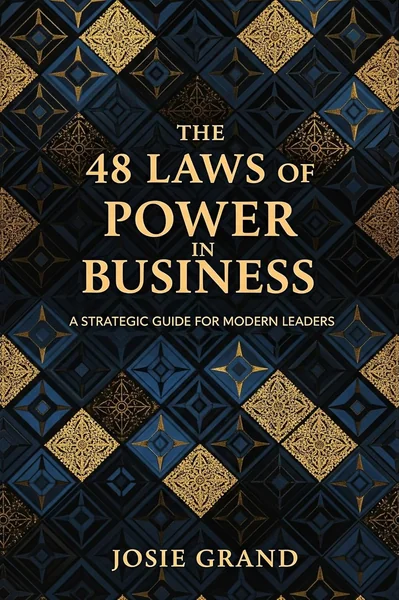
The 48 Laws of Power in Business by Josie Grand Review: A Modern Strategic Operating System
Josie Grand's The 48 Laws of Power in Business: A Strategic Guide for Modern Leaders applies the framework of Robert Greene's foundational work to contemporary business environments, translating classical power dynamics into a practical guide for executives, entrepreneurs, and emerging leaders navigating competitive modern workplaces.
LuvemBooks Verdict
Best for
First-time executives, entrepreneurs navigating investor relationships, and managers facing organizational politics who want a systematic, business-specific translation of the 48 Laws framework rather than a reading of Greene's original.
Worth it if
You operate in competitive professional environments — corporate hierarchies, fundraising, or market competition — and want a structured taxonomy of power and influence tactics mapped explicitly to modern business scenarios.
Skip if
You're already well-versed in Robert Greene's source material, or you prefer ethical leadership frameworks built around collaboration and values-driven culture rather than strategic dominance.
What readers & critics say
External reception retrieved for this title is limited, but commentary on the broader 48 Laws framework is instructive. Kirkus Reviews, reviewing Greene's original, called it "a sort of anti-Book of Virtues" — noting that its worldview assumes everyone is in a "constant duplicitous game to gain more power at the expense of others," a philosophical foundation that directly shapes Grand's adapted guide. Vocal Media cautions that readers should engage the material "warily, knowing that some of the laws discussed raise moral questions," while chrisdessi.beehiiv.com notes that applying these laws can yield "enhanced strategic thinking, improved decision-making, and better leadership" but warns that "misinterpretation and misuse… can lead to ethical quandaries and reputational damage."
“A sort of anti-Book of Virtues — everyone is in a constant duplicitous game to gain more power at the expense of others.”
— Kirkus ReviewsIn This Review
- What Works & What Doesn't
- What the Book Is and What It Sets Out to Do
- Its Place in the Genre and Why It Exists
- What the Guide Does Well
- The Central Tension: Strategy Versus Ethics
- Who Will Get the Most — and the Least — from This Book
What Works & What Doesn't
What Works
- Applies the full 48-law framework systematically to modern business contexts, from investor negotiations to competitive positioning
- Structured around 48 distinct, named laws — from 'Never Outshine the Master' to 'Assume Formlessness' — giving readers a clear, navigable taxonomy
- Draws on a well-established strategic lineage including Machiavellian philosophy, Sun Tzu, and Caesar's leadership tactics, grounding the material in historical precedent
- Explicitly targets a defined professional audience — executives, entrepreneurs, and managers — making its applications concrete rather than abstract
What Doesn't
- The framework's worldview has drawn consistent criticism for promoting an excessively cynical, power-at-all-costs approach that can breed paranoia if misapplied
- Readers already deeply familiar with Robert Greene's original work may find limited new conceptual ground in an adapted guide built on the same 48-law architecture
What the Book Is and What It Sets Out to Do
Its Place in the Genre and Why It Exists
What the Guide Does Well
The Central Tension: Strategy Versus Ethics
Who Will Get the Most — and the Least — from This Book
Frequently Asked Questions
Sources & Further Reading
The key facts and claims in this review are grounded in the retrieved, verified sources listed below.
- Cited in this review
- 1
- 2
chrisdessi.beehiiv.com
- Further reading
- 3
futureventures.ca
- 4
- 5
- 6
makeheadway.com
- 7
- 8
wikisummaries.org
Related Reviews
Reviews of books we picked for readers who enjoyed The 48 Laws of Power in Business.



Reader Comments
No comments yet
Be the first to share your thoughts!