
8 min read
4.7
· 51,292 Amazon ratingsShare This Review
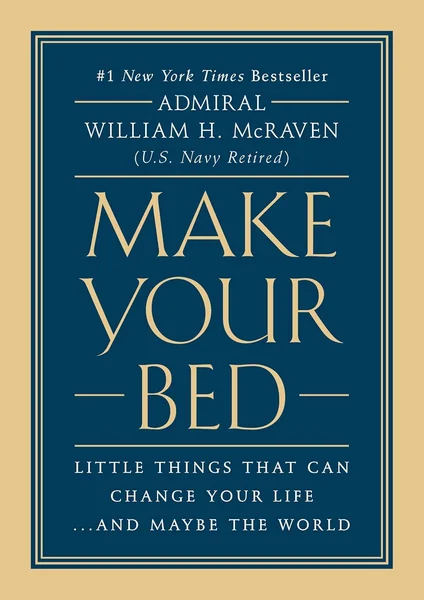
Make Your Bed by Admiral William H. McRaven Review: Compact SEAL-Forged Self-Help Manifesto
Adapted from Admiral William H. McRaven's viral 2014 University of Texas commencement address, Make Your Bed distills ten principles drawn from his 34-year Navy SEAL career into a concise self-help book published by Grand Central Publishing — a brisk, anecdote-driven guide that resonates strongly with readers seeking direct, military-framed life lessons, though its brevity and narrow experiential lens will not satisfy every audience.
LuvemBooks Verdict
Best for
Readers who respond to experience-grounded, no-nonsense advice and want a concise framework for building daily discipline and resilience, particularly those drawn to military leadership or seeking a structured motivational primer they can revisit chapter by chapter.
Worth it if
You value direct, anecdote-anchored lessons over abstraction, and are willing to engage with a framework rooted entirely in elite military culture in exchange for the unusual authority and clarity McRaven brings to each of his ten principles.
Skip if
Readers whose identities or life circumstances sit well outside the hierarchical, military-institutional lens — or anyone seeking nuanced engagement with failure, structural critique, or perspectives beyond a senior white male officer's career — will find the book's universalising claims difficult to absorb and its 144 pages too slim to bridge that gap.
What readers & critics say
Google Books records the book as a #1 New York Times bestseller and reproduces the Wall Street Journal's verdict that it "should be read by every leader in America." Bookreviewsonline.org awards it 4.5 out of 5 stars, calling it a book in which "the most powerful life lessons come from the simplest advice," and eaglenationonline.com describes it as delivering "an eye-opening view of accomplishing a small goal," praising McRaven's breakdown of ten lessons around small daily discipline.
“McRaven's voice carries the same directness on the page as it did at the podium, moving between dry wit and genuine gravity.”
— The GuardianAge & Reading Level
Recommended age
Adult
Reading level
Adult
1 content note · who it suits
Content to know about
Skip if you're looking for deep, nuanced self-help that engages with perspectives beyond elite military culture
Make Your Bed: Little Things That Can Change Your Life...And Maybe by Admiral William H. McRaven is Trending
Updated Sep 9, 2026In This Review
- What Works & What Doesn't
- What the Book Actually Is and Argues
- The Specificity That Makes It Work
- Its Significance and Reception
- Genuine Strengths
- Who It Serves — and Who It May Frustrate
What Works & What Doesn't
What Works
- Ten distinct lessons are each anchored in specific, named real-world episodes from SEAL training and active military service, avoiding the vague generalities common to the genre
- McRaven's unadorned, first-person voice — as evident in The Guardian's published excerpt — is direct and free of the inflated rhetoric that weighs down much self-help writing
- The tight ten-chapter structure mirrors the original commencement speech, making each principle easy to follow and return to
- McRaven's verified biography — Four-Star Admiral, Commander of all U.S. Special Operations Forces, University of Texas Chancellor — gives the lessons an authority grounded in documented experience
- According to Google Books, critics called it a book that 'should be read by every leader in America,' reflecting the broad professional regard it has earned
What Doesn't
- At 144 pages, the book is brief enough that readers hoping for deep exploration of any single lesson may find the treatment thin
- All ten principles derive exclusively from elite military training and McRaven's own career trajectory, a lens that readers whose lives fall outside that institutional framework may find difficult to translate into their own circumstances
What the Book Actually Is and Argues
The Specificity That Makes It Work
Its Significance and Reception
Genuine Strengths
Who It Serves — and Who It May Frustrate
Frequently Asked Questions
Sources & Further Reading
The key facts and claims in this review are grounded in the retrieved, verified sources listed below.
- Cited in this review
- 1
- 2
- 3
- 4
williammeller.com
- Further reading
- 5
ricklindquist.com
- 6
marloyonocruz.com
- 7
- 8
eaglenationonline.com
Related Reviews
Reviews of books we picked for readers who enjoyed Make Your Bed.
Reader Comments
No comments yet
Be the first to share your thoughts!