BOOKS
Published

Read Time

4 min read

Curated & edited by

LuvemBooks Editorial

How we create our reviews →
Share This Review

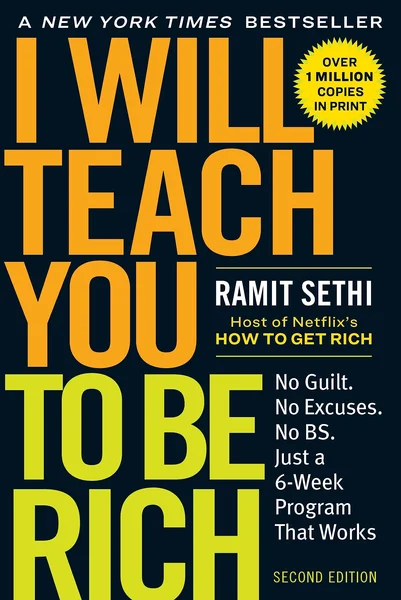
I Will Teach You to Be Rich by Ramit Sethi Review: A No-Nonsense Personal Finance Blueprint

Ramit Sethi's I Will Teach You to Be Rich is a revised, second-edition personal finance guide built around a structured six-week action program, designed to move readers from financial paralysis to proactive money management — with an irreverent, no-excuses voice that has made it a New York Times bestseller.

LuvemBooks Verdict

Best for

Young adults who are starting to take their finances seriously and want a structured, time-bound, action-oriented program rather than open-ended theory or abstract money advice.

Worth it if

You want a concrete six-week course with explicit weekly action lists, time allocations, and a clear focus on high-leverage financial moves — and you're willing to engage with a bold, direct authorial voice to get there.

Skip if

You already have a solid financial foundation and are looking for a comprehensive reference or neutral encyclopaedic treatment — or if emphatic, confidence-forward writing tends to pull you out of the material rather than energise you.

What readers & critics say

Strand Books describes the book's practical approach as delivered in an "irreverent, funny, no-B.S. Style that inspires readers to do what he says," consistent with its positioning as an action-first program. Reader responses on StoryGraph reflect the book's polarising voice: some note genuine learning even with prior finance knowledge, while others acknowledge the advice is sound but find Sethi's target-audience writing style is not written for them.

Sources: Strand Books, The StoryGraph, Reedsy
4.6from 23,520 Amazon ratings— reader ratings, not a LuvemBooks score
In This Review
  • What Works & What Doesn't
  • What the Book Actually Is
  • The Program's Core Philosophy
  • Strengths: Structure and Accessibility
  • Limitations: Voice and Target Audience
  • Who It's For and How It Holds Up

What Works & What Doesn't

What Works
  • Structured six-week program with explicit action lists and time allocations makes financial behaviour change concrete and manageable
  • Focuses on high-leverage 'Big Wins' rather than exhausting minutiae, keeping the program practical and prioritised
  • Revised second edition updates the original 2009 content for contemporary financial products and context
  • Accessible and irreverent voice, described by Strand Books as 'funny' and 'no-B.S.', appeals to readers who find traditional personal finance writing dry or discouraging
  • New York Times bestseller with demonstrated readership across more than fifteen years and two editions
What Doesn't
  • Sethi's confident, emphatic voice is polarising — some readers outside his core target audience find the delivery off-putting even when they agree with the advice
  • Designed as a course to complete rather than a reference to consult, which limits its utility for readers seeking a comprehensive or encyclopaedic financial resource
This is a personal finance guide that prioritises action over theory, built for readers who want a concrete system rather than another round of abstract money advice.

What the Book Actually Is

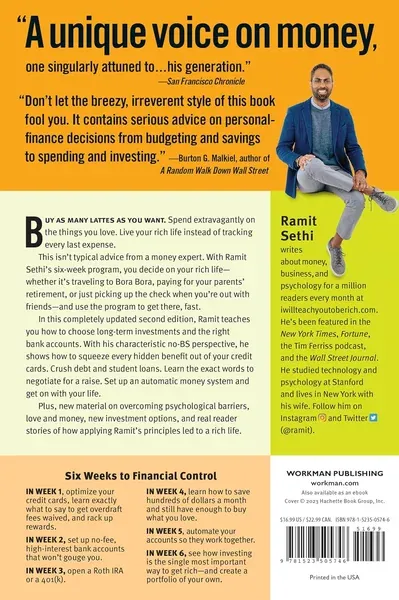
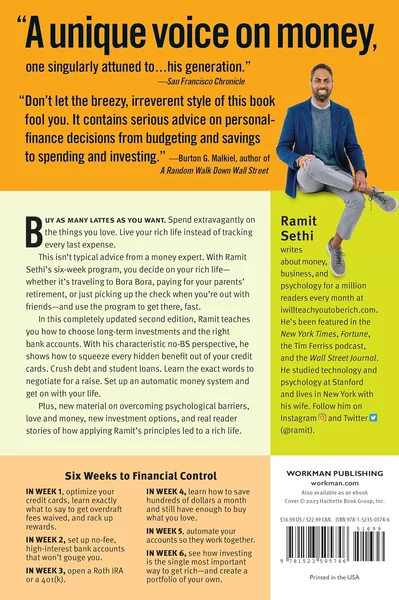
Back cover with testimonials, author bio, and six-week financial control program overview.
First published in 2009, I Will Teach You to Be Rich returned in a revised second edition published by Workman Publishing Company in 2019 — a tenth-anniversary update that preserved the original program's architecture while refreshing its material. The book is structured as a six-week program: each week delivers a focused set of tasks, complete with time allocations, so readers are never left wondering what to do next. Sethi's central argument, laid out in the opening chapter — titled "Would You Rather Be Sexy or Rich?" — is that the problem for most people is not a lack of information but a failure to start. The book frames getting rich as a matter of beginning with small steps and building slowly over time, not of being the smartest person in the room.

The Program's Core Philosophy

Sethi organises the book around what he calls "Big Wins" — the high-leverage financial moves that matter most — while explicitly deprioritising the kind of penny-pinching minutiae that dominates much personal finance writing. He pushes readers to examine their deep motivations, exploring what he calls the relationship between money and fulfilment. The concept of "the Rich Life" runs throughout: Sethi defines it not as accumulation for its own sake but as freedom — the freedom to take extended time off, to travel, to give a spouse or partner room to step back from work. This framing is central to how the program justifies its prescriptions and keeps readers engaged with the why behind each weekly action list.
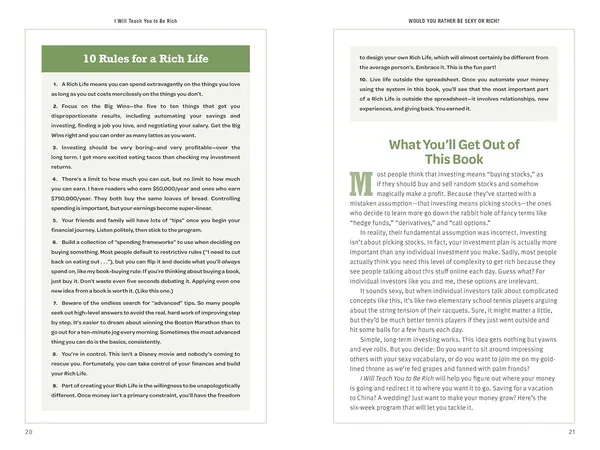
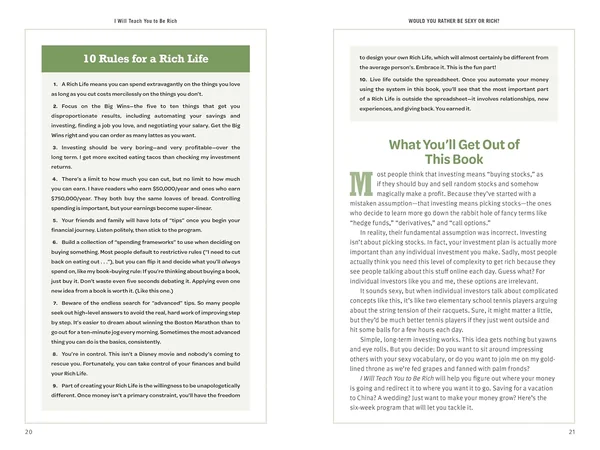
Interior pages showing chapter rules and benefits overview, introducing foundational money management concepts.

Strengths: Structure and Accessibility

The book's most consistently praised quality is its step-by-step structure. The weekly action format — with explicit guidance on what to do and roughly how long each task takes — is designed to make financial behaviour change feel manageable rather than overwhelming. Some readers note that even those who already have a working knowledge of personal finance come away with new frameworks and approaches, pointing to the book's usefulness across a wider experience range than its "beginner" reputation might imply. Illustrations by Nora Krug accompany the text. Strand Books describes the book's practical approach as delivered in an "irreverent, funny, no-B.S. Style that inspires readers to do what he says" — a characterisation consistent with how the program is positioned on Sethi's own platform.

Limitations: Voice and Target Audience

The book's tone is one of its defining features, and also its most polarising quality. Some readers find the confident, direct style energising; others find it grating. As reader responses on retail platforms reflect, Sethi has a specific target audience in mind, and those outside that demographic — particularly readers who already have a solid financial foundation — can find themselves put off by the delivery even while acknowledging the underlying advice is sound. The book does not position itself as a comprehensive reference for every financial situation; it is a program for a particular kind of reader at a particular stage of their financial life, and those who arrive expecting a neutral, encyclopaedic treatment may find the voice a friction point.

Who It's For and How It Holds Up

The second edition's revisions brought the material in line with a decade of changes in financial products, platforms, and cultural context. Its core audience remains young adults who are starting to take their finances seriously and want a structured, time-bound path to action rather than open-ended reading. The six-week format means the book functions less as a reference to consult and more as a course to complete — readers who engage with it as the latter are the ones the program is designed to serve. Its standing as a New York Times bestseller reflects a sustained readership over more than fifteen years, across both its original and revised editions.

Sources & Further Reading

The key facts and claims in this review are grounded in the retrieved, verified sources listed below.

  1. Cited in this review
  2. 1

    iwillteachyoutoberich.com

  3. Further reading
  4. 2
    Ramit Sethi — author profileHigh-authority source

    Ramit Sethi, Wikipedia

  5. 3
  6. 4
  7. 5
  8. 6
  9. 7