BOOKS
Published

Read Time

3 min read

Curated & edited by

LuvemBooks Editorial

How we create our reviews →
Share This Review

Born to Run by Christopher McDougall Review: A Bestselling Nonfiction Adventure That Reshaped Running

Christopher McDougall's Born to Run is a bestselling nonfiction work — originally published in 2009 and since selling over three million copies — that blends adventure narrative, anthropology, and sports science to explore why humans run, and what a reclusive Mexican tribe reveals about the limits of modern athletic convention.

LuvemBooks Verdict

Best for

Readers drawn to adventure nonfiction who want a propulsive, personal narrative that weaves together travelogue, evolutionary biology, and competitive sport — whether or not they run at all.

Worth it if

You want a compulsively readable story grounded in real terrain and real people that opens up genuine questions about human physiology and the nature of endurance running.

Skip if

You're looking for a rigorously peer-reviewed treatment of running biomechanics — the scientific claims, particularly around cushioned shoes causing injury, cite studies whose own authors explicitly caution against the interpretation McDougall draws from them.

What readers & critics say

Kirkus Reviews calls it "a terrific ride, recommended for any athlete," praising McDougall's grounding of the narrative in an evolutionary argument that humans are literally built to run; The Washington Post's Dan Zak, as reported by Wikipedia, acknowledged that while the prose at times strains to be clever, it is "engaging and buddy-buddy, as if he's an enthusiastic friend tripping over himself to tell a great story." Science News noted the book's central challenge to the assumption that humans weren't meant to run long distances, and ESPN's David Fleming, quoted on the author's own site, called it potentially "the best book about the sport, spirit and science of endurance running."

A terrific ride, recommended for any athlete — grounds the narrative in an evolutionary argument that humans are literally 'born to run.'

Kirkus Reviews

Engaging and buddy-buddy, as if he's an enthusiastic friend tripping over himself to tell a great story.

Dan Zak, The Washington Post (via Wikipedia)

Anyone who laces up expensive running shoes to plod through painful miles might be misguided — humans may have evolved to run hundreds of miles at a time.

Science News

I'd be surprised if there's a better book about the sport, spirit and science of endurance running than Born to Run.

David Fleming, ESPN.com (via chrismcdougall.com)
Sources: Wikipedia, Kirkus Reviews, Science News, chrismcdougall.com
4.7from 26,493 Amazon ratings— reader ratings, not a LuvemBooks score

Look inside the book

Preview the actual pages, via Google Books
In This Review
  • What Works & What Doesn't
  • What the Book Is and What It Argues
  • Cultural and Sporting Significance
  • Strengths: Narrative Drive and Accessible Science
  • Genuine Limitations: Contested Claims and Selective Science
  • Who This Book Is For

What Works & What Doesn't

What Works
  • Over three million copies sold and more than four months on the New York Times Best Seller list, demonstrating exceptional crossover appeal
  • Blends adventure narrative, anthropology, and evolutionary biology into an accessible, propulsive read
  • Centers the Tarahumara of Mexico's Copper Canyons as vivid, substantive subjects rather than a backdrop
  • Washington Post and Barnes & Noble both recognized it among the best sports/nonfiction books of 2009
  • Accessible enough for non-runners while substantive enough to engage serious athletes
What Doesn't
  • Some characterizations of Tarahumara society have been criticized as hyperbolic by other authors
  • The scientific claims — particularly around cushioned running shoes causing injury — cite studies whose own authors explicitly caution against the interpretation McDougall draws from them
A compulsively readable work of nonfiction, Born to Run has sold over three million copies and spent more than four months on The New York Times Best Seller list — making it one of the most culturally resonant running books of the modern era.

What the Book Is and What It Argues

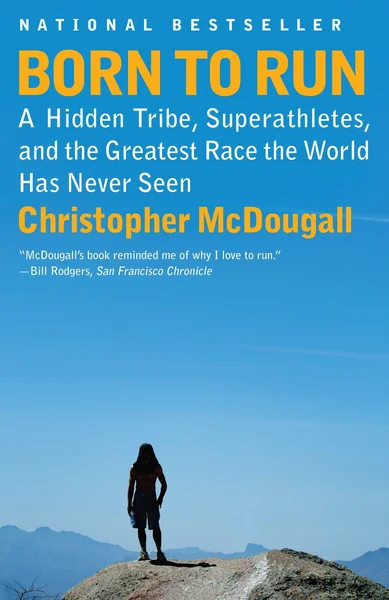
Born to Run: A Hidden Tribe, Superathletes, and the Greatest Race the World Has Never Seen by Christopher McDougall front cover
At its core, Born to Run: A Hidden Tribe, Superathletes, and the Greatest Race the World Has Never Seen is the story of Christopher McDougall — a journalist and self-described injury-plagued runner — tracking down the Tarahumara, a reclusive Native Mexican tribe living deep in the Copper Canyons of Mexico. McDougall documents the Tarahumara's extraordinary capacity for ultra-distance running, covering distances exceeding 100 miles at remarkable speeds, all while wearing thin sandals and sustaining none of the chronic injuries that sideline most American runners. From this central discovery, McDougall builds a broader argument: that modern cushioned running shoes, introduced in their current form around 1972, are a primary driver of the running injury epidemic, and that the human body is, in fact, built for endurance running. He advances the endurance running hypothesis — the idea that humans left the forests and developed the physical traits for long-distance running as a means of pursuing prey across open savannas — positioning Homo sapiens as unique among primates in this capacity.

Cultural and Sporting Significance

The book's impact on the sporting world has been well documented. According to Wikipedia, it received sustained attention in running communities for McDougall's account of how he personally overcame chronic injury by remodeling his gait and footwear choices after the Tarahumara. Named a Washington Post Best Sports Book of 2009 and a Barnes & Noble Best Nonfiction selection, it arrived at a moment when barefoot and minimalist running were gaining traction, and it is widely credited with accelerating that cultural shift. With over three million copies sold, it crossed decisively from niche sports title to mainstream cultural event.

Strengths: Narrative Drive and Accessible Science

The book's greatest commercial and critical strength is McDougall's ability to fuse adventure journalism with scientific inquiry. The Washington Post's Dan Zak, while raising some reservations about the prose, acknowledged that it is "engaging and buddy-buddy, as if he's an enthusiastic friend tripping over himself to tell a great story." That quality — the voice of an enthusiastic guide rather than a detached expert — is central to the book's broad appeal. McDougall structures the science of evolutionary biology, biomechanics, and anthropology within a propulsive narrative, making dense material accessible to readers who have no background in sports medicine. The Tarahumara themselves are rendered as a central, vivid subject rather than a peripheral curiosity, and the book builds toward a dramatic ultra-race in the Copper Canyons involving both Tarahumara runners and elite American ultramarathoners.

Genuine Limitations: Contested Claims and Selective Science

The book's enthusiasm is also the source of its most substantive criticism. Wikipedia notes that several of McDougall's characterizations of Tarahumara society — including sweeping claims that their communities were entirely free of crime, disease, obesity, depression, and aging — have been criticized by authors as hyperbolic. On the scientific side, McDougall cites the Berne Grand Prix questionnaire to support his assertion that modern cushioned shoes cause injury, but as Wikipedia reports, the study's own authors explicitly caution that their correlation between higher shoe prices and injury rates should not be interpreted to mean that expensive shoes cause injuries — and the study itself identified weekly mileage and prior injury history as the primary independent predictors of running injury. Readers seeking a rigorous, peer-reviewed treatment of running biomechanics will find that the book's evidentiary standards do not always meet that bar.

Who This Book Is For

Born to Run is best suited to readers drawn to adventure nonfiction with a strong personal narrative thread — runners and non-runners alike. Its combination of travelogue, evolutionary science, and competitive drama gives it broad appeal well beyond the running community. Readers who prioritize strict scientific sourcing over narrative momentum may find the book frustrating, but those who come for a compelling story grounded in real people, real terrain, and genuine questions about human physiology will find it consistently absorbing. Over fifteen years after its original publication, it remains the entry point through which many readers first encounter the debate over minimalist running and the endurance running hypothesis.

Sources & Further Reading

The key facts and claims in this review are grounded in the retrieved, verified sources listed below.

  1. Cited in this review
  2. 1
  3. 2
  4. Further reading
  5. 3

    Christopher McDougall, Wikipedia

  6. 4
  7. 5
  8. 6
  9. 7
  10. 8
  11. 9
  12. 10
  13. 11
  14. 12
  15. 13