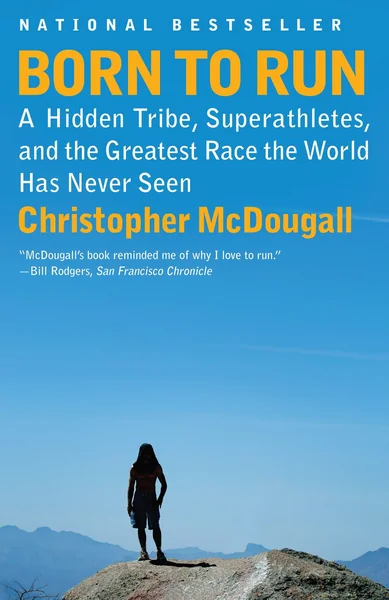
Born to Run: A Hidden Tribe, Superathletes, and the Greatest Race the World Has Never Seen
At a glance

Born to Run
A Hidden Tribe, Superathletes, and the Greatest Race the World Has Never Seen
LuvemBooks Verdict
Best for: Runners and non-runners alike who are drawn to adventure-driven narrative non-fiction and want an accessible, energetic introduction to the worlds of ultramarathoning, minimalist footwear, and evolutionary running science.
Worth it? Skip it? Read the full verdict →Ask LuvemBooks
Was this helpful?
- Is it worth reading?
- For readers drawn to narrative non-fiction that blends personal transformation with reportage and big-idea science, Born to Run is a standout — Washington Post critic Dan Zak described the prose as "engaging and buddy-buddy, as if he's an enthusiastic friend tripping over himself to tell a great story." Its cultural impact is real: the book is credited with significantly influencing how runners think about form, footwear, and human potential, and it appeared on critics' Best of 2009 lists and Barnes & Noble's Best Nonfiction of 2009. The key caveat is that the book's shoe-injury argument overstates the scientific consensus — the very study McDougall cites explicitly warned against the causal interpretation he draws from it — so readers seeking peer-reviewed biomechanical analysis will find the journalistic approach frustrating. As a gateway book that makes runners question their assumptions and non-runners curious about human limits, it has few peers in its genre.
- Similar books
- Readers who enjoyed Born to Run are well served by several books in adjacent territory. Christopher McDougall's Natural Born Heroes and Running with Sherman revisit his themes of human physical potential and adventure narrative. Alex Hutchinson's Endure: Mind, Body, and the Curiously Elastic Limits of Human Performance offers a more rigorously science-grounded exploration of endurance, making it a natural complement for readers who found Born to Run's scientific claims too loosely argued. Dean Karnazes's Ultramarathon Man: Confessions of an All-Night Runner delivers a first-person adventure in the same ultramarathon world, while David Epstein's The Sports Gene: Inside the Science of Extraordinary Athletic Performance digs deeper into the evolutionary and genetic science of athletic ability that McDougall touches on.
- Who should read this?
- Born to Run is the natural read for runners of any level — from competitive ultramarathoners to recreational joggers — who want to question their assumptions about footwear, form, and human potential. It also has genuine appeal for readers interested in indigenous cultures, evolutionary anthropology, and adventure narrative, making its audience considerably broader than the running world alone. Readers who prefer rigorous, peer-reviewed treatment of biomechanics or running physiology may find the journalistic approach frustrating, as the book's strongest claims — particularly the shoe-injury argument — are presented with more confidence than the underlying evidence fully supports.
- About Christopher McDougall
- Christopher McDougall is an American author and journalist.
- What impact did this book have?
- Born to Run is widely credited with reshaping mainstream running culture in the late 2000s and early 2010s — specifically by bringing the minimalist and barefoot footwear debate and the endurance running hypothesis to a broad public audience. According to Wikipedia's reception summary, the book significantly influenced how runners think about form, footwear, and human potential. Its commercial reach — over three million copies sold and more than four months on The New York Times Best Seller list — gave those ideas unusual mainstream visibility, well beyond the specialist running community.
- What are the book's main arguments?
- Born to Run advances two central arguments beyond its adventure narrative. First, McDougall contends that the thick cushioning of modern running shoes — introduced to the mass market beginning in 1972 — is a primary driver of running injuries, contrasting it with the thin sandals worn by Tarahumara runners. Second, he promotes the endurance running hypothesis: the idea that humans, unique among primates, developed the biological capacity for long-distance running as a survival strategy on the African savanna, essentially running prey to exhaustion. Both arguments proved genuinely influential with a wide public audience, though the shoe-injury claim has drawn pointed scrutiny — the Berne Grand Prix questionnaire McDougall cites as evidence comes with an explicit caution from its own authors against the causal reading he applies to it.
Summarize this book
Follow up
Synthesized from verified book data & published reviews · How we review
Press Enter to ask. Answers come from our editorial Q&A — start typing to see related questions.
Age & Reading Level
Recommended age
Adult
Reading level
Adult
who it suits
Skip if you want rigorous, peer-reviewed analysis of running biomechanics rather than enthusiastic adventure journalism
Editorial Review
Christopher McDougall's Born to Run: A Hidden Tribe, Superathletes, and the Greatest Race the World Has Never Seen is a bestselling work of non-fiction that traces the author's journey into the Mexican Copper Canyons to find the reclusive Tarahumara tribe, weaving together adventure narrative, evolutionary science, and a provocative argument about modern running shoes — a combination that has sold over three million copies and spent more than four months on The New York Times Best Seller list.
Read the Full ReviewBooks like Born to Run
Curated picks for readers who enjoyed Born to Run, with our reasoning for each match.