BOOKS
Published

Read Time

3 min read

Curated & edited by

LuvemBooks Editorial

How we create our reviews →
Share This Review

Project Hail Mary by Andy Weir Review: A Thrilling, Hugo-Finalist Hard Sci-Fi Epic

Andy Weir's *Project Hail Mary* is a #1 New York Times bestselling hard science fiction novel in which junior high school teacher and molecular biologist Ryland Grace wakes alone aboard a spacecraft with no memory — only to discover he is humanity's last hope against an extinction-level threat. Praised by Entertainment Weekly as "propulsive," named a Hugo Award finalist, and adapted into a major 2026 motion picture starring Ryan Gosling, the novel is one of the most acclaimed science fiction works of its era.

LuvemBooks Verdict

Best for

Readers who love hard science fiction anchored in real biology and physics — especially fans of The Martian who want a witty, problem-solving protagonist facing even higher stakes on a one-way mission to save humanity.

Worth it if

You find humanity's capacity for ingenuity and unexpected connection compelling, and you're willing to engage with dense but carefully explained science as the primary engine of plot and suspense.

Skip if

You're drawn primarily to emotionally textured, character-driven fiction and have little patience for extended in-narrative scientific exposition — particularly the lengthy passages unpacking Astrophage mechanics.

What readers & critics say

NPR highlights Andy Weir's intentional centering of hope in what it calls his "bestselling" novel, noting the existential stakes of Grace's solo mission to save humanity from a dying Sun. Reader critics retrieved across multiple outlets consistently praise the book's tonal balance — what one reviewer at whatisquinnreading.com describes as "nitty-gritty details… evened out by a story bursting with heart," and McNally Jackson aggregates major outlet praise including The Boston Globe calling it "a crowd-pleaser on the grandest scale" and The Guardian calling it "funny, well plotted, and full of surprises."

A crowd-pleaser on the grandest scale.

McNally Jackson (citing The Boston Globe)

Funny, well plotted, and full of surprises.

McNally Jackson (citing The Guardian)

Weir effortlessly combines pretty dense science with humor and an engaging narrative in a really refreshing way.

Kelly's Reads

Nitty-gritty details on mechanics and physics are evened out by a story bursting with heart.

What Is Quinn Reading
Sources: NPR, What Is Quinn Reading, McNally Jackson, Kelly's Reads, YU Commentator
In This Review
  • What Works & What Doesn't
  • What the Novel Is and What Actually Happens
  • Significance and Reception
  • Weir's Craft: Science as Storytelling Engine
  • A Genuine Limitation: The Weight of Exposition
  • Who This Book Is For and Its Lasting Place

What Works & What Doesn't

What Works
  • #1 New York Times bestseller with 47 weeks on the list and a Hugo Award finalist nod — one of the most decorated science fiction novels of its era
  • Ryland Grace is a fully realized protagonist whose specific expertise in molecular biology drives every plot development, not just his personality
  • Dual-timeline structure — Grace's present mission interwoven with Earth flashbacks — delivers the backstory in carefully rationed pieces that sustain suspense
  • Named one of the 100 Best Books of the 21st Century by the New York Times and praised by major outlets including Entertainment Weekly, USA Today, Kirkus Reviews, and Library Journal
  • The Audie Award-winning audiobook narrated by Ray Porter offers a highly regarded alternative format for the story
What Doesn't
  • The density of in-narrative scientific explanation can slow dramatic momentum in stretches, particularly in sections detailing Astrophage mechanics — a trade-off hard sci-fi readers expect but others may find demanding
  • Readers drawn primarily to emotional or character-driven fiction rather than technical problem-solving may find the novel's priorities at odds with their own
Project Hail Mary is a triumph of high-concept hard science fiction that earned its #1 New York Times bestseller status and its place as a Hugo Award finalist through a relentlessly inventive premise, a vividly drawn protagonist, and a plot structured around scientific problem-solving at the edge of human survival.

What the Novel Is and What Actually Happens

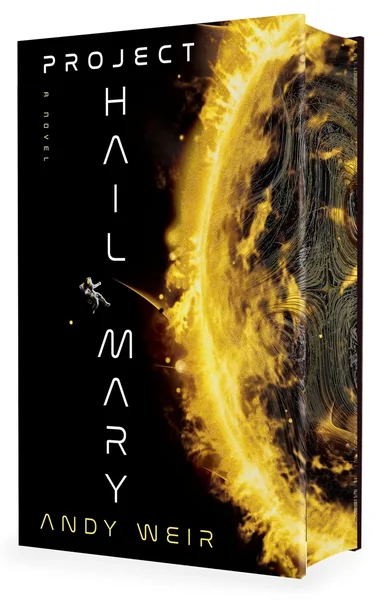
Project Hail Mary (Deluxe Edition): A Novel by Andy Weir front cover
Published in 2021 by Andy Weir, Project Hail Mary opens with Ryland Grace — a junior high school teacher with a PhD in molecular biology — regaining consciousness aboard a spacecraft with no memory of who he is or why he is there. What his returning memories gradually reveal is dire: in the near future, the Sun has been dimming at an exponential rate due to single-celled organisms Grace himself named "Astrophage," which consume electromagnetic radiation and breed by feeding off the Sun and carbon dioxide from Venus. An infrared trail running from the Sun to Venus, dubbed the Petrova line after its discoverer Dr. Irina Petrova, is the first clue. On Earth, former European Space Agency administrator Eva Stratt is granted near-unilateral authority by the world's governments to coordinate a response. Her task force determines that one nearby star, Tau Ceti, has resisted the Astrophage infection — and builds the starship Hail Mary to investigate. Because only enough Astrophage fuel exists for a one-way trip, Grace and his crewmates are sent on a mission from which they were never expected to return. The novel uses two interlocking timelines — Grace's present aboard the ship and flashbacks to his life on Earth — to deliver that backstory in carefully rationed pieces.

Significance and Reception

The record of Project Hail Mary's reception is difficult to overstate. Penguin Random House confirms it debuted on the New York Times bestseller list and reached #1; as of May 2026, Wikipedia notes it had appeared on that list for 47 weeks in total. It was a finalist for the 2022 Hugo Award for Best Novel, and the unabridged audiobook, narrated by Ray Porter, won the 2022 Audie Award for Audiobook of the Year. Major outlets singled it out as one of the year's best books — among them Parade, Newsweek, the New York Public Library, Kirkus Reviews, and Library Journal. The New York Times named it one of the 100 Best Books of the 21st Century. USA Today called it "an epic story of redemption, discovery, and cool speculative sci-fi," and Entertainment Weekly described it as "propulsive." Bestselling author Blake Crouch wrote, "Mark my words: Project Hail Mary is destined to become a classic." That breadth of critical and popular enthusiasm is not a matter of hedged opinion — it is the documented record.

Weir's Craft: Science as Storytelling Engine

What distinguishes Project Hail Mary within Weir's body of work — and within the broader hard sci-fi genre — is the degree to which rigorous scientific reasoning functions as the primary driver of plot and character. Grace's background in molecular biology is not incidental window dressing; it is the mechanism through which every major story development unfolds. The discovery of Astrophage, the engineering of an Astrophage-fueled engine, and Grace's in-mission problem-solving are all constructed around real scientific disciplines. The novel's dual-timeline structure compounds this, allowing Weir to withhold and release information in a way that sustains tension while also rewarding readers who engage with the science. Entertainment Weekly's characterization of the book as "cinematic" reflects how efficiently Weir converts technical material into momentum — a quality that made The Martian a crossover hit and that is on full display here.

A Genuine Limitation: The Weight of Exposition

While the scientific detail is the novel's engine, some readers note that the density of in-narrative explanation can slow the pace in stretches, particularly in the novel's middle sections where Weir unpacks the mechanics of Astrophage at length. One reader account observed that portions of the plot lean heavily on science as explanation in ways that can feel like pauses in dramatic momentum. This is a trade-off inherent to hard science fiction as a form: the payoff for readers who relish technical depth is real, but readers drawn primarily to character or emotional texture may find the expository passages more demanding. It is worth noting that this critique applies to a specific subset of the readership — the novel's overwhelmingly positive critical reception suggests the balance works for the majority.

Who This Book Is For and Its Lasting Place

With a major motion picture directed by Phil Lord and Christopher Miller, starring Ryan Gosling and Sandra Hüller, released to theaters in March 2026, Project Hail Mary has moved well beyond the traditional science fiction readership. Readers who found The Martian accessible will find the same voice here — witty, grounded in character, and deeply committed to making science feel like adventure rather than lecture. The novel is designed for readers who want their speculative fiction anchored in plausible physics and biology, and who find humanity's capacity for ingenuity — and for unexpected connection — to be a worthwhile subject for a thriller. Its New York Times designation as one of the 100 Best Books of the 21st Century places it not just as a genre standout but as a work of broader literary and cultural significance.

Sources & Further Reading

The key facts and claims in this review are grounded in the retrieved, verified sources listed below.

  1. 1
    Andy Weir — author profileHigh-authority source

    Andy Weir, Wikipedia

  2. 2
  3. 3
  4. 4
  5. 5
  6. 6
  7. 7
  8. 8
  9. 9
  10. 10