BOOKS
Published

Read Time

3 min read

Curated & edited by

LuvemBooks Editorial

How we create our reviews →
Share This Review

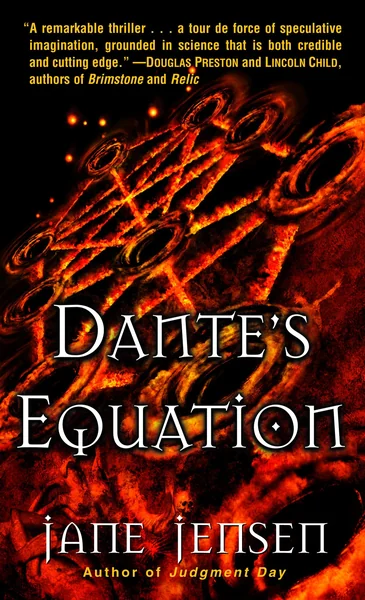
Dante's Equation by Jane Jensen Review: Ambitious Sci-Fi Thriller of Science and Mysticism

Jane Jensen's Dante's Equation is a 2003 science fiction adventure novel that weaves together Kabbalah, theoretical physics, the Holocaust, and multiverse theory into a sprawling, high-concept thriller — one ambitious enough to earn a Philip K. Dick Award Special Citation, even as Kirkus Reviews found its plot and characters a tough slog.

LuvemBooks Verdict

Best for

Readers drawn to speculative fiction that ambitiously fuses Kabbalistic mysticism, theoretical physics, and Holocaust history into a single cosmological framework — and who can tolerate morally ambiguous or outright unlikeable protagonists in service of big ideas.

Worth it if

You prize conceptual architecture and interdisciplinary ambition over tight plotting and sympathetic characters, and the premise of a physicist-mystic vanishing from Auschwitz with a wave equation for good and evil genuinely intrigues you.

Skip if

You need clean internal plot logic and at least one protagonist to root for across 600-plus pages — Kirkus Reviews' warning of a "plot that doesn't add up" and a cast that is largely "a nasty bunch" is a serious red flag for readers expecting a mainstream thriller's satisfactions.

What readers & critics say

Kirkus Reviews called the novel "intriguing and often surprising, but what with a plot that doesn't add up and (with one exception) a nasty bunch of characters: mostly a tough slog," while Publishers Weekly characterised it as "ambitious, if not entirely successful." SFF Chronicles offered a more generous reassessment, finding that Jensen "uses its length to develop the characters into distinctive and convincing individuals," with a reviewer noting their "original high opinion was reinforced by a second reading."

Intriguing and often surprising, but what with a plot that doesn't add up and a nasty bunch of characters: mostly a tough slog.

Kirkus Reviews

Ambitious, if not entirely successful — incorporates elements of Kabbalah as well as theoretical physics.

Publishers Weekly
Sources: Kirkus Reviews, Publishers Weekly, SFF Chronicles, Writers Write, Alchetron
4.1from 67 Amazon ratings— reader ratings, not a LuvemBooks score
In This Review
  • What Works & What Doesn't
  • What the Novel Is and What It Argues
  • Conceptual Ambition and Genre Significance
  • Strengths: Intrigue, Scope, and the Kobinski Thread
  • Limitations: Plot Logic and Character Likeability
  • Who This Book Is For

What Works & What Doesn't

What Works
  • Earned a Philip K. Dick Award Special Citation, recognizing its distinction within speculative fiction
  • Integrates Kabbalistic mysticism, theoretical physics, and Holocaust history into a single, ambitious conceptual framework
  • The Kobinski backstory — a physicist-mystic vanishing from Auschwitz in a witnessed flash of light — provides a compelling narrative engine
  • The multiverse structure, in which each character's spiritual state determines their assigned world, gives the novel unusual architectural depth for the thriller genre
  • Publisher blurb quotes John Case praising it as 'a combustible mixture of science and mysticism, a high-altitude thriller fizzing with intrigue'
What Doesn't
  • Kirkus Reviews found the plot logic ultimately doesn't add up under the weight of its ambitions
  • Kirkus also singled out the characters as largely unsympathetic, calling the overall experience 'mostly a tough slog' — a significant challenge across a very long narrative
  • Jensen herself described the book as a critical and commercial disappointment, signaling that its reach exceeds its grasp in ways even its author acknowledges
Jensen's Dante's Equation is a science fiction adventure novel that earns its Philip K. Dick Award Special Citation through sheer intellectual ambition — though that ambition comes with real trade-offs that readers should weigh before diving in.

What the Novel Is and What It Argues

At its core, Dante's Equation is built around a single audacious premise: that a Polish rabbi and physicist named Yosef Kobinski, imprisoned at Auschwitz during World War II, discovered an actual physical law of good and evil — a wave equation describing a fifth dimension in which spiritual progress or regress determines which universe a being inhabits. Kobinski's manuscript, The Book of Torment, written on whatever materials the camp afforded and later recovered by a follower, becomes the novel's MacGuffin and its moral center. The story opens in the present day (set in 2005), where four characters — each unaware of the others — are independently closing in on Kobinski's legacy: Rabbi Aharon Handalman in Jerusalem, decoding Torah text that keeps surfacing Kobinski's name; physicist Jill Talcott in Seattle, whose energy wave experiments are unknowingly echoing Kobinski's equations; tabloid journalist Denton Wyle in Los Angeles, obsessed with mysterious disappearances since witnessing a friend vanish in a flash of light as a child; and Calder Farris, a cold-eyed Defense Department operative whose mission is to weaponize — or suppress — any dangerous new science. All four eventually converge outside Auschwitz and are pulled through what the novel frames as a micro black hole, scattered across different worlds in the multiverse, each world calibrated to the spiritual frequency of its new inhabitant.

Conceptual Ambition and Genre Significance

The novel's central conceit — that the Kabbalistic framework of the Sefirot and the physicist's wave equation are two languages describing the same underlying reality — gives Dante's Equation a conceptual richness rare in mainstream thriller fiction. A prefatory diagram, "Dante's Wheel," maps the four protagonists' personalities against the divine Sefirot, linking each character to the universe they will inhabit. This structural self-consciousness signals Jensen's intent to write something more than a chase novel: she is building a cosmology. The Philip K. Dick Award Special Citation, granted by the Philadelphia Science Fiction Society to works of distinguished science fiction published in paperback original form, is a meaningful recognition of the novel's place within serious speculative fiction. Jensen had previously published Millennium Rising, and Dante's Equation represented a significant expansion in scope and philosophical ambition from that debut.

Strengths: Intrigue, Scope, and the Kobinski Thread

Where the novel draws the strongest praise is in its synthesis of disciplines that rarely share page space. Penguin Random House's publisher description quotes John Case, author of The Eighth Day, calling it "a combustible mixture of science and mysticism, a high-altitude thriller fizzing with intrigue." The Kobinski backstory — a genius physicist-mystic vanishing from a death camp in a witnessed blaze of light, his equations buried in the earth — is the novel's most compelling narrative engine. The Wikipedia summary of the book's reception notes that one reader response characterized it as "fast-paced, suspenseful, and intellectually engaging," specifically contrasting its handling of religious symbology and thriller mechanics favorably against Dan Brown's The Da Vinci Code. The multiverse structure, in which each character's moral and spiritual state determines the nature of the world they are sent to, gives the second half of the book a genuinely unusual architecture for the genre.

Limitations: Plot Logic and Character Likeability

Kirkus Reviews, in its contemporaneous assessment, lands the most pointed critique: the novel is "intriguing and often surprising, but what with a plot that doesn't add up and (with one exception) a nasty bunch of characters: mostly a tough slog." That verdict points to two distinct friction points. First, the plot's internal logic strains under the weight of its ambitions — the mechanics of how the five-dimensional physics interact with the thriller's on-the-ground procedural elements do not always cohere. Second, and perhaps more damagingly for a 600-page novel, several of the four protagonists are described as difficult to root for. Calder Farris is designed to be antagonistic, but when the characters the reader is meant to follow are also largely unsympathetic, sustaining investment across a long narrative becomes work. Jensen herself, according to the Wikipedia record, described the book as a critical and commercial disappointment — a candid self-assessment that aligns with the mixed critical record.

Who This Book Is For

Dante's Equation rewards readers who come to it specifically for the collision of ideas: Holocaust history, Kabbalistic mysticism, theoretical physics, and parallel-worlds science fiction, all pressed together into a single narrative frame. Those drawn to speculative fiction that takes its conceptual architecture seriously — and who can tolerate morally ambiguous or outright unlikeable protagonists as part of a thematically ambitious design — will find more to engage with here than the Kirkus verdict alone suggests. Readers expecting the smoother character dynamics and tidy plotting of mainstream thrillers may find Jensen's reach exceeds her grasp. It is a novel that, even in falling short of all its ambitions, occupies genuinely unusual territory in the science fiction landscape — which is precisely the kind of work the Philip K. Dick Award Special Citation exists to recognize.

Sources & Further Reading

The key facts and claims in this review are grounded in the retrieved, verified sources listed below.

  1. Cited in this review
  2. 1
  3. Further reading
  4. 2
  5. 3
  6. 4
  7. 5
  8. 6
  9. 7
  10. 8
  11. 9
  12. 10
  13. 11
  14. 12
Related Reviews

Reviews of books we picked for readers who enjoyed Dante's Equation.