BOOKS
Published
Read Time
7 min read
Our Rating
3.2
Share This Review
Snatched Psychology by Mary Nhin - Review
Our Rating
3.2
A well-intentioned introduction to psychology concepts for children that succeeds in making complex ideas accessible, though the extended food metaphors sometimes limit rather than enhance understanding.
In This Review
- What Works & What Doesn't
- A Feast of Psychological Concepts Made Simple
- Nhin's Approach to Child Psychology Education
- Making Psychology Digestible for Young Minds
- Educational Value and Age Appropriateness
- Where It Shines and Where It Stumbles
- Our Take on This Psychology Primer
What Works & What Doesn't
What Works
- Makes psychological concepts accessible to young readers through relatable metaphors
- Includes practical applications children can use in daily situations
- Engaging illustrations support visual learners
- Age-appropriate language and pacing for elementary readers
- Provides good conversation starters for parents and educators
What Doesn't
- Extended food metaphor feels forced when applied to complex psychological concepts
- Limited scope due to metaphorical constraints
- May oversimplify important mental health topics
- Tonal inconsistencies between playful presentation and serious content
A Feast of Psychological Concepts Made Simple
A smart but uneven introduction to self-awareness for elementary-aged readers — the "snack" metaphor earns its keep on simple concepts but buckles under the book's more complex ones. Mary Nhin structures the book around relatable scenarios that children encounter daily. Rather than diving into academic psychological theory, she presents concepts through situations kids understand - from playground dynamics to family interactions. The "snack" metaphor becomes a lens through which young readers can examine their own thoughts and behaviors.
The book's visual presentation supports its accessibility goals. Bright, engaging illustrations complement each concept, helping visual learners grasp abstract psychological ideas. The cover design suggests a playful, non-threatening approach to what could otherwise be intimidating subject matter for young minds.
Perfect for beginners to psychology concepts, the book avoids jargon while maintaining accuracy in its presentation of fundamental ideas. Parents looking for age-appropriate ways to discuss emotional intelligence and self-awareness will find useful conversation starters throughout.
Nhin's Approach to Child Psychology Education
The author's writing style prioritizes clarity over complexity, a wise choice given her target audience. Short sentences and familiar vocabulary make the content accessible to elementary-aged readers, while the metaphorical framework provides memorable hooks for retaining information.
Unlike most psychology books, Nhin doesn't separate theory from application. Instead, she weaves practical examples throughout, showing children how psychological concepts play out in their daily lives. This integration helps young readers see psychology as relevant rather than abstract.
The pacing moves at a comfortable speed for young attention spans. Each concept receives adequate explanation without overwhelming detail, and the food metaphors provide consistent reference points that help maintain engagement across chapters.
Making Psychology Digestible for Young Minds
For readers who want to introduce children to self-awareness concepts, the book offers several strengths. The central metaphor of "eating versus being eaten" translates ideas about agency and choice into language children can understand and remember.
The practical applications focus on everyday situations - handling peer pressure, making good choices, understanding emotions, and developing resilience. These are concrete skills children can practice immediately.
However, the main weakness lies in the metaphor's limitations. While "snack" analogies work well for some concepts, they occasionally feel forced when applied to more nuanced psychological ideas. Some readers might find the extended food metaphor becomes repetitive rather than helpful.
Educational Value and Age Appropriateness
The bottom line on age suitability: this book works best for children aged 8-12 who are beginning to develop abstract thinking skills. Younger children might enjoy the illustrations but miss the psychological connections, while older readers could find the approach too simplistic.

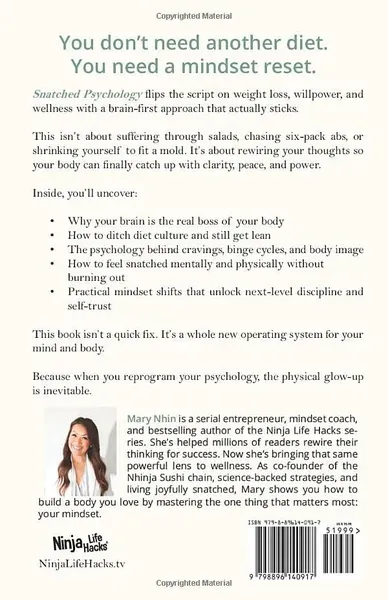
Back cover with book synopsis, key topics, author bio, and barcode.
The educational content aligns with social-emotional learning objectives many schools emphasize. Teachers and counselors looking for accessible resources to discuss self-regulation and decision-making will find practical material here, though the approach may feel overly cute for some educational settings.
Research-backed strategies appear throughout, though Nhin wisely avoids citing studies or using academic language that would alienate young readers. The psychological principles are sound, even if the presentation prioritizes engagement over depth.
Where It Shines and Where It Stumbles
The book succeeds in making psychology approachable for children. The food-metaphor structure gives kids a concrete handle on ideas like peer pressure and emotional choice. Recommended for parents who want a conversation-starter about self-awareness — not a comprehensive guide.
However, where it falls short is in addressing more complex psychological concepts that don't fit neatly into the snack metaphor. Some important ideas about mental health and emotional regulation receive superficial treatment because they don't align well with the book's central conceit.
The illustrations, while engaging, occasionally feel disconnected from the text's more serious psychological points. This creates some tonal inconsistencies that might confuse readers about whether they're reading an educational resource or entertainment.
Not recommended for children dealing with serious mental health challenges, as the simplified approach may trivialize their experiences. Similarly, parents expecting comprehensive coverage of child psychology will find the scope limited by the metaphorical constraints.
Our Take on This Psychology Primer
Snatched Psychology succeeds as an introduction to psychological thinking for elementary-aged children, despite its limitations. The food metaphors give kids a memorable way to think about choice and agency — even when they don't perfectly fit every concept.
Best for parents and educators who can supplement the book with deeper discussions. It works as a starting point for conversations about self-awareness and decision-making, not a complete resource for child psychology education.
If starting a conversation about self-awareness and choice with an 8–12-year-old is your goal, Nhin's approach earns its place on the shelf.
Frequently Asked Questions
is Snatched Psychology: To Eat a Snack or Be a Snack by Mary Nhin worth reading for kids
It depends on the child and the goal — the reviewer calls it a solid introduction to psychological thinking for elementary-aged children, praising its bright illustrations and jargon-free explanations of concepts like emotional intelligence and self-awareness. However, it earns only 3.2/5 because the extended food metaphors can feel forced or repetitive, and it shouldn't be treated as a complete resource for child psychology education.
what is Snatched Psychology: To Eat a Snack or Be a Snack by Mary Nhin actually about
The book uses a "snack" metaphor — framing choices and agency around the idea of "eating versus being eaten" — to introduce children to psychology concepts like peer pressure, emotional regulation, resilience, and decision-making. Rather than presenting academic theory, Mary Nhin grounds every concept in relatable daily scenarios kids encounter, from playground dynamics to family interactions.
what age is Snatched Psychology: To Eat a Snack or Be a Snack by Mary Nhin good for
The reviewer says it works best for children aged 8–12 who are beginning to develop abstract thinking skills. Younger children might enjoy the illustrations but miss the psychological connections, while older readers could find the approach too simplistic.
does the snack metaphor in Snatched Psychology: To Eat a Snack or Be a Snack by Mary Nhin actually work
Partly — the reviewer notes the "eating versus being eaten" framing translates complex ideas about agency and choice into language children can understand and remember, and it provides consistent reference points across chapters. But the main weakness identified is that the metaphor feels forced when applied to more nuanced psychological ideas, and some important concepts about mental health and emotional regulation receive only superficial treatment because they don't fit the central conceit.
can teachers or school counselors use Snatched Psychology: To Eat a Snack or Be a Snack by Mary Nhin in the classroom
The reviewer says the educational content aligns with social-emotional learning objectives many schools emphasize, offering practical material on self-regulation and decision-making. That said, the reviewer also flags that the overly cute approach may not feel appropriate for all educational settings.
is Snatched Psychology: To Eat a Snack or Be a Snack by Mary Nhin good for a child dealing with mental health issues
The reviewer explicitly says it is not recommended for children dealing with serious mental health challenges, warning that the simplified approach may trivialize their experiences. Similarly, parents expecting comprehensive coverage of child psychology will find the scope limited by the metaphorical constraints.
is Snatched Psychology: To Eat a Snack or Be a Snack by Mary Nhin better as a starting point or a complete guide to kids psychology
Strictly a starting point — the reviewer describes it as best used by experienced parents and educators who can supplement its simplified approach with deeper discussions. The content works well as a conversation starter about self-awareness and decision-making, but it is not a complete resource for child psychology education.
Related Reviews
Reviews of books we picked for readers who enjoyed Snatched Psychology.


Reader Comments
No comments yet
Be the first to share your thoughts!