BOOKS
Published

Read Time

8 min read

Curated & edited by

LuvemBooks Editorial

How we create our reviews →
Share This Review

Grudge by Dr. Hussam Atef Elkhatib Review: A Compact Study of Resentment

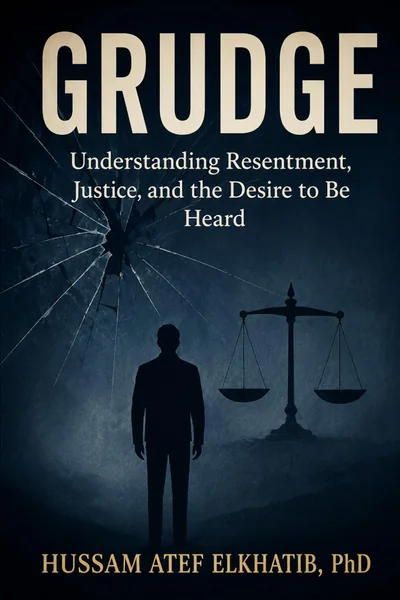
Dr. Hussam Atef Elkhatib's Grudge: Understanding Resentment, Justice, and the Desire to Be Heard is a short, independently published self-help book about why people hold onto emotional pain. Its justice-and-being-heard framing is its strongest asset; at 117 pages, depth is limited and its practical value is untested here.
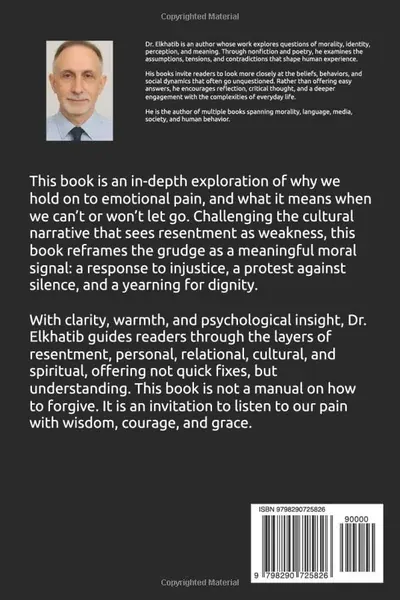
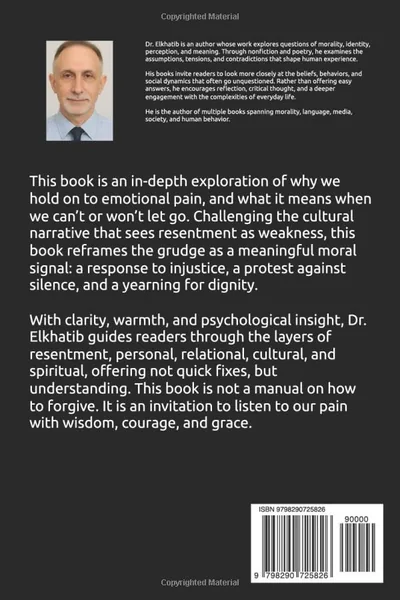
Back cover with author photo, biographical text, book synopsis, and barcode.Tap to enlarge

LuvemBooks Verdict

Best for

A general reader who recognises a persistent resentment in their own life — or wants to understand someone else's — and is looking for a short, sympathetic framework for making sense of it before deciding what to do about it.

Worth it if

Worth it if "just forgive and move on" advice has always rung hollow and you want a compact, compassionate reframe — resentment as a signal about justice and the need to be heard — rather than a clinical protocol or broad emotional-health programme.

Skip if

Skip it if you want a comprehensive treatment with extensive case material, research apparatus, or structured exercises — or if your grievance is deep or trauma-linked, in which case 117 pages of reflective guidance is a starting point, not a substitute for professional support.

Age & Reading Level

Recommended age

Adult

Reading level

Adult

Skip if you want a comprehensive, research-backed treatment of resentment with case studies, structured exercises, or a named therapeutic methodology — at 117 pages this is a reflective entry point, not a clinical protocol.

In This Review
  • What Works & What Doesn't
  • What the Book Argues
  • Scope of This Review
  • Format and Accessibility
  • Where Its Strength Lies
  • Honest Limitations
  • Who It Is For

What Works & What Doesn't

What Works
  • Reframes grudges around justice and the need to be heard — a more productive lens than 'just let it go'
  • Publisher describes a compassionate, non-shaming approach to emotional pain
  • Compact 117-page format lowers the barrier for readers mid-grievance
  • Sustained single-subject focus rather than a diffuse self-help survey
What Doesn't
  • At 117 pages, the treatment of a complex subject is necessarily brief — readers wanting depth, case studies, or structured exercises may find it slight
  • Single-author, single-topic focus means no breadth beyond the one emotion
  • Not grounded in a named, established therapeutic methodology — reflective guidance rather than clinical protocol
A short, independently published examination of why people hold onto resentment, Grudge stakes its value on the usefulness of its central framing rather than on clinical authority or breadth.

What the Book Argues

Grudge: Understanding Resentment, Justice, and the Desire to Be Heard is a self-help title by Dr. Hussam Atef Elkhatib, independently published in paperback in July 2025. The subtitle lays out its three-part thesis: a grudge is not simply anger but a tangle of resentment, a sense of violated justice, and an unmet need to be heard. The publisher's description presents it as a compassionate, in-depth exploration of why people hold on to emotional pain — and of what it means when they can't or won't let go.
That framing is the book's distinguishing move. Rather than treating a grudge as a character flaw to be scolded away, it treats sustained resentment as a signal: something unresolved about fairness, acknowledgement, or voice. Readers who have found "just forgive and move on" advice hollow will recognise the problem the book sets out to address.

Scope of This Review

This is a practical, use-oriented book, and its real test — whether its framing helps a reader actually work through a long-held grievance — is one this review has not applied. What follows is based on the book's published description, format, and positioning, not on hands-on use of its guidance. There is no documented body of professional critical coverage for this title to draw on, so judgements here are limited to what the record supports: what the book contains, how it is pitched, and who it is built for.

Format and Accessibility

At 117 pages in a 6 x 9 inch paperback, Grudge is a compact read rather than a comprehensive psychology text. That brevity cuts both ways. On one side, it keeps the barrier to entry low: a reader in the middle of an actual grievance can engage with a single-focused, short book in a way they never would with a dense clinical volume. On the other, 117 pages is a small canvas for a subject as layered as chronic resentment, and readers wanting extensive case material, research apparatus, or structured exercises should calibrate expectations accordingly.
The book sits in the general self-help space rather than the academic psychology shelf. It is written for lay readers wrestling with their own grudges — or trying to understand someone else's — not for clinicians seeking a professional reference.
Back cover with author photo, biographical text, book synopsis, and barcode.

Where Its Strength Lies

The strongest thing the book has going for it, per its published description, is conceptual: the triad in its subtitle. Connecting grudges to justice and the desire to be heard reframes holding on as an understandable response to feeling wronged and unheard, rather than mere stubbornness. That is a more productive starting point for self-examination than shame-based framing, and it aligns the book with a compassionate rather than prescriptive tone — the description explicitly emphasises compassion in its approach to emotional pain.
A single-author, single-subject treatment also means the book stays on one question throughout, which suits readers who want focus over survey.

Honest Limitations

The same focus that gives the book clarity also bounds it: this is one emotion, examined at short length, from one author's perspective. Readers looking for a broader emotional-health programme, or for guidance grounded in a named therapeutic methodology with an established evidence base, will not find confirmation of that here. The brevity that makes it approachable also means readers with deep or trauma-linked grievances should treat it as a starting point for reflection, not a substitute for professional support — a fair caveat for any short self-help title on this subject.

Who It Is For

Grudge is best suited to a general reader who recognises a persistent resentment in their own life and wants a short, sympathetic framework for understanding it before deciding what to do about it. It is a reflective entry point — modest in length, specific in focus — rather than a definitive treatment of the psychology of forgiveness.

Sources & Further Reading

The key facts and claims in this review are grounded in the retrieved, verified sources listed below.

  1. Cited in this review
  2. 1
  3. Further reading
  4. 2