BOOKS
Published

Read Time

9 min read

Curated & edited by

LuvemBooks Editorial

How we create our reviews →
Share This Review

Good-bye Anxiety, Depression, Addiction & PTSD by Fredric Schiffer M.D. Review: A Clinician's Case for Dual-Brain Healing

This review covers the content and published reception of Good-bye Anxiety, Depression, Addiction & PTSD by Harvard-trained psychiatrist Dr. Fredric Schiffer, published by Stoneway Press in September 2024 — not hands-on application of its techniques. The book presents Schiffer's Dual-Brain Psychology framework, arguing that each brain hemisphere can support a distinct "mind" — one healthy and mature, the other often held in trauma — and that targeting the troubled hemisphere can alleviate anxiety, depression, addiction, and PTSD. It is designed to serve both mental health professionals and general readers seeking self-directed tools for recovery.
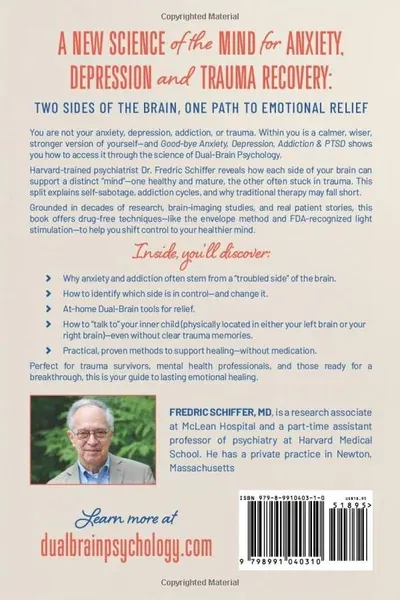
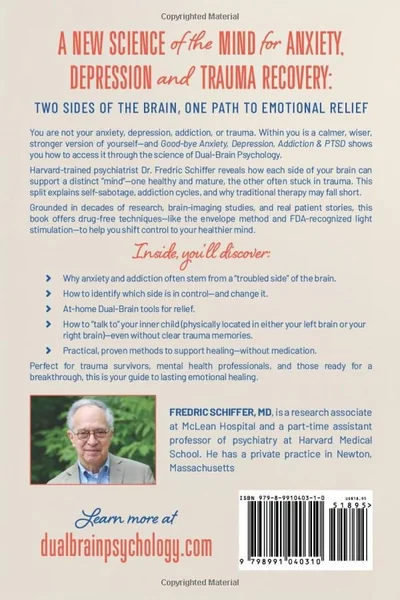
Back cover with book synopsis, author biography with photo, and barcode.Tap to enlarge
In This Review
  • What Works & What Doesn't
  • What the Book Argues and How It Is Structured
  • Its Place in Schiffer's Body of Work
  • Bridging Neuroscience and Practical Application
  • Reception and Credibility Signals
  • Who Will Find It Most Useful

What Works & What Doesn't

What Works
  • Builds systematically on Schiffer's earlier Dual-Brain Psychology framework, offering his most detailed and application-oriented treatment of the theory to date
  • Designed to serve both mental health professionals and general readers, bridging neuroscientific theory with practical self-directed tools
  • Authored by a Harvard-trained psychiatrist whose clinical credentials lend institutional grounding to the framework
  • A credentialed psychiatrist and bestselling author has publicly praised the book for clarifying the neuroscience of the dual-brain system and illustrating its real-world applications
  • Reader commentary highlights its value in making complex hemisphere-specific trauma processing legible and actionable
What Doesn't
  • The independent peer-reviewed scientific standing of Dual-Brain Psychology as a clinical framework is not established by available published sources, making it difficult to assess how well the theory is validated outside Schiffer's own research program
  • Published reception, while positive, is drawn from a narrow base of sources rather than broad, multi-outlet critical evaluation — readers seeking wide consensus will find the record limited
This review is based on published sources and the book's documented content and reception — not hands-on application of its methods.
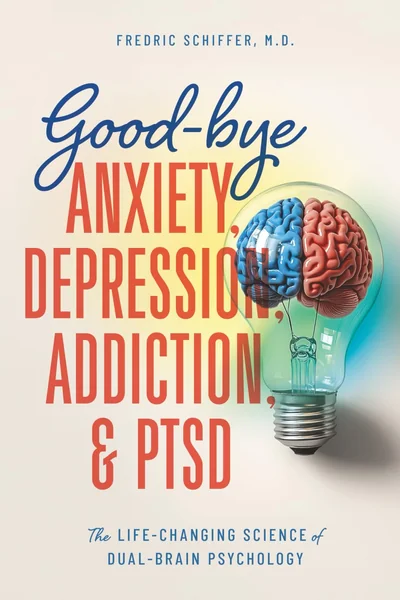
Good-bye Anxiety, Depression, Addiction & PTSD: The Life-Changing Science of Dual-Brain Psychology by Fredric Schiffer front cover

What the Book Argues and How It Is Structured

At the center of Good-bye Anxiety, Depression, Addiction & PTSD is Dr. Fredric Schiffer's Dual-Brain Psychology theory: the proposition that the two hemispheres of the brain can each support a distinct psychological "mind," and that when childhood trauma roots itself in the immature or troubled half of the brain, the result is conditions including anxiety, depression, addiction, and PTSD. Schiffer's thesis, as the book's own framing states, is that "within you is a calmer, wiser, stronger version of yourself," and that Dual-Brain Psychology offers a route to accessing it. The book is structured to move from neuroscientific grounding — explaining how traumatic experiences are processed and stored across different brain regions — into practical territory, offering what the publisher describes as "practical tips and tools to try it for yourself." The 254-page paperback is thus conceived as both an explanatory text and a self-directed guide.
a promising framework for understanding how traumatic experiences are processed and stored in different parts of the brain

Its Place in Schiffer's Body of Work

This volume is explicitly positioned as a continuation and expansion of Schiffer's earlier work. His first book, Of Two Minds, introduced the conceptual foundations of Dual-Brain Psychology, and the current title builds upon them. The blurb from a psychiatrist identified as the New York Times bestselling author of The Body Remembers describes the new book as building "brilliantly upon the foundational insights of his first book," crediting Schiffer with clarifying "the neuroscience of our dual-brain system" while adding "numerous illustrations of how the application of this understanding can lead to healthier happier lives." For readers already familiar with Of Two Minds, this book represents Schiffer's most detailed and application-oriented statement of his framework to date.
Back cover with book synopsis, author biography with photo, and barcode.

Bridging Neuroscience and Practical Application

One of the book's stated design goals — and a point that figures prominently in reader commentary on Barnes & Noble — is its effort to bridge complex neuroscience with accessible, actionable content. The book is written to be "useful for both mental health professionals and individuals seeking personal healing," according to that reader commentary. On the practitioner side, the theoretical scaffolding draws on hemisphere-specific processing of trauma; on the lay-reader side, Schiffer is credited with making that science legible. The companion website, dualbrainpsychology.com, also notes ongoing research into adjunct tools — including specially designed sunglasses intended to stimulate the positive brain hemisphere — signaling that the book exists within an active, evolving research program rather than as a standalone, finished system.

Reception and Credibility Signals

The verified published commentary on the book skews positive, though it is drawn from a relatively narrow set of sources rather than a broad critical consensus. A blurb from a credentialed psychiatrist and bestselling author positions the work favorably within professional circles. Reader commentary on Barnes & Noble describes Schiffer's dual-brain framework as "a promising framework for understanding how traumatic experiences are processed and stored in different parts of the brain," calling the book "a very impressive read" and praising its balance of theory and practical hope for recovery. Schiffer's own credentials — Harvard-trained psychiatrist and veteran clinician — lend institutional weight to the claims being made. That said, the broader scientific standing of Dual-Brain Psychology as a clinical framework, and independent peer-reviewed evaluation of its techniques, are not substantiated by the sources available for this review.

Who Will Find It Most Useful

The book is labeled with a reading age of 16 and up, and its dual orientation — toward professionals and toward individuals managing their own mental health — means its ideal reader is someone with a genuine stake in understanding trauma's neurological roots, not merely a casual reader browsing popular psychology. Those already working within trauma-informed care frameworks may find Schiffer's hemispheric model a stimulating, if unconventional, lens. General readers who have found traditional therapeutic approaches insufficient, and who are drawn to neuroscience-based explanations for emotional struggles, are the audience the book is most directly designed to reach. Readers expecting a conventional cognitive-behavioral or medication-centered approach will find this book occupies distinctly different territory.

Sources & Further Reading

The key facts and claims in this review are grounded in the retrieved, verified sources listed below.

  1. 1
  2. 2
  3. 3