BOOKS
Published

Read Time

8 min read

Reader rating

4.6

· 1,731 Amazon ratings
reader ratings, not a LuvemBooks score
Curated & edited by

LuvemBooks Editorial

How we create our reviews →
Share This Review

A Degree in a Book: Psychology by Dr Alan Porter Review: A Visual Crash Course

Dr Alan Porter's A Degree in a Book: Psychology (Arcturus, 2018) condenses the discipline's major subfields — from Freud and Skinner to cognitive, clinical and forensic psychology — into one visually driven volume of mind maps, diagrams and timelines. It succeeds as an accessible orientation for newcomers and a refresher for returning readers, provided no one mistakes the map for the territory.

LuvemBooks Verdict

Best for

The psychology-curious reader — someone weighing a degree course, a student in an adjacent field, or a former student wanting a refresher — who wants the field's major subfields and figures (Freud to the Five Factor model) mapped visually in a single sitting.

Worth it if

You want a well-organized, visual-first orientation to psychology's competing schools of thought and are happy to treat it as a curated doorway, using the further-reading suggestions to go deeper where it counts.

Skip if

You already know the subject well or need genuine textbook-level analytical depth — the compression means real omissions, some significant, and readers have also criticized the placement of certain sections.

On The StoryGraph, a reader praised it as an excellent introduction to a discipline broader than many realize, highlighting the user-friendly colorful mind maps — while noting, as our review body reflects, that omissions are inevitable in this format. A NetGalley reviewer identifying as a college instructor called it well-written and easy to follow, crediting Porter with laying out the subject matter accessibly; retailer listings such as Shakespeare & Company and Google Books carry the publisher's framing of it as a perfect introduction for students and laypeople alike.

Sources: The StoryGraph, NetGalley, Shakespeare and Company, Google Books
4.6from 1,731 Amazon ratings— reader ratings, not a LuvemBooks score
Buy on Amazon

Age & Reading Level

Recommended age

Adult

Reading level

Adult

Skip if you need the analytical depth of an actual undergraduate textbook — this is a survey that trades depth for breadth, and serious students will need its further-reading trail.

In This Review
  • What Works & What Doesn't
  • What the Book Actually Is
  • The Visual-First Approach
  • Breadth Versus Depth
  • Who It Serves Best

What Works & What Doesn't

What Works
  • Genuinely broad sweep: developmental, cognitive, clinical and forensic psychology plus key figures from Freud and Skinner to Eysenck and Galton in one volume
  • Visual-first format — per-chapter mind maps, flow charts, infographics, timelines and margin annotations — makes competing schools of thought easy to navigate
  • Written by a working academic: Alan Porter is a senior lecturer in psychology at the University of Westminster
  • Accessible prose with technical terms clearly defined, and further-reading suggestions that point readers onward
  • Author is upfront in the introduction that some material has been omitted, setting honest expectations
What Doesn't
  • Compression has a cost: readers note omissions, some significant, across subfields that could each fill a year-long course
  • Section placement and organization have drawn criticism from some readers
  • Not a substitute for a real textbook — depth is sacrificed for breadth, so serious students will need the further-reading trail
  • The 'master the subject in one book' subtitle overpromises relative to what a single survey volume can deliver
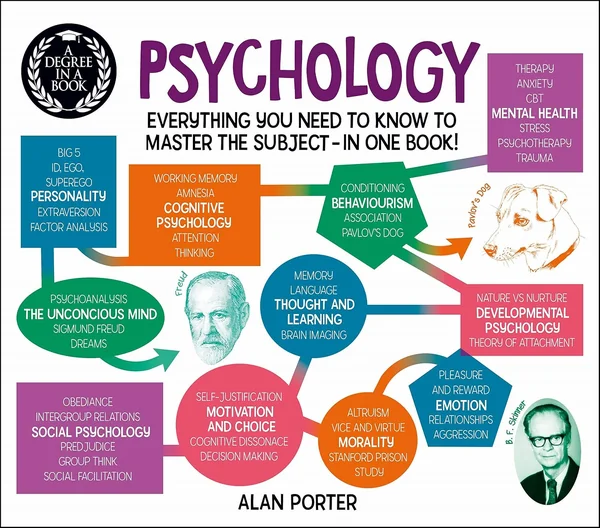
A visually driven, genuinely broad primer on psychology that works best as a map of the field rather than a substitute for the degree its title playfully promises.
A Degree in a Book: Psychology: Everything You Need to Know to Master the Subject in One Book by Dr Alan Porter front cover

What the Book Actually Is

A Degree in a Book: Psychology is a single-volume survey of the discipline written by Dr Alan Porter, a senior lecturer in psychology at the University of Westminster, and published by Arcturus in December 2018 as part of its Degree in a Book series. The premise is stated plainly in the subtitle: everything you need to know to master the subject, in one book. In practice that means a tour of psychology's major subfields — the index alone ranges across developmental, cognitive, clinical and forensic psychology — and the canonical figures behind them, from Freud and B.F. Skinner to Hans Eysenck, Francis Galton, Gustav Fechner, Hermann Ebbinghaus and Edward Thorndike, alongside gestalt approaches, behaviourism, factor analysis and the Five Factor model of personality.
The book is structured for navigation rather than immersion. Each chapter comes with a mind map, technical terms are defined either in the text or alongside it, and the publisher describes a format built around flow charts, infographics, timelines, information boxes, feature spreads and margin annotations, with suggestions for further reading woven in. It is positioned explicitly as an introduction for students and laypeople alike — a foundation, not a finishing school.

The Visual-First Approach

The defining feature of the Degree in a Book format is its commitment to presenting dense material graphically, and the psychology volume leans into that identity. Full-color diagrams, per-chapter mind maps and illustrated spreads are the delivery mechanism, designed so that a reader can grasp the relationship between, say, a school of thought and its key experiments without wading through a conventional textbook chapter. The publisher's framing — the knowledge of a degree for the price of a book — tells you exactly who this is for: the curious general reader, the prospective student weighing a course, or someone returning to the subject years after encountering it.
That design philosophy has real merit for a field like psychology, where the discipline's history is genuinely a history of competing frameworks. Being able to see behaviourism, cognitivism and the psychodynamic tradition laid out as visual systems, with timelines anchoring figures like Fechner and Ebbinghaus in the field's experimental origins, is a legitimate organizational strength rather than a gimmick.

Breadth Versus Depth

The honest tension in this book is built into its concept. Compressing each subfield of psychology into a succinct chapter — when each could sustain a year-long course with its own textbook — inevitably means trade-offs, and readers on The StoryGraph have noted exactly that: there will be omissions, some more significant than others, and the placement of certain sections is open to criticism. Notably, Porter himself acknowledges in the introduction that material some readers would consider interesting or vital has been left out, which is a candid admission that recasts the book as one lecturer's curated syllabus rather than a comprehensive canon.
The same reader response, however, credits the execution on its own terms: the writing is described as easy and accessible, with technical terms clearly defined, and the book judged a worthwhile refresher for those who have studied psychology before as well as a decent entry point for complete newcomers. That dual audience — refresher and introduction — is where the book's pitch is most credible.

Who It Serves Best

This is a book for the psychology-curious rather than the psychology-committed. Someone considering a degree course, a student in an adjacent field who needs the lay of the land, or a general reader who wants Freud, Skinner and the Five Factor model contextualized in one sitting will find the format well matched to that goal. The further-reading suggestions function as an implicit acknowledgement of the book's role: a starting point that points outward.
Those already deep in the subject, or anyone expecting the analytical depth of an actual undergraduate text, should adjust expectations to match the title's wink. What Arcturus and Porter have produced is a well-organized, visually led orientation to a vast discipline — most valuable precisely because it knows it is a doorway and not the building.

Sources & Further Reading

The key facts and claims in this review are grounded in the retrieved, verified sources listed below.

  1. Cited in this review
  2. 1
  3. 2
  4. 3
  5. Further reading
  6. 4
  7. 5