BOOKS
Published

Read Time

8 min read

Reader rating

4.7

· 9,256 Amazon ratings
reader ratings, not a LuvemBooks score
Curated & edited by

LuvemBooks Editorial

How we create our reviews →
Share This Review

Our review

The 12 Week Year by Brian P. Moran & Michael Lennington Review: A Sharp Rethink of Productive Planning

The 12 Week Year by Brian P. Moran and Michael Lennington is a business productivity guide that proposes replacing the traditional twelve-month planning cycle with a compressed twelve-week "year," designed to sustain the focus and urgency that most people only feel at year-end. This review is based on the book's content and published reception, not hands-on application. For readers frustrated by the drift and complacency that annual goal-setting tends to invite, it presents a structured, immediately actionable alternative.
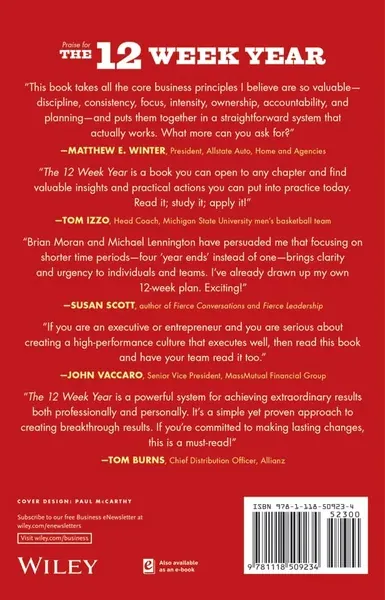

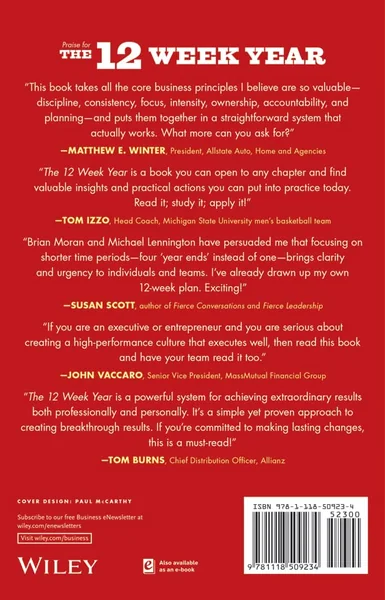
Back cover with title, testimonial quotes from business leaders, publisher logo, and barcode.Author bios page featuring two men with professional headshots and text descriptions of their backgrounds and expertise.Book spine with title and publisher name in vertical red and white text.Tap to enlarge

LuvemBooks Verdict

Best for

Professionals and organizational leaders who feel trapped in annual planning cycles and want a conceptually clear, practitioner-grounded framework for compressing their execution rhythm and rebuilding urgency around goals.

Worth it if

You've watched January resolutions quietly die by March and want a coherent, repeatable system — not just motivation — for closing the gap between knowing what to do and actually doing it across both personal and professional domains.

Skip if

You're already well-versed in short-cycle frameworks like OKRs or GTD, prefer a template-heavy workbook over a philosophy-and-framework guide, or are likely to be put off by a promotional shift in tone in the book's later chapters.

Review coverage at booksuplift.com highlights how the book's core argument — that a twelve-month window breeds complacency and goal abandonment — resonates strongly, with the authors framing belief and urgency as the root drivers of execution. Tolufrimpong.com reinforces this, noting that the authors position the problem as one of execution rather than knowledge, and that readers who have lost momentum on big goals are the book's natural audience.

“The broad spectrum of time gives way to limited thinking and, in some cases, goal abandonment — that's why most people fail.”

— booksuplift.com
Sources: booksuplift.com, tolufrimpong.com, valusource.com, agabosagency.com, charellegriffith.com
4.7from 9,256 Amazon ratings— reader ratings, not a LuvemBooks score
Buy on Amazon

Age & Reading Level

Recommended age

Adult

Reading level

Adult

Skip if you want a template-heavy workbook with built-in planning forms rather than a philosophy-first framework guide.

In This Review
  • What Works & What Doesn't
  • The Central Argument: Annualized Thinking Is the Problem
  • What the Book Actually Covers
  • Reception and Reputation
  • Genuine Strengths
  • Limitations Worth Weighing

What Works & What Doesn't

What Works
  • Crystallizes a counterintuitive but coherent argument — compressing the planning cycle to twelve weeks to replicate year-end urgency year-round
  • Written for both individual professionals and organizational leaders, broadening its practical applicability
  • Authors bring practitioner credibility from hands-on executive coaching and organizational consulting backgrounds
  • Reader commentary notes real shifts in mindset around commitment and goal discipline for those who engage with the system
  • Published by Wiley and sustained across formats, reflecting durable relevance in the productivity genre
What Doesn't
  • Reader commentary notes the book's tone becomes noticeably promotional in its later sections, undercutting the focused energy of its opening argument
  • Readers already versed in short-cycle productivity frameworks (OKRs, GTD) may find the core concepts familiar under a new label
  • Primarily a framework-and-philosophy guide rather than a template-heavy workbook, which may leave more hands-on readers wanting additional structure
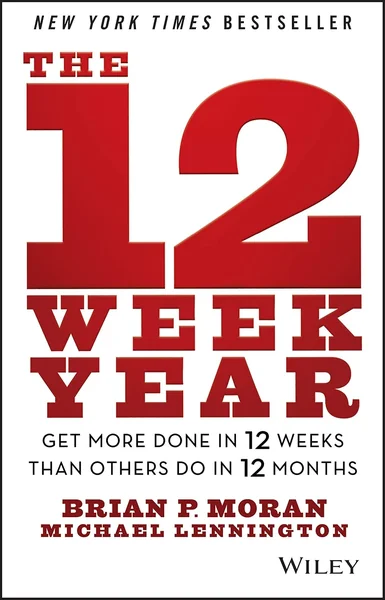
A practical productivity framework built on a deceptively simple premise — redefine what a "year" means and change how urgently you work within it.
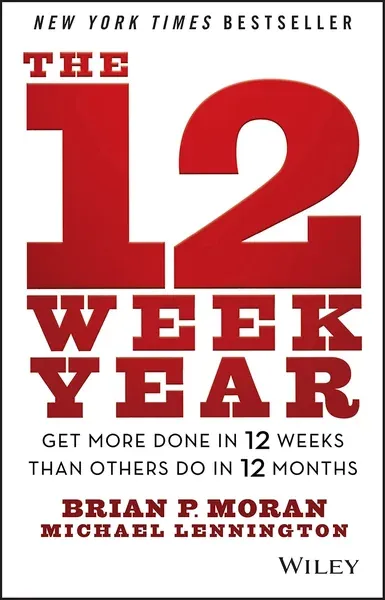
The 12 Week Year: Get More Done in 12 Weeks than Others Do in 12 Months by Brian P. Moran, Michael Lennington front cover

The Central Argument: Annualized Thinking Is the Problem

Moran and Lennington, both founders and leaders of execution-focused coaching organizations, open with a diagnosis that will feel familiar to anyone who has watched a January resolution fade quietly into March: the twelve-month planning cycle creates a persistent illusion that time is abundant. That illusion, they argue, kills urgency and invites complacency. Their solution is the concept they call "periodization" — breaking the calendar into four distinct twelve-week cycles, each treated as a complete year in its own right, with its own goals, plans, and accountability checkpoints. The book's core claim is that twelve weeks is short enough to prevent drift but long enough to accomplish meaningful work. In twelve weeks, there just isn't enough time to get complacent, and urgency increases and intensifies, as the book's framing makes clear.

What the Book Actually Covers

Pitched explicitly as a how-to guide for both individuals and organizations, The 12 Week Year is structured to move from diagnosis to implementation. Moran and Lennington describe the mechanics of building a twelve-week plan, including how to set goals, design weekly routines, and measure lead indicators rather than just outcomes. The framework targets execution effectiveness — the gap between knowing what to do and actually doing it — rather than strategy or ideation. The book also addresses the psychological dimension of the system: why commitment, discipline, and a revised relationship with accountability matter as much as the planning template itself. It is designed to apply across professional and personal domains, positioning itself as relevant to entrepreneurs, corporate leaders, and individuals alike.
Back cover with title, testimonial quotes from business leaders, publisher logo, and barcode.

Reception and Reputation

Published by Wiley in 2013, the book has developed a sustained following in the business and personal productivity space. Reader commentary collected at Apple Books reflects that the system has genuinely shifted mindsets around goal commitment and discipline for a portion of its audience, with some noting visible improvements in their own results. That same commentary, however, flags that the book's tone becomes noticeably more promotional toward its final sections — a recurring observation worth noting. The book's longevity on productivity reading lists, and its availability across multiple formats including audio, point to durable interest rather than a flash-in-the-pan reception.
Book spine with title and publisher name in vertical red and white text.

Genuine Strengths

The framework's most defensible strength is its conceptual clarity. The core idea — compress the cycle, replicate year-end urgency across the whole year — is easy to internalize and hard to dismiss. Moran and Lennington's professional backgrounds as execution coaches (Moran as founder and CEO of The Execution Company; Lennington with prior roles at Arthur Andersen and Senn-Delaney Leadership, and now leading The 12 Week Year Coach) lend the framework a practitioner's grounding rather than a purely academic one. The book is also deliberately dual-audience: it is written to serve both the solo professional redesigning their personal workflow and the organizational leader attempting to shift team culture around deadlines and accountability. That range is an asset for readers whose goals straddle both domains.
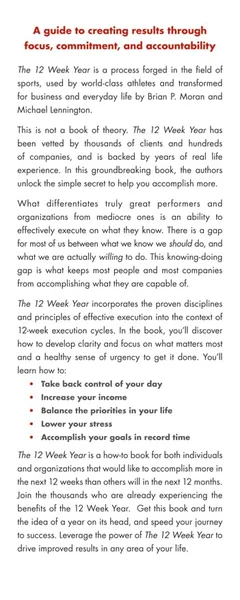
Introductory page explaining the book's purpose, key concepts, and benefits of the twelve-week planning methodology.

Limitations Worth Weighing

The most consistent critique surfaced in reader commentary is that the book's energy flags in its later chapters, where the writing reportedly turns salesy — a notable friction point in a framework that asks readers to sustain discipline and focus to the end. For readers already familiar with productivity literature in the GTD or OKR tradition, some of the underlying principles around urgency and short-cycle planning may feel like familiar territory repackaged with a new periodization label. And because this is a framework-and-philosophy book rather than a fill-in workbook, readers who want step-by-step templates built into the text itself may need to seek supplementary resources. As with any productivity system, whether the structure transfers meaningfully to a specific reader's work context is something published sources alone cannot settle — that depends entirely on implementation.

Sources & Further Reading

The key facts and claims in this review are grounded in the retrieved, verified sources listed below.

  1. 1
  2. 2
  3. 3
  4. 4
  5. 5

    12weekyear.com

  6. 6
  7. 7
  8. 8
  9. 9
  10. 10
  11. 11