BOOKS
Published

Read Time

3 min read

Reader rating

4.6

· 1,405 Amazon ratings
reader ratings, not a LuvemBooks score
Curated & edited by

LuvemBooks Editorial

How we create our reviews →
Share This Review

Fear and Loathing on the Campaign Trail '72 by Hunter S. Thompson Review: Gonzo Journalism's Defining Political Masterwork

Half a century after its original publication, Hunter S. Thompson's Fear and Loathing on the Campaign Trail '72 endures as a cornerstone of American political journalism — a raw, funny, and ferocious account of the 1972 presidential race that critical coverage called "the best account yet published of what it feels like to be out there in the middle of the American political process." This review covers the book's content, context, and published reception; it does not reflect hands-on application or use.

LuvemBooks Verdict

Best for

Readers drawn to American political history, literary journalism, or Hunter S. Thompson's career who want to understand the 1972 presidential race through the most viscerally immersive — if deliberately unorthodox — account ever written about it.

Worth it if

You want to experience the emotional texture and exhausting reality of a presidential campaign as lived from the inside, and you're comfortable with a narrator who uses exaggeration, fury, and self-implication as deliberate journalistic tools rather than liabilities.

Skip if

You're looking for a neutral, factually reliable documentary record of the 1972 election — Thompson's Gonzo method intentionally blurs fact and fictionalization, and the episodic structure born from serialized deadline dispatches makes for uneven reading if you need chronological rigor.

Wikipedia notes the book is widely considered a hallmark of campaign journalism that helped establish Thompson as a major political observer, despite — or because of — its unconventional blend of vulgarity, humorous exaggeration, and blurred fact and experience. Not Even Past credits Thompson's "clarity and wit" with firmly establishing the work as a celebrated piece of political journalism and its author as an icon of American literature, while Kirkus Reviews recognized from the outset Thompson's singular "eye for gnostic drill" and "ear for byzantine bullshit" as he trained his pen on every event and aspirant across the campaign trail.

Armed only with an eye for gnostic drill, an ear for byzantine bullshit, and a pen aimed pointedly at the political gonads of every event and aspirant who crossed his mad path.

Kirkus Reviews
Sources: Wikipedia, Kirkus Reviews, Not Even Past
4.6from 1,405 Amazon ratings— reader ratings, not a LuvemBooks score
In This Review
  • What Works & What Doesn't
  • What the Book Actually Is
  • Place in American Political Journalism
  • Strengths: Voice, Access, and Emotional Honesty
  • Genuine Limitations
  • Who This Edition Is For

What Works & What Doesn't

What Works
  • Considered a landmark of American political journalism, with a reception spanning five decades and a major-outlet endorsement from The New York Times Book Review
  • Thompson's Gonzo approach captures the emotional and experiential reality of the campaign trail in a way conventional reporting does not
  • Illustrated throughout by Ralph Steadman, adding a visual dimension unique among campaign books
  • The 50th-anniversary reprint includes a new foreword by Johnny Knoxville, contextualizing the work for contemporary readers
  • Draws on Thompson's real-time, insider access to the 1972 Democratic primaries and the McGovern–Nixon general election
What Doesn't
  • The Gonzo method — which deliberately blends fact, exaggeration, and fictionalization — makes the book an unreliable straight factual record for readers seeking neutral documentation
  • Its origins as serialized magazine dispatches assembled under deadline pressure give the text an episodic, uneven structure in places
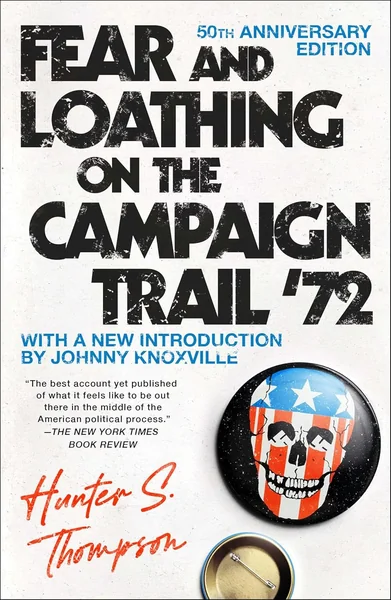
A half-century on, Fear and Loathing on the Campaign Trail '72 remains what critics described as "the best account yet published of what it feels like to be out there in the middle of the American political process."
Fear and Loathing on the Campaign Trail '72 by Hunter S. Thompson front cover

What the Book Actually Is

Fear and Loathing on the Campaign Trail '72 is a work of political journalism — part chronicle, part polemic, part Gonzo performance — that recounts, analyzes, and at times fictionalizes the 1972 U.S. Presidential campaign. Thompson covered the race from the Democratic primaries all the way through the eventual showdown between George McGovern and Richard Nixon, the latter of whom won re-election in a landslide that left McGovern carrying only Massachusetts and Washington, D.C. The book was largely derived from dispatches Thompson serialized in Rolling Stone throughout 1972, assembled — often chaotically — into a continuous narrative. The book opens with a quietly ominous line: "OUTSIDE MY NEW FRONT DOOR the street is full of leaves." What follows is anything but quiet. Illustrated by Ralph Steadman, whose work appears throughout, the book is an artifact of a specific journalistic moment, built from deadline dispatches rather than retrospective polish.
the best account yet published of what it feels like to be out there in the middle of the American political process.

Place in American Political Journalism

Few books in the genre occupy the cultural territory this one does. Simon & Schuster's publisher materials describe it as one of the bestselling campaign books of all time, and its durability across five decades places it alongside a small handful of titles that have genuinely redefined how political reporting can be written. Wikipedia's reception summary notes that, despite Thompson's unconventional style — vulgarity, humorous exaggeration, and the blurring of fact and experience — the book is considered a hallmark of campaign journalism and helped establish Thompson as a major political observer. It arrived alongside Timothy Crouse's The Boys on the Bus (1973), a companion piece of sorts that critically analyzed mainstream press coverage of the same campaign; together, the two books set the terms for how the '72 race has been understood ever since.

Strengths: Voice, Access, and Emotional Honesty

What distinguishes the book from conventional campaign reporting is Thompson's insistence on placing himself — his exhaustion, his fury, his grudging admiration for certain figures — inside the story. He began his coverage in December 1971 from a rented apartment in Washington, D.C., describing the experience as "living in an armed camp, a condition of constant fear." That emotional register never drops. The Simon & Schuster publisher description characterizes the account as infused with "characteristic wit, intensity, and emotion," and the cumulative effect, as the campaign grinds toward McGovern's catastrophic defeat, is one of genuine burnout rendered on the page. The publisher calls the work "hilarious, terrifying, insightful, and compulsively readable" — an assessment that aligns with its long-standing reputation as the rare piece of political writing that captures not just the mechanics of a campaign but its texture and toll.

Genuine Limitations

The book's greatest strength is also its most significant limitation for some readers. Thompson's Gonzo method — the deliberate conflation of reporter and story, the use of exaggeration as a rhetorical tool — means the text is not a reliable factual record in the traditional journalistic sense. The work recounts, analyzes, and fictionalizes by design. Readers seeking a strictly documented, neutral account of the 1972 election will find the approach frustrating or disorienting. Additionally, because the text emerged from serialized magazine dispatches assembled under pressure, its structure is episodic and uneven; some sections read as more complete and considered than others. The collaborative, deadline-driven nature of its composition — with editors assembling the finished text with Thompson over the phone — is part of its origin story, and that improvised quality is present in the reading experience.

Who This Edition Is For

This Simon & Schuster reprint edition includes a foreword by Johnny Knoxville, framing the 50th-anniversary context for a new generation of readers. It is designed for anyone interested in American political history, the evolution of journalism as a form, or the broader arc of Hunter S. Thompson's career — which also includes Hell's Angels, Fear and Loathing in Las Vegas, and The Great Shark Hunt. Readers who approach it as a primary source for the 1972 campaign should be aware of its Gonzo framework; readers who approach it as a work of literary nonfiction will find one of the most distinctive voices in twentieth-century American writing at the height of his engagement with the political world.

Sources & Further Reading

The key facts and claims in this review are grounded in the retrieved, verified sources listed below.

  1. Cited in this review
  2. 1
  3. 2
  4. Further reading
  5. 3

    Hunter S. Thompson, Wikipedia