BOOKS
Published

Read Time

3 min read

Curated & edited by

LuvemBooks Editorial

How we create our reviews →
Share This Review

Popular Philosophy by Ai Siqi Review: A Landmark of Marxist Popularisation

Popular Philosophy by Ai Siqi (pen name of Li Shengxuan, 1910–1966) is a foundational work of Chinese Marxist thought, written to make the core tenets of dialectical materialism, epistemology, and materialist philosophy accessible to a broad popular readership. Originally composed in the 1930s during Ai Siqi's time writing for the magazine Reading Life in Shanghai, it remains one of the most widely recognised introductory texts in Marxist philosophy published in twentieth-century China.

LuvemBooks Verdict

Best for

Readers new to Marxist philosophy — particularly those interested in how dialectical materialism was taught and disseminated in twentieth-century China — who want a historically grounded, plainly written introduction to its three core pillars: materialism, epistemology, and dialectics.

Worth it if

Worth reading if you want to understand Popular Philosophy as both an entry point to Marxist theory and as a primary document of Chinese Marxist pedagogy, tracing how ideology was translated for mass audiences during a period of intense political contest in 1930s China.

Skip if

Skip it if you're looking for a balanced, pluralistic survey of philosophical schools or already have an intermediate grasp of Marxist theory — the text is avowedly polemical and deliberately introductory, offering little engagement with competing interpretations or broader philosophical traditions.

What readers & critics say

Atlantis Press, in a published academic article on the work, characterises Popular Philosophy as "an important representative work of the renowned Marxist philosopher Ai Siqi," noting that its grounding of theory in Chinese practice helped it win wide popular support for Marxist philosophy. Wikipedia's entry on Ai Siqi corroborates the book's place within a broader biography of committed Marxist intellectual work, tracing the author's path from student reading clubs in Kunming through editorial work in Shanghai to a position of institutional authority after the founding of the People's Republic.

Sources: Atlantis Press, Wikipedia – Ai Siqi
In This Review
  • What Works & What Doesn't
  • What the Book Is and What It Contains
  • Origins and Historical Context
  • Significance and Reception
  • Core Strengths
  • Limitations and Audience Considerations

What Works & What Doesn't

What Works
  • Structured around three clearly defined pillars — materialism, epistemology, and dialectics — giving first-time readers an ordered framework
  • Written in deliberately plain and vivid language, making Marxist theory accessible to readers without a formal philosophy background
  • A historically significant text: its origins in 1930s Shanghai editorial culture and its continued republication, including a 1981 People's Publishing House collected edition, reflect genuine and enduring institutional standing
  • Provides essential context for understanding how Marxist philosophy was taught and disseminated in twentieth-century China
What Doesn't
  • Explicitly polemical in framing, presenting dialectical materialism as the sole correct worldview rather than one position within a broader philosophical landscape — limiting its usefulness for readers seeking balanced philosophical survey
  • As an introductory popularisation by design, it does not engage with philosophical complexity or competing interpretations within Marxist thought, making it too narrow for readers with prior knowledge of the subject
Popular Philosophy stands as one of the most consequential works of Marxist popular education produced in twentieth-century China, and its place in the history of Chinese philosophical writing is unambiguous.

What the Book Is and What It Contains

Back cover with blue abstract background and barcode label in lower right corner.
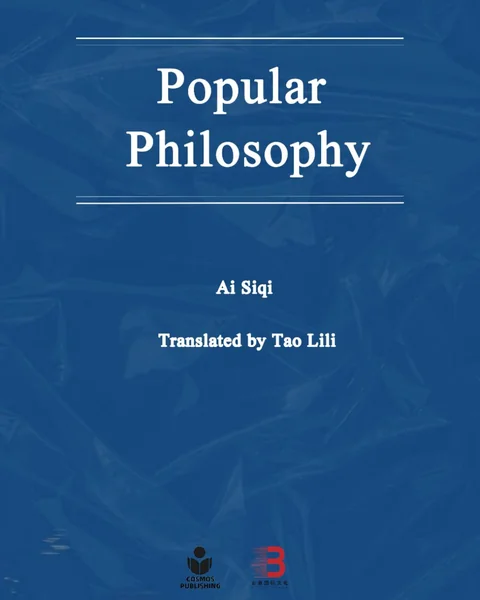
Popular Philosophy is a non-fiction philosophical primer by Ai Siqi — the pen name of Li Shengxuan (1910–1966), a Chinese Marxist philosopher. The book is structured around three core areas of Marxist basic theory: materialism, epistemology, and dialectics. Its explicit design goal, as described in the Atlantis Press record of the work, is to explain these three pillars "with extremely plain, vivid and popular language," making them available to readers with no prior training in formal philosophy. The text is not a work of original academic theory but a consciously simplified guide — a concise popular reading of Marxist principles intended for a mass audience.

Origins and Historical Context

The book emerged directly from Ai Siqi's editorial and journalistic work in Shanghai in the 1930s. According to Wikipedia, it was his opportunity to host the magazine Reading Life and work for the Shenbao library — alongside figures such as Li Gongpu, Xia Zhengnong, Gao Shiqi, and Liu Xi — that gave Ai Siqi the platform and impetus to write Popular Philosophy. Ai Siqi's own biography shaped the work's political orientation: having encountered Marxism through a reading club he organised as a student in Kunming, and later making contact with members of the Tokyo branch of the Chinese Communist Party during his time studying in Japan, he brought a committed ideological perspective to the project. The text explicitly frames dialectical materialism as the correct worldview for China's labour class and the CPC, positioning idealist philosophies such as those of Chen Lifu and Chiang Kai-shek as philosophically opposed to this materialist standpoint.

Significance and Reception

Popular Philosophy is described by Atlantis Press as "an important representative work of the renowned Marxist philosopher Ai Siqi," a characterisation consistent with the book's well-documented status as a landmark of Chinese Marxist education. Its influence extended well beyond academic circles: it was written precisely to reach ordinary readers and political activists during a period of intense ideological contest in China. A collected edition was published by the People's Publishing House in Beijing in 1981, and revised editions have continued to circulate, attesting to the work's enduring institutional standing in China's Marxist intellectual tradition.

Core Strengths

The book's principal strength lies in its accessibility. Its three-part structure — materialism, epistemology, dialectics — provides a clear and ordered framework for readers encountering these concepts for the first time. The deliberate use of plain and vivid language, as the source record consistently describes, was a considered authorial and political choice: Ai Siqi's aim was to bring philosophy down from the lecture hall and into the hands of workers and activists. This approach made Popular Philosophy one of the earliest and most successful attempts in the Chinese context to translate dense Marxist theoretical vocabulary into broadly readable prose. Readers looking for an introduction to Marxist philosophy as it was understood and taught in twentieth-century China will find a concisely organised and historically grounded entry point.

Limitations and Audience Considerations

The book's very accessibility is also the boundary of its ambition. As an explicitly introductory and popularising text, Popular Philosophy does not engage with philosophical complexity, competing interpretations within Marxist thought, or the broader Western philosophical tradition against which Marxist theory developed. Its framing is avowedly polemical — it presents dialectical materialism not as one philosophical position among many but as the scientifically correct worldview, explicitly contrasting it with named idealist opponents. Readers seeking a neutral or pluralistic survey of philosophical schools, or those already familiar with Marxist theory at an intermediate or advanced level, will find the scope narrow and the argumentation one-directional. The work is best understood as a historical document of Chinese Marxist pedagogy as much as a living philosophical guide.

Sources & Further Reading

The key facts and claims in this review are grounded in the retrieved, verified sources listed below.

  1. Cited in this review
  2. 1
    Siqi Ai — author profileHigh-authority source

    Siqi Ai, Wikipedia

  3. 2
  4. Further reading
  5. 3
  6. 4
  7. 5
Related Reviews

Reviews of books we picked for readers who enjoyed Popular Philosophy.