This review covers the novel's content and published reception; it does not reflect hands-on reading or testing.
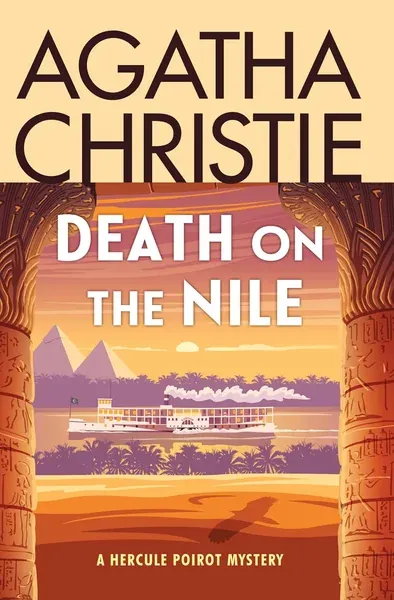
Death on the Nile: A Hercule Poirot Mystery: The Official Authorized Edition (Hercule Poirot Mysteries, 17) by Agatha Christie front cover
What the Novel Contains
Death on the Nile: A Hercule Poirot Mystery: The Official Authorized Edition is a classic closed-circle mystery set largely aboard the steamer Karnak as it travels the River Nile from Shellal to Wadi Halfa.
Poirot is on vacation in Aswan when he is approached by wealthy heiress Linnet Doyle (née Ridgeway), who has recently married Simon Doyle — formerly the fiancé of her own friend Jacqueline de Bellefort. Jacqueline, consumed by jealousy, pursues the couple throughout their honeymoon, and when Linnet is found shot through the head, the assembled cast of passengers becomes a crowded pool of suspects.
That cast is genuinely large: it includes Linnet's maid Louise Bourget, her trustee Andrew Pennington, romance novelist Salome Otterbourne and her daughter Rosalie, solicitor Jim Fanthorp, Austrian physician Dr Bessner, and a half-dozen others. Poirot's friend Colonel Race joins the voyage at Wadi Halfa, adding a further thread involving a suspected political agitator among the passengers.
Its Place in Christie's Work
First published by the Collins Crime Club on 1 November 1937, the novel sits seventeenth in the Hercule Poirot series. Bookshop.org's publisher description calls it one of Christie's most famous mysteries and "one of Christie's most legendary and timeless works."
Agatha Christie is, according to publisher materials, the most widely published author of all time, outsold only by the Bible and Shakespeare — a claim that underscores the canon weight this novel carries. The Egyptian setting distinguished it from Christie's more domestic fare and has fuelled multiple adaptations across film, television, stage, and games over the decades.
It is worth noting that Death on the Nile shares its title with a 1933 Christie short story featuring Parker Pyne; the two are unrelated, and this novel is the work most readers mean when they use the name.
Strengths: Plot Architecture and Character Density
The novel's central design strength is its commitment to misdirection: Jacqueline de Bellefort is such an obvious suspect from the opening pages that the real mechanics of the crime require careful concealment by Christie across a crowded ensemble. The publisher's own copy highlights the tactic — Poirot recalls an earlier threat made by a passenger: "I'd like to put my dear little pistol against her head and just press the trigger" — precisely because the book trains readers to look in one direction while the solution assembles elsewhere.
Some readers on Bookclubs.com found that the large passenger roster made character introductions slow before the Karnak sets sail, but the same commenters noted that once the action moves aboard ship, the pace picks up and the detail brought to each character becomes an asset. The Egyptian backdrop — Abu Simbel, Wadi Halfa, the Nile itself — functions as more than scenery, giving the novel its distinctly expansive atmosphere compared to Christie's drawing-room puzzles.
Where Some Readers Push Back
Reader response is not uniform. Some commenters on Bookclubs.com found the novel simply did not connect with them on a personal level, with one noting plainly that the book "did not vibe" despite acknowledging Christie's craft.
The slow assembly of the full cast before the murder occurs is a recurring point of friction for readers who prefer a faster opening.
The novel is also a product of its 1937 moment: the language, social attitudes, and characterisation of certain figures reflect assumptions of that era, which some contemporary readers flag as requiring context. No independent critical source in the available record treats this as disqualifying, but it is a real consideration for readers new to Golden Age detective fiction.
This Edition and Who It's For
This 2024 reissue from William Morrow Paperbacks is the Official Authorized Edition, issued under the new series look for the Hercule Poirot Mysteries line. It presents the novel in its established text with no additions beyond the updated packaging.
The book is best suited to readers coming to classic British detective fiction for the first time — the Egyptian setting and large ensemble give it a cinematic scale that translates well for readers who know Christie only through adaptations — as well as established fans working through the Poirot series in sequence. Readers who prefer psychological suspense or action-led plotting over the methodical assembly of clues and character motives may find the pacing deliberate, particularly in the early chapters before the murder occurs.