BOOKS
Published

Read Time

8 min read

Reader rating

4.5

· 593 Amazon ratings
reader ratings, not a LuvemBooks score
Curated & edited by

LuvemBooks Editorial

How we create our reviews →
Share This Review

Bicycling with Butterflies by Sara Dykman Review: A 10,201-Mile Ride for Monarch Conservation

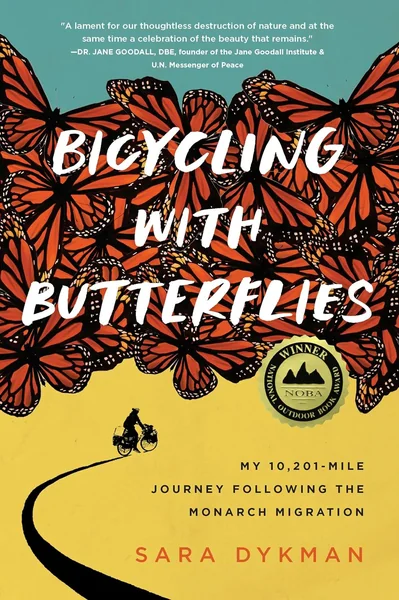
Sara Dykman's account of her 2017 ride tracing the monarch migration 10,201 miles from Mexico to Canada and back — the first person ever to do so — pairs solo-adventure storytelling with accessible science and conservation advocacy. A 2021 National Outdoor Book Award winner, endorsed by Jane Goodall.
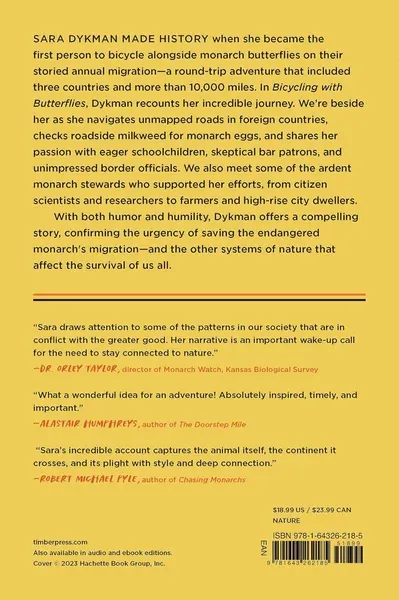
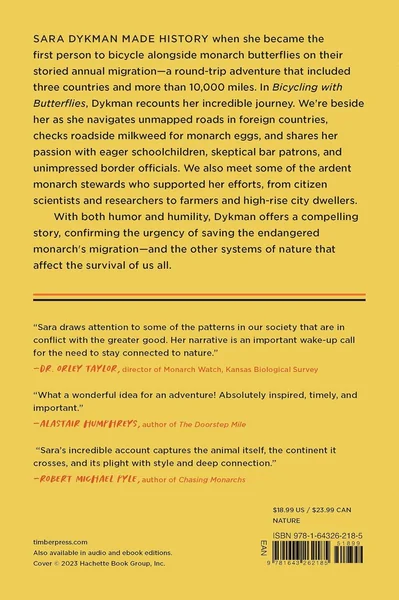
Back cover with synopsis, review quotes from conservation and nature writers, and publication details.Tap to enlarge

LuvemBooks Verdict

Best for

Cyclists and thru-adventure readers, pollinator enthusiasts, educators, book clubs, and milkweed gardeners who want a long-haul journey fused with substantive monarch science and a conservation mission — the book's documented 10,201-mile first and its National Outdoor Book Award–winning pedigree make it the definitive account of tracing the migration at bicycle speed.

Worth it if

It's worth reading if you want your nature writing to double as a call to action: the migration's own dramatic architecture carries the narrative, the monarch science is substantive and accessible, and the argument that individual action connects to a hemispheric phenomenon is earned by the ride itself.

Skip if

Readers wanting a detached, purely observational travelogue should look elsewhere — the conservation advocacy is the point of the whole enterprise, not a subplot — and its deliberately narrow single-species lens won't satisfy those seeking wide-ranging natural history across many ecosystems.

The Dyck Arboretum's Nature Book Club, which read the book as a group, praised its "poignant" writing on traveling at bicycle speed and its treatment of the tallgrass prairie's collapse, while The Portugal News called it "a modern travelogue for a noble cause" and "a unique book which needs to be read." Readers on The StoryGraph have highlighted its candid account of both the highs and lows of the solo ride alongside the monarch natural history.

Sources: Dyck Arboretum Nature Book Club, The Portugal News, The StoryGraph
4.5from 593 Amazon ratings— reader ratings, not a LuvemBooks score
Buy on Amazon

Age & Reading Level

Recommended age

Adult

Reading level

Adult

Skip if you want a detached, purely observational travelogue — the conservation advocacy is the point of the whole book, not a subplot.

In This Review
  • What Works & What Doesn't
  • A First-of-Its-Kind Journey
  • Part Travelogue, Part Field Lesson
  • Advocacy in Every Mile
  • Reception and Standing
  • Who It's For

What Works & What Doesn't

What Works
  • A documented first: Dykman was the first person to bicycle the monarch's full migration route — 10,201 miles through three countries in 2017
  • Winner of a 2021 National Outdoor Book Award in outdoor literature
  • Combines solo-adventure narrative with substantive, accessible monarch science — milkweed ecology, tagging programs, pollinator way stations
  • Endorsed by Jane Goodall, with jacket praise noting Dykman's humor and humility
  • Built-in educational mission: the ride included presentations at 50+ schools and nature centers reaching over 9,000 students
What Doesn't
  • Advocacy is pervasive rather than incidental — readers wanting a detached, purely observational travelogue may find the conservation messaging insistent
  • Deliberately narrow, single-species focus; less satisfying for readers seeking broad natural history across many ecosystems
Bicycling with Butterflies is a genuinely singular adventure memoir — part long-distance cycling narrative, part natural-history lesson, part conservation call to action — and its 2021 National Outdoor Book Award confirms it delivers on an audacious premise.

A First-of-Its-Kind Journey

The premise needs no embellishment: from March to December 2017, Sara Dykman became the first person to bicycle alongside the monarch butterfly migration, following the insects from their overwintering grounds in central Mexico north to Canada and back again — a round trip of 10,201 miles across three countries. The book, subtitled My 10,201-Mile Journey Following the Monarch Migration, is her account of that solo ride, published by Timber Press (this paperback edition dated February 2023). It is the written record of what she calls "butterbiking," her fourth adventure under an educational project she runs called Beyond a Book. The migration itself provides the narrative architecture — the monarchs' multi-generational relay north and the single "super generation's" return south give the journey a built-in dramatic shape that most improvised long-distance bike trips lack, and the fact that no one had ever attempted to trace it by bicycle makes the feat a documented first rather than a marketing flourish.

Part Travelogue, Part Field Lesson

What distinguishes the book from a standard adventure diary is how much monarch biology and ecology it carries. Dykman uses the ride as a spine for explaining the migration's mechanics: the role of milkweed as the sole food source of the monarch caterpillar, the citizen-science tagging programs that have tracked individual butterflies, and the network of pollinator "way stations" gardeners have planted along the flyway. A write-up from the Dyck Arboretum's Nature Book Club, which read the book, highlights its treatment of the tallgrass prairie's collapse — noting the book's point that only about 1 percent of the historic prairie remains — and its emphasis on the interconnectedness of living systems and the consequences of human choices. Publisher copy describes science, nature, and adventure woven into a single account, and the source material bears that out: this is a nature book that happens to be told from a bicycle saddle, not a cycling book with butterflies as decoration.

Advocacy in Every Mile

Readers should know what they are signing up for tonally: this is advocacy-forward writing. Dykman did not simply ride the route — during the trip she visited more than 50 schools and nature centers, presenting to over 9,000 students with the message that anyone can be a scientist, conservationist, and adventurer, and the book extends that mission to the page. It urges readers to plant milkweed, support pollinator habitat, and treat the monarch's decline as a shared responsibility. The Dyck Arboretum review singles out her argument for traveling at bicycle speed — that moving slowly reveals a living world that highway velocity renders invisible — as one of the book's most poignant threads. For readers who want their nature writing to double as a call to action, this is the book's engine. For those after a detached, purely observational travelogue, the persistence of the message may feel insistent; the conservation argument is not a subplot here but the point of the whole enterprise.
Back cover with synopsis, review quotes from conservation and nature writers, and publication details.

Reception and Standing

The strongest external validation is concrete: the book won a 2021 National Outdoor Book Award in outdoor literature, one of the most established prizes in the genre. It also carries an endorsement from Dr. Jane Goodall, who calls the monarch migration "one of the wonders of the world" and urges that it be saved for future generations, and jacket praise describes Dykman telling her story "with both humor and humility." Its adoption by reading groups like the Dyck Arboretum's Nature Book Club points to a second life beyond the adventure shelf — it functions well as a discussion book for environmental and community reading programs. Note that this review draws on the published record around the book — its synopsis, award history, endorsements, and reader commentary — rather than a hands-on evaluation.

Who It's For

This is an easy recommendation for several distinct audiences: cyclists and thru-adventure readers who want a long-haul journey with an unusual purpose; butterfly and pollinator enthusiasts, who will find the migration rendered at human scale; educators and book clubs, given its built-in outreach pedigree; and gardeners already planting milkweed who want the larger story their patch connects to. Its single-species focus is a depth-over-breadth proposition — readers seeking wide-ranging natural history across many ecosystems will find the lens deliberately narrow, fixed on one insect and the human systems around it. But that focus is also the achievement. By the end of 10,201 miles, the monarch is no longer a symbol pasted onto a bike trip; it is the reason the trip coheres, and the book's argument — that individual action connects to a hemispheric phenomenon — is carried by the structure of the ride itself.

Sources & Further Reading

The key facts and claims in this review are grounded in the retrieved, verified sources listed below.

  1. Cited in this review
  2. 1
  3. 2
  4. Further reading
  5. 3
  6. 4

    beyondabook.org

  7. 5
  8. 6
  9. 7
  10. 8
  11. 9