BOOKS
Published

Read Time

3 min read

Curated & edited by

LuvemBooks Editorial

How we create our reviews →
Share This Review

Insights from The Life-Changing Magic of Tidying Up by Juggernaut Review: A Slim Kindle Summary of Kondo's Method

Juggernaut's Insights from The Life-Changing Magic of Tidying Up is a 7-page Kindle companion that distills Marie Kondo's KonMari philosophy into a condensed English-language overview, offering a quick entry point to Kondo's ideas about decluttering and intentional living — though its extreme brevity makes it a summary supplement rather than a substitute for Kondo's original work.

LuvemBooks Verdict

Best for

Readers who want a quick, low-commitment orientation to the KonMari method before deciding whether to invest time in Marie Kondo's full original book.

Worth it if

You want a structured, seven-page recap of the KonMari method's core principles — especially the "spark joy" framework and category-based tidying — as a fast pre-read or post-read refresher, with no time to spare for Kondo's full-length argument.

Skip if

You want Kondo's complete reasoning, personal anecdotes, cultural context, or any tactile guidance on folding and storage — for that, the original book is the only viable option, and this summary cannot substitute for it.

What readers & critics say

Critical reception of the underlying Kondo source text is broadly positive but notes real limitations: reviewers at thedeepdish.org flag that the original book is "hopelessly cluttered and repetitive," while sarahgvincentviews.com points out that Kondo's folding and drawer-storage instructions rely on visualisation that text alone struggles to convey — limitations a seven-page summary inherits rather than resolves. More positively, treehugger.com praises Kondo's alternative take on minimalism as one that makes tidying feel "light and relaxed" rather than austere, and breakthetwitch.com describes it as highly recommended for anyone looking to begin or continue a decluttering practice.

Sources: The Deep Dish, Sarah G Vincent Views, Treehugger, Break the Twitch
4.4from 44 Amazon ratings— reader ratings, not a LuvemBooks score
In This Review
  • What Works & What Doesn't
  • What This Publication Actually Is
  • The Core Argument It Covers
  • Significance of the Source Material
  • Genuine Strengths of This Format
  • Limitations Worth Knowing

What Works & What Doesn't

What Works
  • Provides a fast, low-commitment entry point to the KonMari method for readers evaluating Kondo's full book
  • Kindle format includes screen reader support and enhanced typesetting for broad accessibility
  • Covers Kondo's central argument — that decisive, category-based tidying outperforms incremental cleaning — in a structured way
  • Useful as a quick recap of key principles for readers already familiar with Kondo's original work
What Doesn't
  • At only 7 verified pages, this is a summary supplement — it cannot substitute for the depth, reasoning, or cultural context of Kondo's original book
  • Kondo's method includes tactile guidance (such as folding techniques) that is difficult to convey in text alone, a limitation a condensed summary cannot overcome
This Kindle edition is a third-party insights guide, not the original book by Marie Kondo — readers seeking Kondo's full text should be aware of this distinction before purchasing.

What This Publication Actually Is

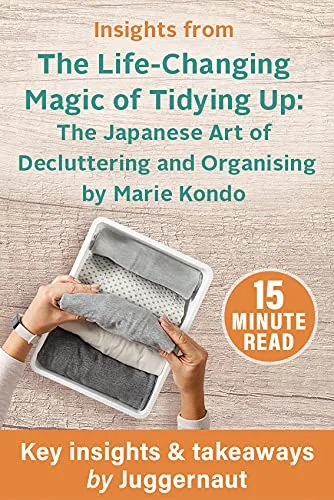
Insights from The Life-Changing Magic of Tidying Up: The Japanese Art of Decluttering and Organizing by Marie Kondo in 15 mins by Juggernaut front cover
Published by Juggernaut in June 2021, this Kindle edition is an insights and summary companion to Marie Kondo's internationally recognised self-help book, The Life-Changing Magic of Tidying Up: The Japanese Art of Decluttering and Organizing. At a verified print length of 7 pages, it is not a reprint or abridgement of Kondo's original work but rather a distillation of its core ideas. The summary format is designed to give readers a rapid orientation to the KonMari method — Kondo's signature approach to tidying, which centres on evaluating possessions by whether they "spark joy" and organising by category rather than by room.

The Core Argument It Covers

The ideas at the heart of this summary trace back to Kondo's foundational challenge to conventional tidying wisdom. As documented through the original source text, Kondo argues that creating more storage space merely masks clutter rather than resolving it, and that gradual or incremental tidying fails to produce lasting results. Instead, her method advocates a single, decisive tidying event — tackling categories of belongings in a specific order — as the path to a permanently tidy home. One of the source's most quoted lines encapsulates its philosophy: "Tidying brings visible results. Tidying never lies." These are the premises this Juggernaut summary is structured to convey.

Significance of the Source Material

The original Kondo book from which these insights are drawn is a cultural phenomenon that brought Japanese minimalist philosophy to a global English-language audience. Its central concept — retaining only items that "spark joy" — became widely discussed far beyond the self-help genre, influencing interior design discourse, sustainability conversations, and eventually a Netflix series. A summary guide targeting this title is therefore entering well-charted territory, and readers will find no shortage of ways to engage with these ideas at greater depth elsewhere. The Juggernaut publication functions as an on-ramp to that larger conversation.

Genuine Strengths of This Format

For readers who want to quickly assess whether Kondo's methodology is worth their time before committing to her full-length work, a concise summary guide serves a clear purpose. The Kindle format supports screen readers and has enhanced typesetting and Word Wise enabled, making it accessible across a range of devices and reading needs. At its compact length, it requires minimal time investment and can serve as a pre-read refresher or a post-read reference for the method's key tenets. For someone who has already encountered the KonMari method but wants a structured recap of its principles, this format is purpose-built for that use case.

Limitations Worth Knowing

The most significant limitation of this publication is structural and unavoidable: at 7 pages, it cannot replicate the texture or depth of Kondo's original argument. Criticism of the source material itself is relevant context here — reviewers of the original book have noted that it can be repetitive and that some of its guidance (such as Kondo's instructions for folding and vertical drawer storage) is genuinely difficult to follow without visual illustration, a limitation a text-only summary cannot resolve. Additionally, Kondo's anthropomorphisation of possessions — her practice of speaking to belongings — has drawn scepticism from some readers, and a brief summary is unlikely to provide the contextual framing that makes those ideas land more persuasively. Readers who want Kondo's full reasoning, her personal anecdotes, and the cultural context behind her philosophy will need to go directly to the source.

Sources & Further Reading

The key facts and claims in this review are grounded in the retrieved, verified sources listed below.

  1. Cited in this review
  2. 1
  3. 2
  4. 3
  5. Further reading
  6. 4
  7. 5
  8. 6