
BOOKS
Published
Read Time
8 min read
Share This Review
A Plague upon Humanity by Daniel Barenblatt Review: A Haunting, Meticulously Documented Historical Exposé
Daniel Barenblatt's A Plague upon Humanity is a rigorous work of historical research that brings the full, devastating scope of Imperial Japan's biological warfare program — and the postwar cover-up that buried it — into sharp relief, drawing on firsthand accounts from both perpetrators and survivors to chronicle one of the twentieth century's least-prosecuted atrocities.
In This Review
- What Works & What Doesn't
- What the Book Documents
- The Postwar Cover-Up
- Significance and Scholarly Contribution
- Strengths and Limitations of the Approach
- Who This Book Is For
What Works & What Doesn't
What Works
- Draws on a decade of original research, incorporating firsthand accounts from both perpetrators and survivors of Unit 731
- Exposes the postwar American cover-up — the deal struck under General MacArthur that immunized Unit 731's doctors from prosecution — with documented specificity
- Situates Unit 731 within the broader context of Imperial Japan's military aggression, including the Mukden Incident and campaigns in Manchuria
- Provides an accessible English-language account of a subject long obscured from Western historical consciousness
What Doesn't
- Kirkus Reviews flagged the study as 'surprisingly tortuous,' suggesting the book's density and evidentiary weight can be demanding for general readers
- The subject's complexity — spanning military history, medical ethics, and Cold War politics — means no single dimension receives the sustained narrative focus some readers may prefer
This review is based on the book's content and published critical reception, not hands-on use or reading.
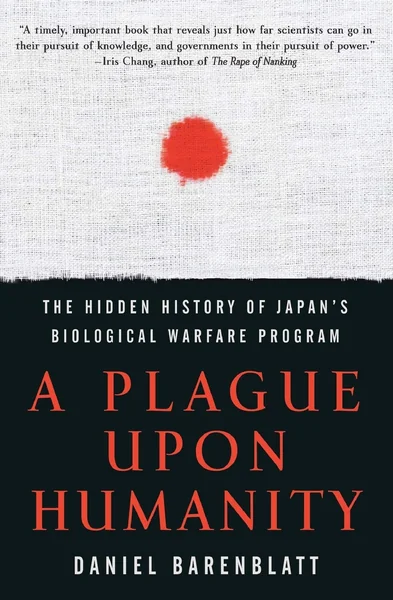
A Plague upon Humanity: The Hidden History of Japan's Biological Warfare Program – Unit 731's Human Experiments and the Post-War Cover-Up by Daniel Barenblatt front cover
What the Book Documents
A Plague upon Humanity investigates the biological warfare program developed by Imperial Japan's military research group known as Unit 731, active during the 1930s and 1940s. At its center is Lieutenant General Shiro Ishii, the unit's commanding scientist, whom Barenblatt — drawing on a decade of research — characterizes as "the archetype of a highly functioning sociopath, playing the dramatic role of the unstable 'mad doctor' with flourish." The program included human experimentation on prisoners, the aerial spraying of entire cities with fleas carrying bubonic plague, and the deployment of dozens of biological weapons against Chinese soldiers and civilians, as well as Russian and Mongolian troops stationed on the Manchurian frontier. Chinese researchers have estimated that as many as 580,000 people were killed by Japanese germ warfare operations, a figure Barenblatt incorporates into his account alongside his own findings.
“the archetype of a highly functioning sociopath, playing the dramatic role of the unstable 'mad doctor' with flourish.”
The Postwar Cover-Up
One of the book's defining arguments concerns not just what Unit 731 did, but what happened — and critically, what did not happen — afterward. Barenblatt documents that U.S. Occupation forces under General Douglas MacArthur struck a deal with the doctors of Unit 731 that shielded them from accountability for their atrocities, allowing key figures to escape the kind of prosecution applied at Nuremberg. He further establishes, through his research, that the Allied powers had knowledge of Unit 731 and its program as early as 1939. This Cold War calculus — in which Pentagon officials chose to absorb Japan's biological warfare data rather than prosecute its architects — forms the moral and political backbone of the book's second half.
Significance and Scholarly Contribution
critics described the work as "a surprisingly tortuous study of Imperial Japan's biological warfare program," acknowledging that while Unit 731 is no longer entirely secret — having figured in news coverage of ongoing Chinese reparations demands — Barenblatt's decade of tracking the story yields "hard-won facts" not widely available in prior English-language treatments. The book's scope extends beyond the laboratory to encompass the staged Mukden Incident of 1931 that triggered Japan's invasion of Manchuria, situating Unit 731 within the full arc of Imperial Japan's military aggression. By incorporating firsthand accounts from both perpetrators and survivors, Barenblatt gives the historical record a human dimension that purely archival accounts can lack.
Strengths and Limitations of the Approach
The book's documented strengths lie in its depth of primary sourcing — firsthand testimony, newly surfaced evidence — and in Barenblatt's willingness to assign moral culpability not only to the Japanese military but to American Cold War decision-makers. Critical coverage review, however, noted the "tortuous" quality of the study, a word that in context signals that the book's density and the complexity of its subject matter can make for demanding reading. Readers seeking a streamlined narrative may find the volume of documented detail challenging to absorb, while those with a prior academic background in the Pacific War or war crimes history will find the evidentiary approach appropriate to the gravity of the subject.
Who This Book Is For
Published by HarperPerennial and now available in a reprint paperback edition, A Plague upon Humanity is aimed at general readers with a serious interest in World War II history, war crimes accountability, and the intersection of science and state violence. It functions as both an introduction to Unit 731 for those unfamiliar with the subject and as a contribution to ongoing historical debates about postwar justice — or the deliberate lack of it. Readers drawn to works that confront the political dimensions of historical memory, particularly as they relate to American foreign policy in the Pacific, will find Barenblatt's argument directly and unflinchingly stated.
Frequently Asked Questions
Is A Plague upon Humanity worth reading for someone new to the subject of Unit 731?
The review indicates the book functions as both an introduction to Unit 731 for those unfamiliar with the subject and as a contribution to ongoing historical debates about postwar justice. LuvemBooks notes it is aimed at general readers with a serious interest in World War II history, war crimes accountability, and the intersection of science and state violence, making it accessible to newcomers while still substantive enough for more informed readers.
What is the central argument of A Plague upon Humanity?
The book's central argument is twofold: it documents the horrific scope of Unit 731's biological warfare program, and it establishes that U.S. Occupation forces under General Douglas MacArthur struck a deal with the unit's doctors that shielded them from prosecution. Barenblatt further argues that the Allied powers had knowledge of Unit 731 as early as 1939, and that Pentagon officials chose to absorb Japan's biological warfare data rather than hold its architects accountable — a Cold War calculus that forms the moral and political backbone of the book's second half.
Who was Shiro Ishii and how does the book portray him?
Lieutenant General Shiro Ishii was the commanding scientist of Unit 731, and Barenblatt characterizes him as the archetype of a highly functioning sociopath, playing the dramatic role of the unstable mad doctor with flourish. The review notes this characterization is drawn from a decade of Barenblatt's research and is central to understanding the human agency behind the program's atrocities.
What kinds of atrocities does the book document Unit 731 committing?
The review details that Unit 731 conducted human experimentation on prisoners, aerially sprayed entire cities with fleas carrying bubonic plague, and deployed dozens of biological weapons against Chinese soldiers and civilians, as well as Russian and Mongolian troops on the Manchurian frontier. Chinese researchers have estimated that as many as 580,000 people were killed by Japanese germ warfare operations, a figure Barenblatt incorporates into his account.
How does the book handle the postwar cover-up of Unit 731?
Barenblatt documents that U.S. Occupation forces allowed key figures from Unit 731 to escape the kind of prosecution applied at Nuremberg, in exchange for access to Japan's biological warfare data. The review describes this Cold War calculus as the moral and political backbone of the book's second half, with Barenblatt unflinchingly assigning culpability not only to the Japanese military but to American Cold War decision-makers.
Did the U.S. government know about Unit 731 during the war?
Yes, the review states that Barenblatt establishes through his research that the Allied powers had knowledge of Unit 731 and its program as early as 1939. This foreknowledge is central to his argument about the deliberate nature of the postwar cover-up and the moral responsibility of American officials.
What is the Mukden Incident and why does the book discuss it?
The review explains that the book covers the staged Mukden Incident of 1931, which triggered Japan's invasion of Manchuria, situating Unit 731 within the full arc of Imperial Japan's military aggression. By including this broader historical context, Barenblatt frames the biological warfare program not as an isolated aberration but as part of a larger pattern of imperial violence.
What primary sources does Barenblatt draw on?
The review highlights that the book's documented strengths lie in its depth of primary sourcing, including firsthand testimony from both perpetrators and survivors, as well as newly surfaced evidence. This combination of voices gives the historical record a human dimension that purely archival accounts can lack, according to the review.
How long did Barenblatt research this book?
The review notes that Barenblatt spent a decade researching the story of Unit 731, and that this sustained effort yields hard-won facts not widely available in prior English-language treatments of the subject.
Is the writing style accessible or is this a dense academic read?
The review signals that the book can be demanding, noting that critical coverage described it as a surprisingly tortuous study, a word that in context reflects the density of the subject matter and the volume of documented detail. Readers seeking a streamlined narrative may find it challenging to absorb, while those with a prior academic background in the Pacific War or war crimes history will find the evidentiary approach appropriate to the gravity of the subject.
Reader Comments
No comments yet
Be the first to share your thoughts!