
BOOKS
Published

Read Time

8 min read

Reader rating

4.3

· 36,134 Amazon ratings
reader ratings, not a LuvemBooks score
Curated & edited by

LuvemBooks Editorial

How we create our reviews →
Share This Review

The First Witch of Boston by Andrea Catalano Review: Fact-Based Puritan Tragedy and Love Story

Andrea Catalano's The First Witch of Boston (Lake Union, 2025) reconstructs the true case of Margaret Jones, the first woman executed for witchcraft in Boston in 1648, through her discovered journals and her husband Thomas's memories. Built on actual diaries and court records, it is as much a decades-spanning love story as a witch-trial drama — and its heavy themes won't suit every reader.

LuvemBooks Verdict

Best for

Historical-fiction readers drawn to fact-based Puritan witch-trial stories — especially those who want the real Margaret Jones case rendered as an intimate, decades-spanning marriage portrait rather than a courtroom thriller — and book clubs, which the author actively supports with a press kit and visits.

Worth it if

You're reading for the historical texture, the tenderness of the central marriage, and the slow convergence of fear and superstition on one independent woman — and you can accept a tragedy whose ending is known from page one.

Skip if

Skip it if you want a propulsive, trial-centered drama with genuine suspense, or if depictions of miscarriage, child loss, sexual trauma, and execution — relentless given the foregone conclusion — are likely to be too heavy.

Early reception is positive but divided: Readers Enjoy Authors Dreams praised it as a "beautifully researched, emotionally powerful novel" rich in 17th-century detail, while blogger Toby A. Smith found it "less than I had hoped," conceding that readers interested in Puritan-era witch trials will likely enjoy it. GoBookMart highlighted its dual register — intimate in the accused woman's daily life, public in showing how gossip, law, and gender produced a conviction — and Vocal Media admired its raw depiction of the trial's cruelty building toward the inevitable.

Sources: Readers Enjoy Authors Dreams, Toby A. Smith, GoBookMart, Vocal Media, A Casual Reader
4.3from 36,134 Amazon ratings— reader ratings, not a LuvemBooks score
Buy on Amazon

Age & Reading Level

Recommended age

Adult

Reading level

Adult

Content to know about

execution by hanging
miscarriage and child loss
sexual trauma
historical misogyny
religious persecution

Best for: Adults — capital punishment, sexual trauma, miscarriage, and child loss sit at the center of the narrative

Skip if you want a suspenseful, trial-centered drama — the outcome is known from page one and the book leans toward domestic tragedy.

In This Review
  • What Works & What Doesn't
  • The True Story Behind the Novel
  • A Marriage Told in Two Voices
  • Where the Research Shows
  • The Weight of the Material, and a Divided Reception
  • Who This Book Is For

What Works & What Doesn't

What Works
  • Grounded in the real 1648 case of Margaret Jones, drawing on actual diary entries and court records
  • Distinctive dual structure: Margaret's discovered journal entries interwoven with Thomas's third-person memories
  • Praised by early reviewers for rich 17th-century period detail and tense courtroom and community scenes
  • Functions as both a witch-trial narrative and a decades-spanning marriage story across England and New England
  • Book-club friendly, with the author offering a press kit and club visits
What Doesn't
  • Extremely heavy subject matter — miscarriage, child loss, sexual trauma, and capital punishment — that some readers will find relentless
  • The outcome is known from page one, so readers wanting suspense or a trial-centered drama may find it leans toward domestic tragedy
  • Reception is positive but not universal; at least one early reviewer found it fell short of expectations
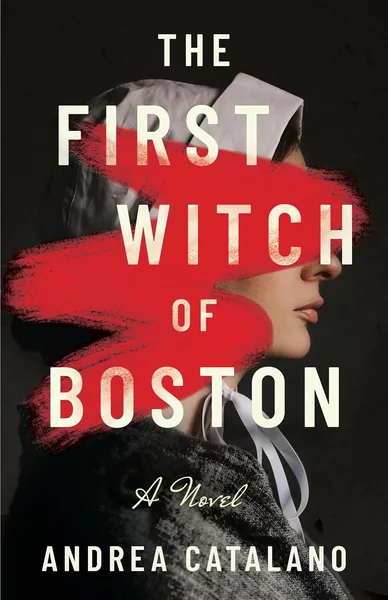
A meticulously sourced, emotionally heavy historical novel that reconstructs the 1648 execution of Margaret Jones — and the marriage that preceded it — with more romance and domestic detail than courtroom spectacle.
The First Witch of Boston: A Novel by Andrea Catalano front cover

The True Story Behind the Novel

The First Witch of Boston is built on a documented historical case: Margaret Jones (1613–1648), the first woman tried and executed for witchcraft in Boston, hanged in June 1648. Andrea Catalano, an author with a background in history education, grounds the novel in actual diary entries and court records, then imagines the life that the record leaves blank. The book opens in 1646, when Maggie and her husband, Thomas Jones, relocate from London to the Charlestown section of Boston to build a new life among a strict Puritan community — one that, as the publisher's synopsis puts it, demands women be meek and quiet. Maggie is neither. A talented herbalist and midwife with what one reviewer describes as a contemporary woman's outlook, she chafes against the role assigned to her, and her independence becomes the seed of the accusation that will destroy her. The result is positioned as both the story of a woman unjustly accused and a love story spanning the political and social turmoil of Old and New England.
beautifully researched, emotionally powerful novel

A Marriage Told in Two Voices

The novel's most distinctive formal choice is its structure. Margaret is already dead when the book begins: Thomas discovers the journals she kept from the time they met until her execution, and her brief first-person entries are interwoven with his third-person recollections. Through that alternating frame the narrative travels from rural Berkshire, England, to bustling London, and finally to the young port town of Charlestown, tracing roughly two decades of a marriage between two very different temperaments bound by lasting love. It is a deliberate piece of design — the reader holds the ending from page one, so the suspense comes not from whether Maggie will be condemned but from watching a community's fear, hypocrisy, petty jealousy, and superstition slowly converge on her. Readers should know going in that this is not a mystery or a thriller; it is a tragedy with its verdict printed on the cover.

Where the Research Shows

The strongest praise the book has earned centers on its historical texture. A review at Readers Enjoy Authors Dreams calls it a "beautifully researched, emotionally powerful novel," singling out the period detail — the food, drink, and societal rituals of 17th-century Boston — and describing the courtroom scenes, communal suspicion, and religious hypocrisy as rendered with sustained tension. That same review frames the book as a meditation on love, courage, and the cost of being true to oneself. The author's stated reliance on diaries and court records gives the witchcraft accusation a procedural plausibility: Maggie's skills as a midwife and herbalist, her refusal to defer, and the community's anxieties are all historically legible ingredients in a witch panic, and the novel assembles them accordingly.

The Weight of the Material, and a Divided Reception

This is heavy reading by any measure. The novel engages with capital punishment, miscarriage, child loss, historical misogyny, and sexual trauma alongside the witchcraft charge itself — content that some readers will find powerful and others will find relentless, particularly given that the outcome is known from the start. Reception among early reviewers is genuinely positive but not uniform. Blogger Toby A. Smith found the novel "less than I had hoped," while conceding that readers with an interest in witches and their trials during Puritan times will likely enjoy it. That split is informative: the book leans hard into the intimate, domestic side of its material — the marriage, the journals, the private grief — and readers who come expecting a trial-centered drama may find the balance tilted toward the love story. Those who come for the marriage and the world, per the more enthusiastic notices, will find plenty to hold them.

Who This Book Is For

Published by Lake Union Publishing in September 2025, The First Witch of Boston sits comfortably alongside the current wave of fact-based witch-trial fiction, and it earns its place through the specificity of its source material and the unusual tenderness of its central relationship. It is a strong fit for historical-fiction readers drawn to the Puritan era, for book clubs — the author maintains a press kit and schedules club visits — and for anyone interested in the Margaret Jones case itself. Readers sensitive to depictions of pregnancy loss or sexual trauma should approach with care, and those wanting a propulsive courtroom narrative should calibrate expectations. As a portrait of a real woman rescued from a one-line historical record and restored to a full imagined life, it is a serious, somber piece of work.

Sources & Further Reading

The key facts and claims in this review are grounded in the retrieved, verified sources listed below.

  1. Cited in this review
  2. 1
  3. 2
  4. 3
  5. Further reading
  6. 4
  7. 5
  8. 6
  9. 7
  10. 8
  11. 9
  12. 10
  13. 11
  14. 12
  15. 13