
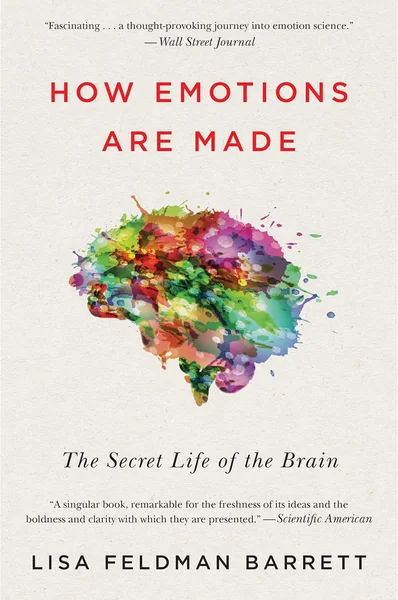
How Emotions Are Made: The Secret Life of the Brain―How We Create by Lisa Barrett
by Lisa Barrett
4.5
Other articles on this book
The Theory of Constructed Emotion: How Your Brain Builds Every Feeling You Have
Lisa Barrett's theory holds that emotions aren't hardwired reflexes but brain predictions built from body signals and memory.
6 min read
Most people assume that emotions happen to them — that fear, anger, or sadness are hardwired responses that flare up automatically, reading the world and reporting the truth. Neuroscientist Lisa Feldman Barrett disagrees, and she has the research to back it up. Her theory of constructed emotion holds that the brain doesn't detect feelings the way a smoke alarm detects fire. Instead, it actively manufactures every emotional experience, moment by moment, from raw sensory data, a library of past experiences, and the cultural concepts it has learned to apply. It is a sweeping reappraisal of what emotions actually are — and it has profound consequences for psychology, medicine, law, and everyday life.
The Classical View Barrett Is Arguing Against
For more than a century, the dominant framework in emotion science has been what Barrett calls the classical view — the idea that a small set of basic emotions (typically fear, anger, disgust, sadness, happiness, and surprise) are universal, biologically fixed, and readable in the face. This tradition runs from Charles Darwin's The Expression of the Emotions in Man and Animals (1872) through the influential work of psychologist Paul Ekman on facial action coding, whose atlas of facial expressions became the foundation for everything from lie-detection software to airport security protocols. The classical view assumes a dedicated neural circuit for each basic emotion — a kind of fingerprint in the brain that fires whenever a particular feeling arises.
Barrett's decades of neuroimaging research at Northeastern University and Massachusetts General Hospital eroded her confidence in that model. When her lab and others went looking for consistent, emotion-specific neural fingerprints, they largely failed to find them. The brain regions associated with fear, for instance, were also active during curiosity, excitement, and physical pain. No single circuit mapped cleanly onto a single feeling. The classical architecture, she concluded, was not a scientific finding but an assumption — one that had calcified into orthodoxy.
Construction: The Core Mechanism
If emotions aren't pre-loaded modules, what are they? Barrett's answer draws on a model of the brain as a prediction machine. Rather than passively receiving sensory input and then reacting, the brain is continuously generating predictions about what incoming signals mean — drawing on everything it has encountered before. This framework has deep roots in neuroscience and philosophy; predictive coding theory, associated with researchers like Karl Friston and Andy Clark, holds that perception itself is fundamentally a process of hypothesis-testing, with the brain updating its models only when predictions fail.
Barrett applies this logic specifically to the body's internal signals — a field called interoception. The brain is constantly monitoring the state of your heart, lungs, gut, muscles, and immune system, trying to predict what those signals mean and what the body needs next. That ongoing hum of bodily sensation is the raw material for emotion. But sensation alone is not yet feeling. To turn vague physical unease into a named emotion like 'dread' or 'excitement,' the brain needs concepts — categories learned through experience and culture that allow it to make sense of the body's state in light of the current situation.
The process runs roughly like this: you're about to give a public speech and your heart accelerates, your palms sweat, your stomach tightens. Your brain searches its predictive models and, drawing on past experiences of public speaking and the cultural concept 'stage fright,' categorizes those sensations as anxiety. But the same bodily state, recategorized through the concept 'excitement,' would feel different — and mounting evidence suggests it would perform differently too. The construction is not arbitrary; it is constrained by context and experience. But it is still construction.
The Role of Culture and Concepts
One of the most striking implications of constructed emotion theory is that emotional granularity varies across cultures — and that variation is not merely linguistic but experiential. Languages carve up emotional space differently. German has Schadenfreude (pleasure at another's misfortune); Mandarin has yuèdú (a specific kind of melancholy at time's passage); the Utku Inuit famously lack a concept equivalent to 'anger' as English speakers use it. Barrett argues these are not just translation gaps but genuine differences in what people feel, because the concepts available to a brain shape the predictions it can make.
This is why emotional vocabulary — what researchers call emotional granularity — matters practically. People with richer, more differentiated emotional lexicons tend to regulate their emotions more effectively, seek help more precisely, and show better mental health outcomes. Teaching children (or adults) more nuanced emotion concepts doesn't just give them better words; it literally expands the repertoire of experiences their brains can construct. Barrett calls this process emotional intelligence in its most literal sense: the brain becoming more skilled at categorizing internal states.
Why This Theory Changes So Much
The stakes here extend well beyond academic psychology. If emotions are constructed rather than detected, then facial expression analysis cannot reliably read inner states — a direct challenge to the multi-billion-dollar emotion AI industry and to courtroom practices that treat visible distress as proof of felt distress. The theory of constructed emotion has been cited in debates over the validity of airport screening tools, pain assessment in patients who cannot speak, and the admissibility of emotional evidence in criminal trials.
For individuals, the implications are less dramatic but more immediately useful. If your brain constructs emotions from predictions, those predictions can — with effort — be revised. Emotional reappraisal, long studied by psychologists as a cognitive regulation strategy, gains new mechanistic grounding in Barrett's model: you're not suppressing a pre-existing emotion, you're changing the predictive model before the emotion fully materializes. Similarly, practices like mindfulness that build interoceptive awareness are, in Barrett's framing, literally improving the quality of the data the brain has to work with.
Critics of the theory — and there are serious ones — argue that Barrett underweights evidence for cross-cultural consistency in emotional expression, and that the predictive-coding framework, while intellectually compelling, remains difficult to test with the precision needed to rule out competing accounts. The debate is active and productive. But even skeptics tend to agree that the classical view was never as well-supported as its prominence suggested, and that Barrett has permanently raised the evidentiary bar for any theory of emotion.
Where to Read More
Barrett lays out the full evidence for constructed emotion — from neuroimaging studies to cross-cultural linguistics to clinical applications — in How Emotions Are Made, which pairs rigorous science with prose accessible to any curious reader. For a focused assessment of how successfully she makes that case, the LuvemBooks review of How Emotions Are Made weighs both the theory's strengths and the questions it leaves open.
Frequently asked questions
What is the theory of constructed emotion in simple terms?
The theory of constructed emotion, developed by neuroscientist Lisa Feldman Barrett, holds that emotions aren't pre-programmed biological reflexes. Instead, the brain actively builds each emotional experience by combining bodily sensations, past memories, and learned cultural concepts — making feelings a kind of ongoing prediction rather than a fixed response.
How does constructed emotion theory differ from basic emotion theory?
Basic emotion theory (associated with Paul Ekman) claims a small set of universal emotions — fear, anger, happiness, etc. — are hardwired and recognizable across cultures in facial expressions. Constructed emotion theory argues no such fixed neural circuits exist; instead, the brain assembles feelings contextually, meaning the same bodily state can produce different emotions depending on the situation.
What role does culture play in the theory of constructed emotion?
Culture supplies the emotional concepts a brain uses to categorize bodily sensations. Because languages and cultures carve up emotional space differently — some having words for states English lacks entirely — people across cultures may genuinely experience different emotions from similar physiological states, not just describe the same feelings with different words.
What is interoception and why does it matter for emotions?
Interoception is the brain's monitoring of the body's internal signals — heartbeat, breathing, gut sensations, muscle tension. Barrett argues this stream of bodily data is the raw material from which emotions are constructed. Greater interoceptive awareness gives the brain better data, which is why mindfulness and body-awareness practices can improve emotional regulation.
Does constructed emotion theory have practical applications?
Yes. The theory supports emotional reappraisal as a regulation strategy, encourages building richer emotional vocabulary to improve mental health, and challenges technologies that claim to read emotions from faces. It also has implications for law, medicine, and education — anywhere professionals make decisions based on visible emotional expression.
Continue exploring